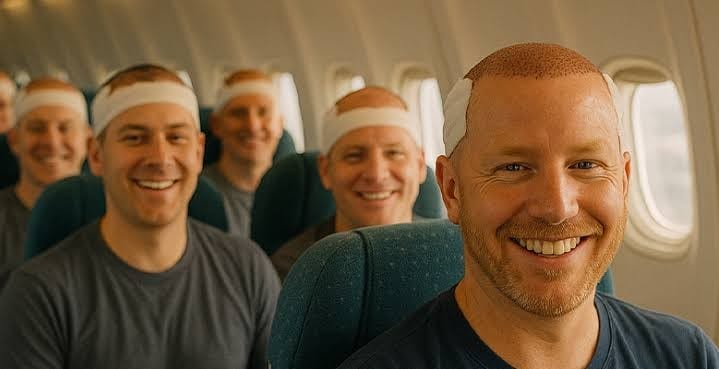
Flying after a hair transplant
Flying home is safe for the grafts themselves, and most clinics ask patients to stay for the first check and wash before travelling.
Flying home is safe for the grafts themselves, and most clinics ask patients to stay for the first check and wash before travelling. The real hazards are the airport and cabin: crowds, luggage, overhead lockers, dry air and sleeping against a headrest.
Does cabin pressure on a flight put grafts at risk?
No. Commercial cabins are pressurised, and the modest pressure change does not affect implanted grafts, even though patients often worry about this specifically. What actually matters for a healing scalp is everything else around the flight, not the cabin pressure itself.
What are the actual hazards of flying after a hair transplant?
The actual hazards are overhead lockers, the classic way to knock a freshly grafted scalp; crowds at security and boarding; luggage straps and lifting cases; headrests pressing the back of the head if you fall asleep; dry cabin air that dries crusts you are keeping soft; and tight caps or hoods pulled on and off.
- Overhead lockers, the classic way to knock a freshly grafted scalp
- Crowds at security and boarding
- Luggage, including straps over the shoulder and lifting cases
- Headrests, where falling asleep presses the back of the head
- Very dry cabin air, which dries crusts you are trying to keep soft
- Tight caps and hoods pulled on and off
How soon after surgery can you fly home?
Most clinics ask patients to remain locally for the first post-operative check and wash, commonly a couple of days after surgery, before flying, because that supervision matters more than the flight itself. Very short trips that put you on a plane just hours after surgery are worth avoiding for that reason.
Our guide to travelling for a hair transplant covers the wider planning.
How can you make the flight home easier on a healing scalp?
Make the flight easier with a travel pillow so the back of the head does not rest on the seat, saline spray used through the flight, an aisle seat to avoid climbing past people, checked luggage instead of wrestling a case overhead, a loose hood rather than a pull-on cap, and water instead of alcohol.
- A travel pillow so the back of the head does not rest on the seat
- Saline spray in a permitted container, used through the flight
- An aisle seat to avoid climbing past people
- Checked luggage rather than wrestling a case overhead
- A loose hood rather than a cap that must be pulled on
- Water rather than alcohol, which worsens swelling
Sources
- Bernstein RM, Rassman WR. Graft Anchoring in Hair Transplantation. Dermatologic Surgery, 2006;32(2):198-204. pubmed.ncbi.nlm.nih.gov/16442039
This article summarises published research and standard clinical practice. It is general educational information, not medical advice, and it does not replace the instructions your own surgical team gives you. Where their guidance differs from anything here, follow theirs.
Get a no-obligation assessment against fixed criteria, directly on WhatsApp.