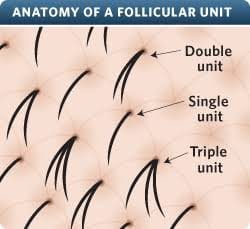
Follicular unit composition: singles, doubles and triples
Hair grows in natural groupings of one to four hairs.
Hair grows in natural groupings of one to four hairs. The mix in your donor area determines how many hairs a given graft count actually delivers, and it is the reason 'grafts' and 'hairs' are not interchangeable terms.
What is a follicular unit, and why does composition matter?
Human scalp hair grows in follicular units — natural clusters of one to four terminal hairs sharing sebaceous glands, an arrector pili muscle and a perifollicular structure. Modern surgery moves these units intact rather than individual hairs or plugs, producing natural-looking results. Jimenez and Ruifernández modelled this distribution in 1999 to estimate donor size requirements.
Human scalp hair does not grow as evenly distributed single strands. It emerges in follicular units: clusters of one to four terminal hairs sharing sebaceous glands, an arrector pili muscle and a common perifollicular structure.
This is the anatomical basis of modern transplantation. Rather than moving individual hairs or larger plugs, surgery moves these natural units intact, which is what produces a result that looks like normally growing hair rather than the tufted appearance of older techniques.
Jimenez and Ruifernández set out the distribution of human hair in follicular units in Dermatologic Surgery in 1999, building a mathematical model specifically for estimating the donor size required in follicular unit transplantation. The model exists because the composition of the donor area changes the arithmetic of any plan.
How much does follicular unit composition change the hair count from an identical graft number?
Two patients quoted the same 2 000 grafts can receive very different hair counts: a donor area averaging 2.4 hairs per unit yields roughly 4 800 hairs, while one averaging 1.7 yields roughly 3 400 — a gap of about 1 400 hairs from an identical graft number, caused entirely by donor composition rather than any misleading quote.
Suppose two patients are each quoted 2 000 grafts.
The first has a donor area dominated by two- and three-hair units, averaging perhaps 2.4 hairs per graft. Those 2 000 grafts carry roughly 4 800 hairs.
The second has a donor area dominated by singles and doubles, averaging perhaps 1.7. The same 2 000 grafts carry roughly 3 400 hairs.
That is a difference of about 1 400 hairs from an identical graft count — a substantial gap in coverage, arising entirely from donor composition. Neither patient was misled about the number of grafts; the number simply does not mean the same thing for both.
Where are single-, double- and multi-hair follicular units placed in a transplant?
Composition is a design resource: single-hair units go at the hairline's leading edge, where a natural line is irregular and soft; two-hair units sit just behind, building density; and three- and four-hair units go in the mid-scalp and crown, where density matters more than close-range detail. Grafts should be sorted and placed by size deliberately.
Composition is not just an accounting matter. It is a design resource, because different unit sizes belong in different places.
- Single-hair units go at the very front edge of the hairline. A natural hairline is irregular and soft, made of single hairs in an uneven line. Placing multi-hair grafts at the front edge is one of the classic causes of a result that reads as surgical.
- Two-hair units sit immediately behind the leading edge, building density as the hairline transitions inward.
- Three- and four-hair units go in the mid-scalp and crown, where density matters and nothing is examined at close range.
A surgeon planning properly sorts grafts by size during dissection and distributes them deliberately. A clinic that does not sort is placing whatever comes next, which shows at the hairline.
Why do 'graft count' and 'hair count' quotes from different clinics not compare directly?
Because grafts and hairs are different units, quotes can look larger or cheaper than they are: some clinics quote hair counts, roughly double the graft number, or bill per hair instead of per graft. Comparing a graft quote from one clinic to a hair quote from another is meaningless — ask which unit applies.
Because grafts and hairs are different units, quotes can be constructed to look larger than they are — or to appear cheaper per unit.
Some clinics quote hair counts rather than graft counts, which produces a number roughly twice as large for the same work. Others quote grafts but bill per hair. Neither is necessarily dishonest, but comparing a graft quote from one clinic against a hair quote from another is meaningless.
The questions that resolve it: is this figure grafts or hairs, what is my average hairs per follicular unit, and is the price per graft or per hair?
What should patients ask about their own follicular unit composition?
Patients should ask their average hairs per follicular unit, what proportion of donor units are singles, whether grafts will be sorted by size and by whom, and how many single-hair grafts are planned for the hairline — a specific number signals a real plan; a vague answer signals a hairline built from whatever arrives.
- What is my average number of hairs per follicular unit?
- What proportion of my donor units are singles?
- Will grafts be sorted by size, and who does the sorting?
- How many single-hair grafts are planned for the hairline?
The last question is a good test of how carefully a hairline has been designed. A specific number indicates a plan; a vague answer indicates that the hairline will be built from whatever arrives.
Sources
- Jimenez F, Ruifernández JM. Distribution of human hair in follicular units. A mathematical model for estimating the donor size in follicular unit transplantation. Dermatologic Surgery, 1999;25(4):294-298. pubmed.ncbi.nlm.nih.gov/10417585
- Rassman WR, Bernstein RM, McClellan R, Jones R, Worton E, Uyttendaele H. Follicular unit extraction: minimally invasive surgery for hair transplantation. Dermatologic Surgery, 2002;28(8):720-728. pubmed.ncbi.nlm.nih.gov/12174065
- Parsley WM, Perez-Meza D. Review of factors affecting the growth and survival of follicular grafts. Journal of Cutaneous and Aesthetic Surgery, 2010;3(2). jcasonline.com
- Zhao Y, Zhang J, Jiang B, Fan Z, Miao Y. Development of an Evaluation System to Classify Beard Donor Area for Hair Transplantation. Dermatologic Surgery, 2025;51(9):882-886. pubmed.ncbi.nlm.nih.gov/40323042
This article summarises published research and standard clinical practice. It is general educational information, not medical advice, and it does not replace the instructions your own surgical team gives you. Where their guidance differs from anything here, follow theirs.
Get a no-obligation assessment against fixed criteria, directly on WhatsApp.