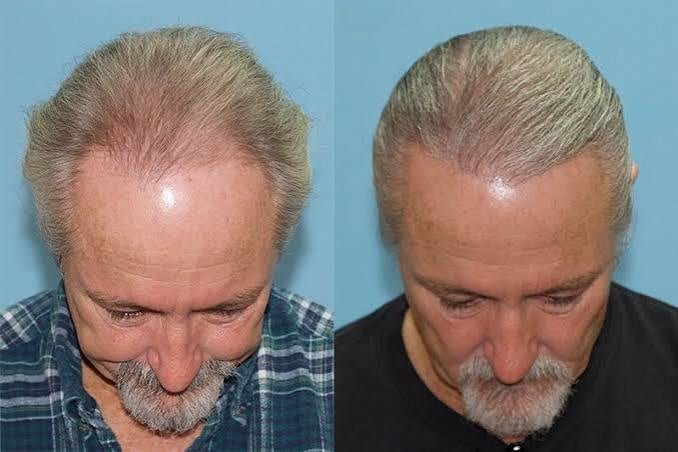
Gray hair transition in transplanted grafts
Transplanted follicles grey on the donor area's schedule because pigmentation is a property of the follicle.
Transplanted follicles grey on the donor area's schedule because pigmentation is a property of the follicle. In practice this usually means the transplanted zone greys roughly in step with the back and sides, which looks natural.
Why does transplanted hair grey on the donor area's schedule, not the recipient area's?
Because hair colour is a property of the follicle itself, not the skin around it. Melanocytes in the hair bulb produce pigment, and their decline drives greying. Since a transplant moves the follicle intact, that timetable moves with it — a follicle set to grey at fifty will grey at fifty wherever it is placed.
Hair colour is a property of the follicle, not of the skin it sits in. Melanocytes in the hair bulb produce pigment, and their decline over time is what produces grey and then white hair.
Because a transplant moves the follicle intact, it moves that timetable with it. A follicle taken from an occipital area that was going to grey at fifty will grey at fifty, wherever it has been placed.
This is the same principle as calibre, curl and growth-cycle length — the donor follicle's characteristics travel with it, which is the basis of the whole procedure.
Does transplanted hair grey at a different rate than your natural hair?
Usually not. The donor area and frontal scalp typically grey on similar schedules, so a scalp-to-scalp transplant greys in step and looks natural. Beard and body hair grafts are the exceptions, since beard and scalp hair often grey on different schedules in the same person — one reason beard hair belongs behind the visible frontal zone.
For most patients it looks entirely unremarkable, because the donor area and the frontal scalp usually grey on broadly similar schedules anyway.
The transplanted zone greys roughly in step with the back and sides. Since that is how hair greys naturally, the result continues to look like ordinary hair.
Two situations produce a visible mismatch:
- Beard hair grafts. Beard and scalp hair frequently grey on different schedules in the same person. A patient whose beard greyed early and whose scalp did not may find beard grafts in the crown greying ahead of the surrounding hair. This is one more reason beard hair belongs behind the visible frontal zone.
- Body hair grafts, for the same reason.
Does going grey affect how full a hair transplant looks?
Yes — greying often makes a thinning result look fuller. Baldness reads as contrast between dark hair and lighter skin, so as hair greys that contrast falls and the same density appears denser. The same effect reduces the visibility of donor-area scars, partly offsetting the native hair loss that continues over time.
Greying generally improves the appearance of a thinning or moderately dense result, and this is worth knowing.
What makes a scalp look bald is contrast between dark hair and lighter skin. As hair greys, that contrast falls, and the same actual density reads as fuller. A grey-haired man with moderate density often looks better covered than a dark-haired man with the same count.
The same effect applies in the donor area, where greying reduces the visibility of hypopigmented dot scars.
So for patients transplanted in their thirties and forties, the passage of time works against them through native hair loss and partly for them through reduced contrast.
What should you keep in mind about greying after a hair transplant?
Expect grafts to follow the donor area's greying schedule, not stay their current colour. Ask your clinic about timing before colouring transplanted hair, since it behaves like ordinary hair once healed. Scalp micropigmentation needs revisiting as you grey, since pigment matched to dark hair looks increasingly wrong against grey.
- Do not expect grafts to stay their current colour. They will follow the donor area's schedule.
- Colouring transplanted hair is a matter for your clinic's timing advice after surgery; once healed it behaves like ordinary hair.
- Scalp micropigmentation needs revisiting as you grey. Pigment matched to dark hair looks increasingly wrong against grey, and this is a maintenance cost worth knowing about before starting.
- If beard hair is proposed, ask whether your beard and scalp grey at different rates, and where those grafts are going.
Is there published long-term data on how transplanted hair grafts grey?
No. No published study has followed the pigmentation of transplanted grafts over decades, because this field lacks long-term follow-up generally. This account follows from donor dominance, a well-established principle, and consistent clinical experience — it is not a measured finding and should be treated as such.
Sources
- Jimenez F, Ruifernández JM. Distribution of human hair in follicular units. A mathematical model for estimating the donor size in follicular unit transplantation. Dermatologic Surgery, 1999;25(4):294-298. pubmed.ncbi.nlm.nih.gov/10417585
- Zhao Y, Zhang J, Jiang B, Fan Z, Miao Y. Development of an Evaluation System to Classify Beard Donor Area for Hair Transplantation. Dermatologic Surgery, 2025;51(9):882-886. pubmed.ncbi.nlm.nih.gov/40323042
- Umar S, Khanna R, Maldonado JC, Chouhan K, Gonzales A. Beard and Body Hair Transplantation by Follicular Unit Excision Using a Skin-Responsive Device: A Multicenter Study. Dermatologic Surgery, 2024;50(3):306-308. pubmed.ncbi.nlm.nih.gov/38127669
- Maas D, et al. Rethinking the occipital scalp as a control in advanced androgenetic alopecia. Journal of the American Academy of Dermatology, 2026 (ahead of print). pubmed.ncbi.nlm.nih.gov/42398778
- Rassman WR, Bernstein RM, McClellan R, Jones R, Worton E, Uyttendaele H. Follicular unit extraction: minimally invasive surgery for hair transplantation. Dermatologic Surgery, 2002;28(8):720-728. pubmed.ncbi.nlm.nih.gov/12174065
This article summarises published research and standard clinical practice. It is general educational information, not medical advice, and it does not replace the instructions your own surgical team gives you. Where their guidance differs from anything here, follow theirs.
Get a no-obligation assessment against fixed criteria, directly on WhatsApp.