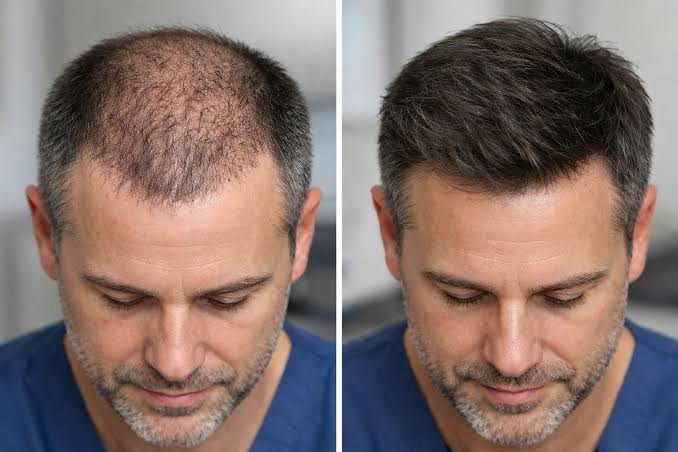
Does transplanted hair change texture over time
Transplanted hair keeps the characteristics of its donor follicle, so it ages the way the donor area ages — greying, some loss of calibre.
Transplanted hair keeps the characteristics of its donor follicle, so it ages the way the donor area ages — greying, some loss of calibre. Early texture differences usually reflect the recovery cycle rather than a permanent change.
Why does transplanted hair feel different in the first year?
Transplanted hair commonly feels coarser, wirier, kinked, or a different colour in the first year because the follicle has just been through extraction, a period without blood supply, implantation, and a resting phase — this is a feature of early regrowth, not a permanent change, and it usually normalises by two years.
A common report in the first year is that transplanted hair feels different from the surrounding hair — coarser, wirier, sometimes kinked or growing at an odd angle, sometimes a slightly different colour.
This is usually a feature of early regrowth rather than a permanent property. The follicle has been through extraction, a period without blood supply, implantation and a full resting phase before restarting. The first hair it produces frequently differs from what it produced before.
Over subsequent growth cycles the hair generally normalises. Most patients who noticed a texture difference at six or nine months do not notice it at two years.
Which hair characteristics stay the same after a transplant?
Calibre, curl, colour, greying pattern, and growth cycle length all persist after a transplant because they belong to the donor follicle, not the surgery: a coarse donor follicle stays coarse (why beard hair at a hairline remains conspicuous), and transplanted hair greys on the donor area's schedule, not the recipient area's.
The characteristics that do persist are the ones that belong to the donor follicle rather than to the surgery.
- Calibre. A coarse donor follicle produces coarse hair. This is why beard hair remains conspicuous at a hairline permanently, and why donor calibre is assessed before surgery.
- Curl. Follicle shape determines it, and it travels with the graft.
- Colour and greying pattern. Determined by the follicle, so transplanted hair greys on the donor area's schedule, not the recipient area's.
- Growth cycle length. This is why body hair grafts reach a shorter maximum length than scalp hair regardless of where they are placed.
How does transplanted hair age over the long term?
Transplanted hair ages the way donor hair ages, since it carries donor characteristics: it greys roughly in step with the back and sides, its calibre reduces with age independently of androgenetic alopecia, and it loses density as the donor zone does — none of which is a transplant failure, just ordinary ageing.
Because transplanted hair carries donor characteristics, it ages the way donor hair ages.
- Greying follows the donor area's timing. In practice this usually means the transplanted zone greys roughly in step with the back and sides — which generally looks natural, since that is how hair greys anyway.
- Age-related calibre reduction. Hair thins with age independently of androgenetic alopecia, and transplanted hair is not exempt.
- Age-related density loss affects the donor zone too, and grafts from it behave accordingly.
None of these is a failure of the transplant. They are the ordinary ageing of hair, occurring in hair that happens to have been moved.
When is a hair texture mismatch a permanent design problem?
A texture mismatch is permanent, not a healing issue, when it comes from placement decisions: beard hair used at the hairline, body hair placed in a visible zone, multi-hair grafts at the leading edge, or coarse occipital hair used for temple points or eyebrows where fine hair is needed — none of these resolve with time.
There are cases where a texture mismatch is permanent and was created at surgery rather than by biology.
- Beard hair at the hairline. Beard hair is markedly coarser than scalp hair, and placed at the front edge it is conspicuous permanently. It belongs in the mid-scalp and crown.
- Body hair in a visible zone. Different texture, different curl and shorter achievable length.
- Multi-hair grafts at the leading edge. Not a texture problem strictly, but it produces the tufted appearance often described as one.
- Coarse occipital hair used for temple points or eyebrows, where fine hair is required.
These are placement decisions, and unlike the recovery-related differences they do not resolve with time.
What texture changes should you expect month by month after a transplant?
Expect fine, sometimes wiry or kinked hair at months three to six (not representative), thickening and normalising texture at months six to twelve, and hair generally indistinguishable from surrounding donor-derived hair from year two onward; if a texture mismatch persists past two years, it's usually a placement issue worth raising with your surgeon.
- Months 3-6. First growth. Often fine, sometimes wiry or kinked. Not representative.
- Months 6-12. Thickening and normalising. Texture differences reducing.
- Year 2 onward. Transplanted hair generally indistinguishable in texture from surrounding donor-derived hair.
- Beyond. Ages with the donor area — greying, gradual calibre reduction.
If a genuine texture mismatch persists past two years, it is usually a placement issue rather than a maturation issue, and worth raising with the surgeon.
Sources
- Parsley WM, Perez-Meza D. Review of factors affecting the growth and survival of follicular grafts. Journal of Cutaneous and Aesthetic Surgery, 2010;3(2). jcasonline.com
- Umar S, Khanna R, Maldonado JC, Chouhan K, Gonzales A. Beard and Body Hair Transplantation by Follicular Unit Excision Using a Skin-Responsive Device: A Multicenter Study. Dermatologic Surgery, 2024;50(3):306-308. pubmed.ncbi.nlm.nih.gov/38127669
- Zhao Y, Zhang J, Jiang B, Fan Z, Miao Y. Development of an Evaluation System to Classify Beard Donor Area for Hair Transplantation. Dermatologic Surgery, 2025;51(9):882-886. pubmed.ncbi.nlm.nih.gov/40323042
- Jimenez F, Ruifernández JM. Distribution of human hair in follicular units. A mathematical model for estimating the donor size in follicular unit transplantation. Dermatologic Surgery, 1999;25(4):294-298. pubmed.ncbi.nlm.nih.gov/10417585
- Bernstein RM, Rassman WR. Graft Anchoring in Hair Transplantation. Dermatologic Surgery, 2006;32(2):198-204. pubmed.ncbi.nlm.nih.gov/16442039
This article summarises published research and standard clinical practice. It is general educational information, not medical advice, and it does not replace the instructions your own surgical team gives you. Where their guidance differs from anything here, follow theirs.
Get a no-obligation assessment against fixed criteria, directly on WhatsApp.