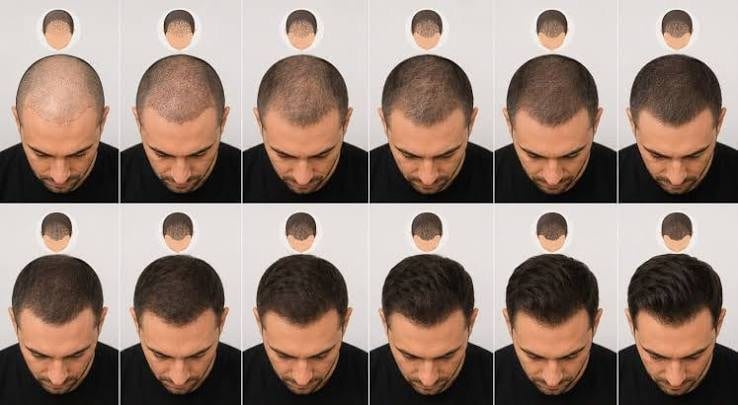
Growth timeline after FUE, month by month
Transplanted hair sheds within the first weeks, spends a dormant period, then begins growing from around months three to four, with the result settling at about twelve months.
Transplanted hair sheds within the first weeks, spends a dormant period, then begins growing from around months three to four, with the result settling at about twelve months. The middle of that curve looks worse than the starting point, which is normal.
Why doesn't transplanted hair grow for months?
Transplanted hair doesn't grow for months because transplantation stresses the follicle, which sheds its existing shaft and enters a resting phase; the follicle survives even though the visible hair does not. It must complete rest and re-enter growth before a new shaft appears and grows long enough to see, a sequence that cannot be accelerated.
What is the month-by-month FUE growth timeline?
The FUE timeline runs from crusting and shedding in weeks one to two, transplanted shafts shedding at weeks two to three, a dormant phase at months one to three, new colourless growth from months three to four, steady thickening through months four to eight, and a settled result by month twelve, the crown often lagging.
- Weeks 1 to 2: crusting, then shedding begins
- Weeks 2 to 3: transplanted shafts shed
- Months 1 to 3: dormant phase; the area can look worse than before surgery
- Months 3 to 4: new growth begins, fine and often colourless at first
- Months 4 to 8: steady thickening and lengthening
- Months 8 to 12: texture and calibre mature
- Month 12: the settled result, with the crown often lagging
Why does month three look like the transplant failed?
Around month three is when people most often conclude the procedure failed, because transplanted hair has gone and not yet returned, and any native hair lost to shock loss has also gone: two sheds coincide and neither has recovered. This is the normal shape of the growth curve, not a sign of failure.
How should you judge whether your FUE result is on track?
Judge your result by photographing in consistent lighting monthly rather than checking the mirror daily, and assess at twelve months, allowing longer for the crown, which characteristically grows more slowly. If there is genuinely no growth anywhere by around eight to ten months, that's a conversation with your surgeon, not something to keep waiting out.
How the result holds once growth is complete is a separate question, covered under longevity.
Sources
- Parsley WM, Perez-Meza D. Review of factors affecting the growth and survival of follicular grafts. Journal of Cutaneous and Aesthetic Surgery, 2010;3(2). jcasonline.com
This article summarises published research and standard clinical practice. It is general educational information, not medical advice, and it does not replace the instructions your own surgical team gives you. Where their guidance differs from anything here, follow theirs.
Get a no-obligation assessment against fixed criteria, directly on WhatsApp.