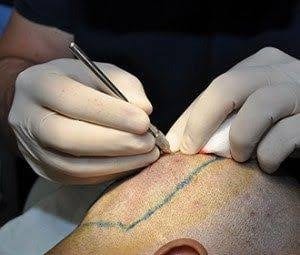
Manual vs motorized punch extraction
Manual punches are turned by hand; motorised punches rotate or oscillate under power.
Manual punches are turned by hand; motorised punches rotate or oscillate under power. Motorised extraction is faster and less tiring, manual gives more tactile feedback, and skilled surgeons produce good results with either.
What is the difference between manual and motorised FUE punches?
A manual punch is turned around the follicular unit by hand, letting the surgeon feel resistance as it passes through tissue, while a motorised punch spins or oscillates, cutting faster with less physical effort. Both aim to produce the same result: a clean cylinder of tissue with the follicle intact inside it.
What are the trade-offs between manual and motorised FUE punches?
Motorised punches cut faster, shortening the session and the out-of-body time for early grafts, while manual punches give more feedback on depth and resistance, which some surgeons prefer in difficult donor areas. Manual extraction causes more fatigue over thousands of grafts, and motorised punches can generate friction heat if used carelessly.
- Speed. Motorised is faster, which shortens the session and therefore the out-of-body time for the first grafts.
- Feedback. Manual gives more sensation of depth and resistance, which some surgeons prefer in difficult donor areas.
- Fatigue. Manual extraction across thousands of grafts is physically demanding, and fatigue affects accuracy.
- Heat. Motorised punches can generate friction heat if used carelessly.
- Curly and afro-textured hair, where the follicle curves under the skin, is where technique choice matters most.
What actually predicts a high transection rate in FUE?
Not the instrument itself, but punch sharpness, correct diameter for the hair, correct depth, matching the punch angle to the follicle's own angle, and the operator's experience. Review literature shows damage to the bulge region is more harmful than damage to the bulb, which is why clean extraction matters more than fast extraction.
What should you ask a clinic about their FUE punch technique?
Useful questions include what punch type and diameter the clinic will use for your hair, who actually performs the extraction, what their typical transection rate is and how it is measured, and how punch sharpness is maintained and managed throughout a long extraction session.
- What punch type and diameter will be used for my hair?
- Who performs the extraction?
- What is your typical transection rate and how is it measured?
- How is punch sharpness managed across a long session?
Sources
- Parsley WM, Perez-Meza D. Review of factors affecting the growth and survival of follicular grafts. Journal of Cutaneous and Aesthetic Surgery, 2010;3(2). jcasonline.com
This article summarises published research and standard clinical practice. It is general educational information, not medical advice, and it does not replace the instructions your own surgical team gives you. Where their guidance differs from anything here, follow theirs.
Get a no-obligation assessment against fixed criteria, directly on WhatsApp.