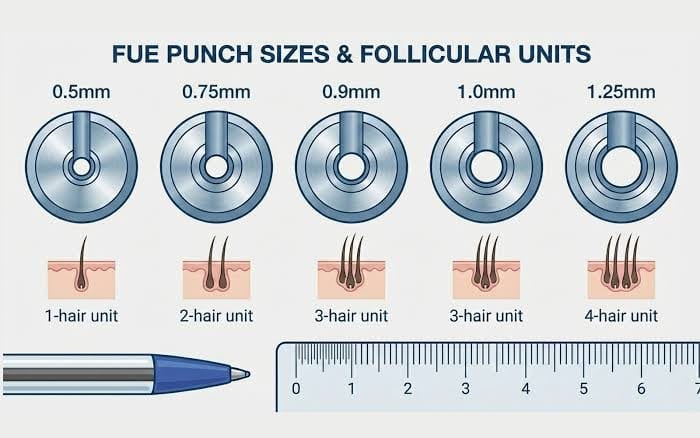
Punch sizes and why they matter for scarring
Punch diameter sets a direct trade-off: smaller punches leave smaller donor scars but raise the risk of cutting through follicles, while larger punches protect the graft and leave more visible dots.
Punch diameter sets a direct trade-off: smaller punches leave smaller donor scars but raise the risk of cutting through follicles, while larger punches protect the graft and leave more visible dots. The right size depends on your hair, not on a marketing number.
Why does FUE punch size matter for scarring and transection risk?
The punch must encircle the follicular unit without touching it. Too small and it transects the follicle's edge; too large and it removes more tissue, leaving a bigger hole and a visible dot. FUE punches typically run under a millimetre, and clinics competing to quote the smallest number is not always in the patient's interest.
Why isn't the smallest FUE punch always the best choice?
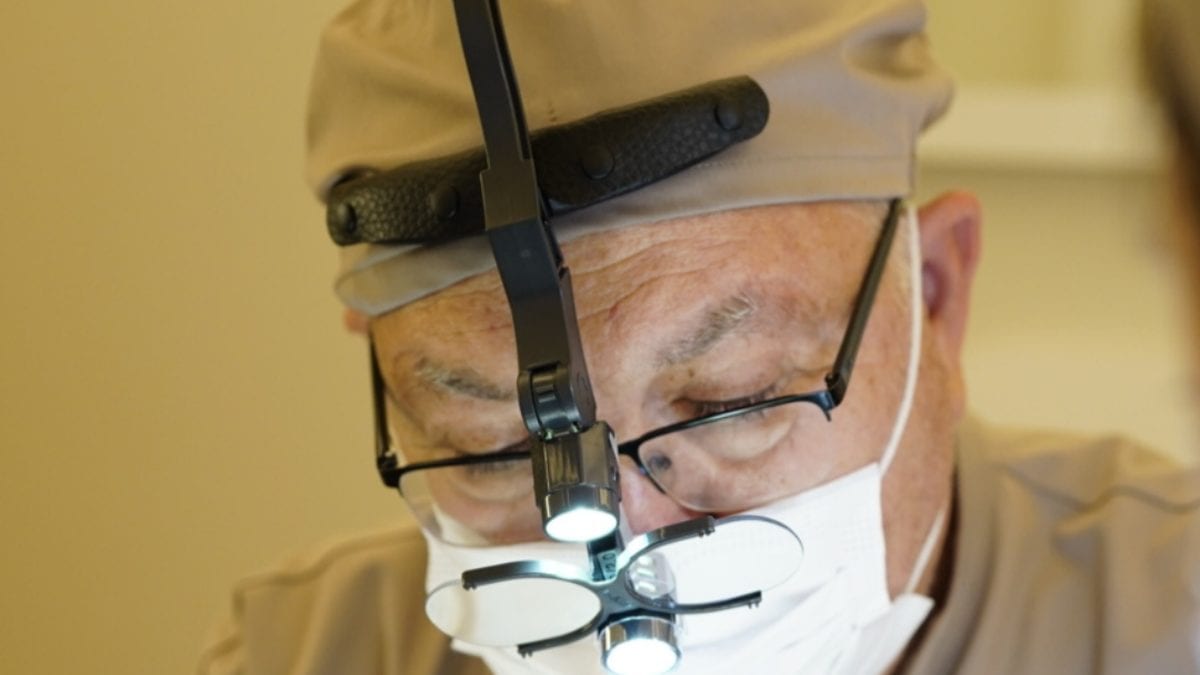
Coarse hair needs a larger punch than fine hair, follicular units of three or four hairs are wider than single-hair units, and afro-textured hair curves beneath the skin and needs more clearance. A punch too small for the hair raises transection, and a transected follicle does not grow.
- Coarse hair needs a larger punch than fine hair
- Follicular units of three or four hairs are wider than single-hair units
- Afro-textured hair curves beneath the skin and needs more clearance
- A punch too small for the hair raises transection, and a transected follicle does not grow
A clinic advertising an unusually small punch for every patient is advertising a fixed answer to a variable question.
How does FUE punch size affect the appearance of the donor area?
Each extraction leaves a small round scar; individually these are hard to see, but collectively, across thousands of extractions, they thin the donor area's appearance, and larger punches make that more apparent at short hair lengths. Over-harvesting is therefore a lasting problem: the dots do not fade, and the donor area does not regenerate.
What should you ask a clinic about punch size before FUE?
Ask what punch diameter the clinic will use for your hair and why, whether they vary punch size across the donor area, how they handle multi-hair follicular units, and whether you can see donor areas of previous patients with their hair cut short to judge visible scarring.
- What punch diameter will you use for my hair, and why that size?
- Do you vary punch size across the donor area?
- How do you handle multi-hair units?
- May I see donor areas of previous patients with hair cut short?
Sources
- Parsley WM, Perez-Meza D. Review of factors affecting the growth and survival of follicular grafts. Journal of Cutaneous and Aesthetic Surgery, 2010;3(2). jcasonline.com
This article summarises published research and standard clinical practice. It is general educational information, not medical advice, and it does not replace the instructions your own surgical team gives you. Where their guidance differs from anything here, follow theirs.
Get a no-obligation assessment against fixed criteria, directly on WhatsApp.