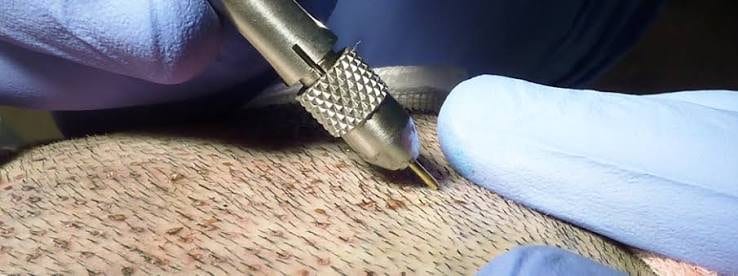
Punch technology comparisons across clinics
Clinics market punch technology heavily, with proprietary names for what are largely variations on sharp, dull, serrated and trumpet-shaped tips.
Clinics market punch technology heavily, with proprietary names for what are largely variations on sharp, dull, serrated and trumpet-shaped tips. The differences are real but modest, and none of them substitutes for the operator's skill.
What are the actual variables in FUE punch technology?
The real variables are diameter, a trade-off between scar size and transection risk; tip geometry, since sharp tips cut cleanly but can transect while dull tips separate tissue more gently but need more force; serrated edges for grip with less rotation; flared interiors to reduce graft compression; and a physical depth-control stop.
- Diameter, the trade-off between scar size and transection risk
- Tip geometry: sharp cuts cleanly but can transect; dull or blunt tips separate tissue and are gentler on the follicle but need more force
- Serrated edges, intended to grip and cut with less rotation
- Trumpet or flared interiors, intended to reduce compression of the graft as it enters the punch
- Depth control, often a physical stop to prevent going too deep
What does clinics' punch-technology marketing actually add?
Many clinics brand their punch, or their punch-and-motor combination, with a proprietary name and present it as a distinct procedure, when in most cases it is simply a variation on standard punch geometries. That does not make it worthless, but it makes it a detail rather than a differentiator, worth weighing as such.
Why does punch sharpness matter more than punch branding?
Punch sharpness degrades across thousands of extractions: a punch that was ideal at graft 200 may be blunt by graft 2 500, and blunt punches raise the transection rate. How often punches are changed during a session is therefore a more useful question than what the punch is called, yet it is almost never volunteered.
What questions should patients ask about punch technology?
Useful questions include what diameter and tip type will be used for your hair and why, how often punches are replaced during the session, what the typical transection rate is and how it is measured, and whether the clinic performs a test extraction first.
- What diameter and tip type will you use for my hair, and why?
- How often are punches replaced during a session?
- What is your typical transection rate and how is it measured?
- Do you do a test extraction first?
Instrument choice is one difference between techniques; the rest are compared in our guide to transplant methods.
Sources
- Parsley WM, Perez-Meza D. Review of factors affecting the growth and survival of follicular grafts. Journal of Cutaneous and Aesthetic Surgery, 2010;3(2). jcasonline.com
This article summarises published research and standard clinical practice. It is general educational information, not medical advice, and it does not replace the instructions your own surgical team gives you. Where their guidance differs from anything here, follow theirs.
Get a no-obligation assessment against fixed criteria, directly on WhatsApp.