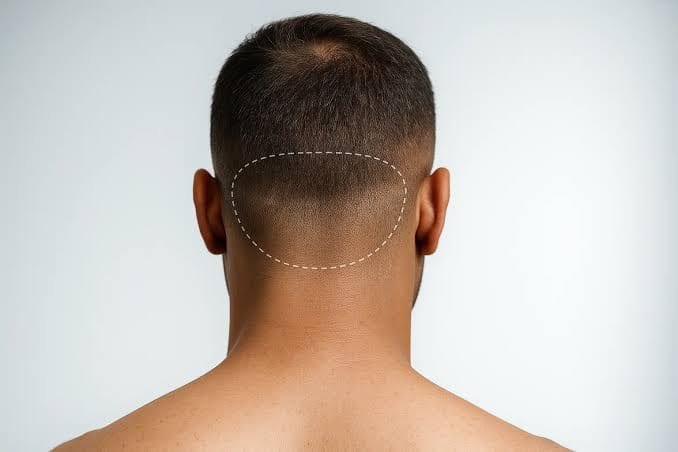
Numbness in the donor area: how long it lasts
A numb patch at the back of the head is normal after surgery. Feeling usually returns, slowly.
Reduced sensation in the donor area is common after both FUE and strip surgery, caused by disruption of small sensory nerve branches in the scalp. It typically improves over weeks to months, and in a minority of cases small patches remain permanently altered.
Why does numbness happen in the donor area?
The scalp is supplied by a network of fine sensory nerves. Any procedure that cuts or punches through that layer interrupts some branches, leaving a patch of skin whose nerve supply is temporarily disconnected. This is an expected consequence of surgery, which is why sensation is usually described as numb or tingly rather than painful.
What does donor-area numbness feel like?
Donor-area numbness can feel like reduced or absent light touch across part of the area, a tight or heavy sensation, or tingling and pins and needles as nerves recover. Some people notice a mismatch, where pressure is felt normally but light touch is not.
- Reduced or absent light touch across part of the donor area
- A tight or heavy feeling
- Tingling, pins and needles, or occasional brief odd sensations as nerves recover
- Sometimes a mismatch, where pressure is felt but light touch is not
How long does donor-area numbness last?
Recovery follows nerve regeneration, which is slow. Most people see steady improvement over the first few months, with most sensation back within roughly three to six months, though slower resolution is possible beyond that. Strip surgery, a full-thickness linear incision, more commonly leaves a band of lasting altered sensation above the scar than FUE does.
Our guide to FUT (strip surgery) covers the wider trade-offs.
When should you raise donor-area numbness with your clinic?
Raise donor-area numbness with your clinic if it comes with significant pain rather than simple absence of feeling, if it spreads beyond the surgical area, if sensation that was returning then worsens again, or if there is no improvement at all after six months.
- Numbness accompanied by significant pain rather than absence of feeling
- Numbness spreading beyond the surgical area
- Sensation that was returning and then worsens
- No improvement at all after six months
Sources
- Bernstein RM, Rassman WR. Graft Anchoring in Hair Transplantation. Dermatologic Surgery, 2006;32(2):198-204. pubmed.ncbi.nlm.nih.gov/16442039
This article summarises published research and standard clinical practice. It is general educational information, not medical advice, and it does not replace the instructions your own surgical team gives you. Where their guidance differs from anything here, follow theirs.
Get a no-obligation assessment against fixed criteria, directly on WhatsApp.