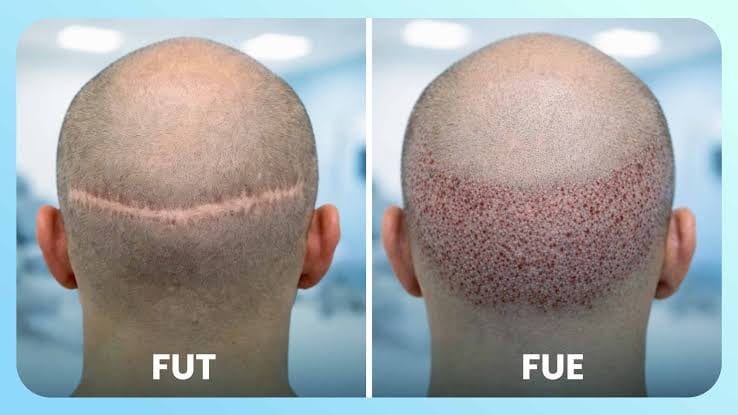
Scalp tightness after FUT vs FUE
After strip surgery the scalp has been stitched under tension; after FUE it has not, and you can feel the difference for weeks.
Tightness after surgery is markedly different between the two techniques. Strip surgery removes a section of scalp and closes the gap, producing real, sustained tension; FUE removes follicles individually and produces mild, short-lived tightness from swelling rather than from closure.
Why does tightness after FUT differ from tightness after FUE?
In strip surgery, a band of scalp is excised and the edges pulled together under sutures; scalp is not very elastic, so closing that gap creates genuine, weeks-long tension. In FUE, follicular units are punched out with no tissue closed under tension; tightness instead comes from swelling and small healing wounds, resolving as swelling does.
In strip surgery a band of scalp is excised and the edges are pulled together and sutured. The scalp is not elastic in the way skin elsewhere is, so closing that gap places the tissue under genuine tension. That tension is felt for weeks and is the reason strip patients are told to avoid stretching the area.
In FUE, individual follicular units are punched out. No tissue is closed under tension. What tightness there is comes from swelling and from thousands of small healing wounds, and it resolves as the swelling does.
What tightness should you expect after FUT surgery?
After FUT, expect noticeable tightness for the first one to three weeks, including a pulling sensation when looking down or turning your head, easing gradually as tissue relaxes and remodels. Occasionally tightness lasts longer where the strip was wide relative to scalp laxity, the same tension that can make a strip scar stretch and widen.
- Noticeable tightness for the first one to three weeks
- A pulling sensation when looking down or turning the head
- Gradual easing as the tissue relaxes and remodels
- Occasional lasting tightness where the strip was wide relative to scalp laxity
Excessive closure tension is also the main reason a strip scar stretches and widens, which is why surgeons assess scalp laxity before deciding strip width.
What tightness should you expect after FUE surgery?
After FUE, expect only mild tightness in the first few days, largely tracking the swelling that follows surgery rather than any tissue closure. It has usually resolved within about a week, and there is no sustained pulling sensation.
- Mild tightness in the first few days, largely tracking the swelling
- Usually resolved within about a week
- No sustained pulling sensation
When is post-transplant tightness a warning sign?
Tightness is a warning sign if it increases rather than eases after the first days, if it comes with severe pain, marked swelling or a firm bulge, which can indicate bleeding under the skin, or if skin over the closure looks pale, dusky or shiny. Fever alongside any of these should be reported.
- Tightness that increases rather than eases after the first days
- Tightness with severe pain, marked swelling or a firm bulge, which can indicate bleeding under the skin
- Skin over the closure that looks pale, dusky or shiny
- Fever alongside any of the above
Sources
- Bernstein RM, Rassman WR. Graft Anchoring in Hair Transplantation. Dermatologic Surgery, 2006;32(2):198-204. pubmed.ncbi.nlm.nih.gov/16442039
This article summarises published research and standard clinical practice. It is general educational information, not medical advice, and it does not replace the instructions your own surgical team gives you. Where their guidance differs from anything here, follow theirs.
Get a no-obligation assessment against fixed criteria, directly on WhatsApp.