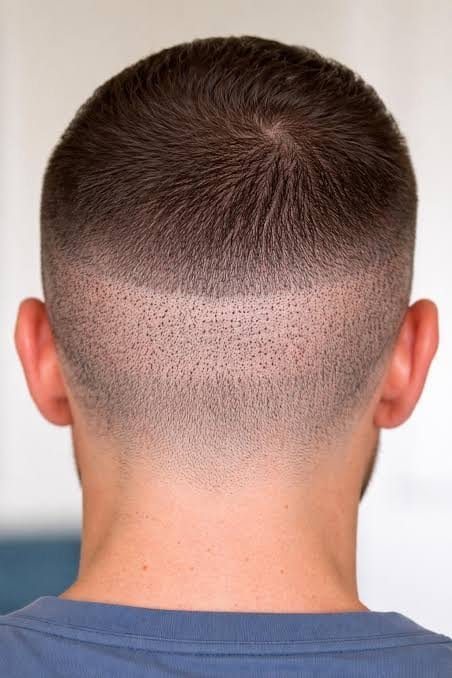
Donor area scarring: what to expect
FUE leaves hundreds or thousands of small round scars rather than one line.
FUE leaves hundreds or thousands of small round scars rather than one line. Individually they are difficult to see; the risk is cumulative, because heavy or repeated harvesting produces a generally thinner, stippled donor area that cannot be reversed.
What do FUE donor scars look like?
Each FUE extraction leaves a round white dot about the width of the punch, invisible at normal hair lengths. Shaved very short under strong light, the dots appear as a fine stipple, with visibility depending on punch size, graft numbers, how evenly extraction was spread, skin-tone contrast, and hairstyle.
What's the real risk with FUE donor scarring?
The real risk isn't one visible scar; it's a donor area that looks thinner overall because too much was taken, or taken from too small a patch. That's permanent, since extracted follicles never regrow. It's the single most common irreversible mistake in this field, usually made chasing a high graft count in one session.
What makes FUE donor scarring worse?
FUE donor scarring gets worse with excessive graft numbers relative to donor capacity, extraction concentrated in one area instead of spread evenly, oversized punches, harvesting outside the safe donor zone, repeated sessions without reassessing remaining density, and a personal tendency to scar prominently.
- Excessive graft numbers relative to the donor's actual capacity
- Harvesting concentrated in one area rather than spread evenly
- Punches larger than necessary for the hair
- Extraction outside the safe donor zone, where hair will thin later anyway
- Multiple sessions without reassessing remaining density
- A personal tendency to scar prominently
How can FUE donor scarring be reduced?
FUE donor scarring can be reduced with realistic graft numbers agreed against measured donor density, even distribution of extraction across the whole safe zone, appropriately sized punches, and by reviewing previous patients' donor areas at short hair length. Scalp micropigmentation remains available afterward for additional camouflage if wanted.
- Realistic graft numbers agreed against measured donor density
- Even distribution across the whole safe zone
- Appropriate punch sizing
- Asking to see previous patients' donor areas at short hair length
- Scalp micropigmentation later if additional camouflage is wanted
Sources
- Parsley WM, Perez-Meza D. Review of factors affecting the growth and survival of follicular grafts. Journal of Cutaneous and Aesthetic Surgery, 2010;3(2). jcasonline.com
This article summarises published research and standard clinical practice. It is general educational information, not medical advice, and it does not replace the instructions your own surgical team gives you. Where their guidance differs from anything here, follow theirs.
Get a no-obligation assessment against fixed criteria, directly on WhatsApp.