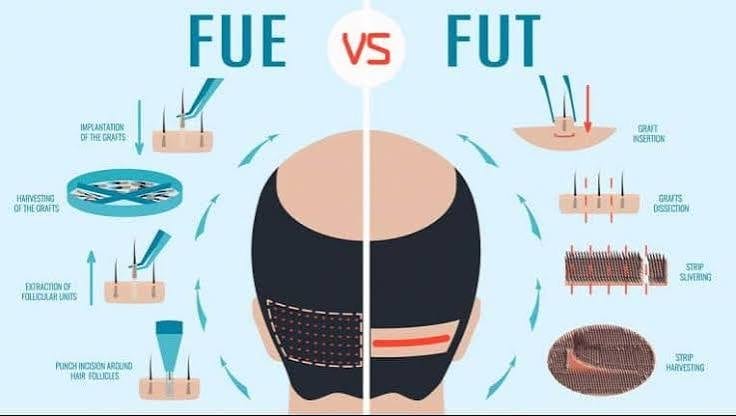
FUE vs FUT: how the techniques differ
The two techniques differ only in how hair is harvested.
The two techniques differ only in how hair is harvested. FUE punches follicular units out individually, leaving scattered small dots; FUT removes a strip of scalp and leaves a single line. Everything downstream, including placement and growth, is the same.
What is the actual difference between FUE and FUT?
FUE and FUT differ only in harvesting. FUT excises a strip of scalp from the back of the head, closes the wound, and dissects units from it under magnification, while FUE punches each unit directly out of the scalp. After that, the two procedures are identical: sites are made and grafts placed the same way.
How do FUE and FUT scars differ?
FUT leaves one linear scar that is well concealed by hair of moderate length but visible if shaved short, while FUE leaves many small round scars scattered across the donor area, individually hard to see but noticeable as thinning or stippling if harvesting was heavy or the head is shaved very short. Neither is scarless.
- FUT leaves one linear scar. Well concealed by hair of moderate length; visible if the head is shaved short.
- FUE leaves many small round scars scattered across the donor area. Individually hard to see, but visible as generalised thinning or stippling if harvesting was heavy or the head is shaved very short.
Neither is scarless. The choice is which kind of scar suits how you wear your hair.
What are the practical differences between FUE and FUT beyond scarring?
Beyond scarring, FUE usually requires the donor area shaved while FUT does not; FUT involves sutures and closure tension so tightness lasts longer; strip surgery can yield very high graft numbers in one sitting; FUE extraction is slower per graft, lengthening the operation; and the two draw on the donor area differently over a lifetime.
- Shaving: FUE usually needs the donor area shaved; FUT does not.
- Recovery: FUT involves sutures and real closure tension, so tightness lasts longer.
- Session size: strip can yield very high graft numbers in one sitting.
- Speed: extraction in FUE is slower per graft, which lengthens the operation.
- Donor management: the two draw on the donor differently over a lifetime.
How do you choose between FUE and FUT?
Choose based on hair length and graft needs: if you wear or may wear your hair very short, the linear FUT scar is the deciding factor and FUE is usually preferred; if you keep hair longer and need a very high graft count in one session, strip surgery (FUT) remains competitive.
Our fuller guide to FUT and strip surgery covers the scar question in detail.
Sources
- Parsley WM, Perez-Meza D. Review of factors affecting the growth and survival of follicular grafts. Journal of Cutaneous and Aesthetic Surgery, 2010;3(2). jcasonline.com
This article summarises published research and standard clinical practice. It is general educational information, not medical advice, and it does not replace the instructions your own surgical team gives you. Where their guidance differs from anything here, follow theirs.
Get a no-obligation assessment against fixed criteria, directly on WhatsApp.