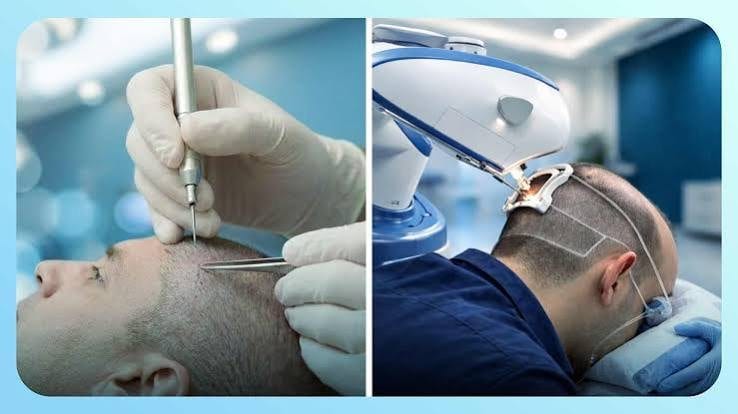
Robotic FUE (ARTAS) vs manual FUE
Robotic systems assist extraction by imaging the donor area and positioning the punch automatically.
Robotic systems assist extraction by imaging the donor area and positioning the punch automatically. Adoption has stayed low, largely because the machines are expensive and many surgeons judge human hands better where the donor area is uneven.
What does robotic FUE (ARTAS) actually do during extraction?
Robotic systems use optical imaging to identify follicular units, calculate each one's angle, and drive a punch to extract it, aiming for consistent angle, depth and force without fatigue over long sessions. The robot does not design the hairline, decide graft distribution, or place grafts into recipient sites — those remain human decisions.
What are the advantages of robotic FUE extraction?
Robotic FUE offers a consistent extraction angle across thousands of grafts, no fatigue effect late in a long session, reproducible punch depth on every follicle, and systematic spacing across the donor area that avoids over-harvesting any single patch — the main advantages clinics cite for automated extraction systems.
- Consistent extraction angle across thousands of grafts
- No fatigue effect late in a long session
- Reproducible punch depth
- Systematic spacing that avoids over-harvesting one patch
What are the disadvantages of robotic FUE extraction?
Robotic FUE systems are expensive to buy and maintain, a cost passed on to patients, and many surgeons argue human judgement still outperforms automated pattern recognition in uneven donor areas. The systems generally work best on straight, dark hair with good contrast, and are not obviously faster than a skilled manual team.
- Cost. The machines are expensive to buy and maintain, which is passed on.
- Uneven donor areas. Many surgeons argue human judgement still outperforms automated pattern recognition where hair direction and density vary.
- Hair type limits. Systems generally perform best on straight, dark hair with good contrast.
- Speed. Not obviously faster than a skilled manual team.
How common is robotic FUE compared with manual FUE?
Robotic extraction remains a small minority of procedures worldwide, recorded at roughly 4 percent of the market with a projection toward about 12 percent by 2028 — a shift expected to track falling hardware costs rather than better outcomes. Choosing a robotic clinic over a manual one therefore tells you little on its own.
Our statistics page has the current figures.
Sources
- Parsley WM, Perez-Meza D. Review of factors affecting the growth and survival of follicular grafts. Journal of Cutaneous and Aesthetic Surgery, 2010;3(2). jcasonline.com
This article summarises published research and standard clinical practice. It is general educational information, not medical advice, and it does not replace the instructions your own surgical team gives you. Where their guidance differs from anything here, follow theirs.
Get a no-obligation assessment against fixed criteria, directly on WhatsApp.