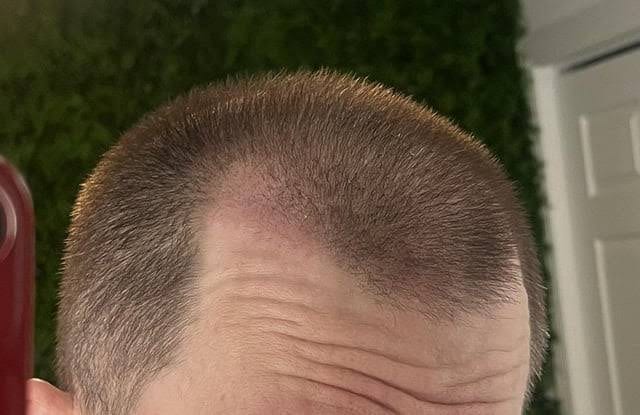
Redness in the recipient area: normal vs concerning
Redness is the scalp healing. Which way it is heading tells you whether the healing is on track.
Redness after a transplant is the visible sign of thousands of small wounds healing and increased blood flow to the area. It normally fades over weeks to a few months, faster in lighter skin. Redness that increases, concentrates, or arrives with heat and pain is a different matter.
Why does the recipient area stay red after a hair transplant?
Each recipient site is a small incision, and the scalp reacts by increasing blood flow to the whole region, the same vascular response that helps new grafts grow, so redness signals the process working rather than a complication. It fades as healing completes and the vessels return to normal calibre.
What is the normal timeline for redness to fade after a hair transplant?
Redness is pronounced pink or red with crusting in week 1, persists without crusts through weeks 2 to 4, fades gradually and unevenly through months 2 to 4, and can leave faint pinkness longer in fair skin. Patches clear at different rates, which is normal, not a sign some grafts have failed.
- Week 1: pronounced pink or red, with crusting
- Weeks 2 to 4: redness persists but the crusts are gone
- Months 2 to 4: gradual, uneven fading
- Beyond: in some people, particularly with fair skin, faint pinkness lingers longer
Fading is rarely even. Patches clear at different rates, which is normal and not a sign that some grafts have failed.
What makes post-transplant redness last longer?
Four factors make redness linger after a hair transplant: fair skin, where the contrast is simply more visible; larger sessions and higher planting densities; sun exposure, which prolongs and can darken the discolouration; and picking or irritating the recipient area.
- Fair skin, where the contrast is simply more visible
- Larger sessions and higher planting densities
- Sun exposure, which prolongs and can darken the discolouration
- Picking or irritating the area
When should you contact the clinic about redness after a hair transplant?
What matters is direction of travel: steadily improving redness is healing; redness getting worse after the first few days is not. Contact the clinic for redness that is increasing, redness concentrated around specific grafts with pus or a bump, heat, marked tenderness or spreading edges, or fever, since these suggest infection or folliculitis.
The distinction that matters is direction of travel. Redness that is steadily improving is healing. Redness that is getting worse after the first few days is not.
- Redness that is increasing rather than fading
- Redness concentrated around specific grafts with pus or a bump
- Heat, marked tenderness or spreading edges
- Fever alongside any of the above
These suggest infection or folliculitis, both treatable and both worth acting on early.
Where redness sits in the wider healing sequence is covered in our aftercare guide.
Sources
- Bernstein RM, Rassman WR. Graft Anchoring in Hair Transplantation. Dermatologic Surgery, 2006;32(2):198-204. pubmed.ncbi.nlm.nih.gov/16442039
This article summarises published research and standard clinical practice. It is general educational information, not medical advice, and it does not replace the instructions your own surgical team gives you. Where their guidance differs from anything here, follow theirs.
Get a no-obligation assessment against fixed criteria, directly on WhatsApp.