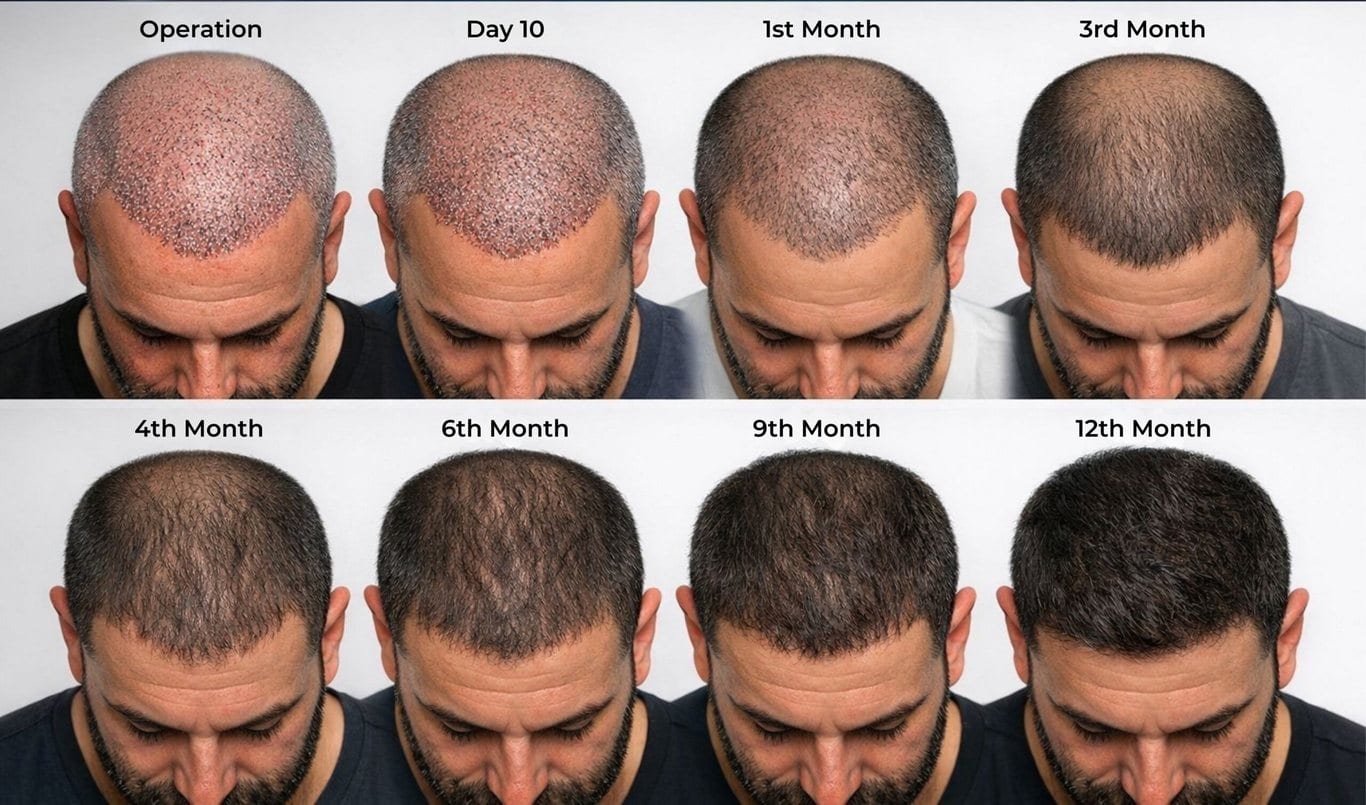
Week-by-week scalp recovery, weeks 1-8
For most of the first two months, the scalp looks worse before it looks better. Knowing which phase you are in makes that easier to sit through.
The first eight weeks after a transplant move through three distinct phases: a fortnight of physical vulnerability, a dormant middle stretch when the transplanted hairs shed, and, for some people, the first faint regrowth. Knowing which phase you are in stops you mistaking normal events for failure.
What happens to grafts during weeks 1 and 2 after a hair transplant?
Weeks 1 and 2 are the only period a graft can be dislodged: pulling a hair removes one within two days, pulling an adherent crust can cost a graft through day five, and grafts are secure from day nine. Crusts shed by days seven to fourteen, and swelling peaks around days two to four.
This is the only stretch in which a graft can be physically removed. Research on graft anchoring found that pulling a hair dislodged the graft for the first two days, that pulling an adherent crust could still cost a graft through day five, and that by day nine grafts were no longer at risk.
Crusts form in the first day or two and generally shed between days seven and fourteen. Swelling appears around days two to four and settles within the week. The donor area is usually the more uncomfortable of the two sites.
What happens to transplanted hair in weeks 3 and 4?
By weeks 3 and 4, most people have lost most or all of the transplanted hair shafts, which typically shed in weeks two to three as the follicles enter a resting phase after the shock of transplantation; the follicles themselves stay. The scalp can look emptier than before surgery, which is expected; increasing redness, pus, or pain is not.
What happens during weeks 5 to 8 after a hair transplant?
Weeks 5 to 8 bring little visible change: the recipient area keeps fading from pink toward normal skin tone, faster in lighter skin and slower in darker skin, native shock-loss hair usually starts recovering, and some patients see faint regrowth by the end of the window while many see none yet.
Very little visible happens. The recipient area continues to fade from pink toward normal skin tone, faster in lighter skin and slower in darker skin. Some people see the first fine regrowth toward the end of this window; many see nothing until later.
Native hair that shed through shock loss usually begins recovering in this period.
- Recipient redness fading, unevenly
- Donor area healed, possibly still numb
- Little or no visible new growth yet
- No crusting
What is the best way to track hair transplant progress?
Judging results at eight weeks is far too early: the clinical timeline is shedding at weeks two to three, new growth from around months three to four, and a final settled result at about twelve months. Photographs in consistent lighting every four weeks beat daily mirror checks, which are skewed by lighting and hair length.
Our aftercare guide covers the routine week by week.
Sources
- Bernstein RM, Rassman WR. Graft Anchoring in Hair Transplantation. Dermatologic Surgery, 2006;32(2):198-204. pubmed.ncbi.nlm.nih.gov/16442039
This article summarises published research and standard clinical practice. It is general educational information, not medical advice, and it does not replace the instructions your own surgical team gives you. Where their guidance differs from anything here, follow theirs.
Get a no-obligation assessment against fixed criteria, directly on WhatsApp.