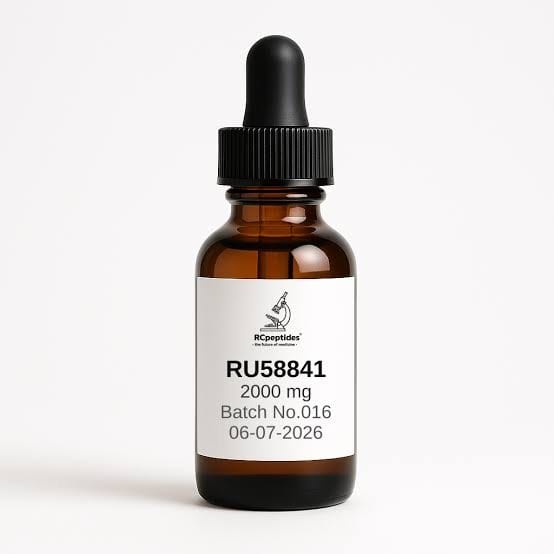
RU58841: experimental topical antiandrogen
RU58841 is an experimental topical anti-androgen sold through research-chemical channels.
RU58841 is an experimental topical anti-androgen sold through research-chemical channels. It has never completed clinical development, has no approval anywhere, and no established safety data in humans.
What is RU58841?
RU58841 is a non-steroidal anti-androgen developed to act locally at the androgen receptor in the skin, intended to avoid systemic anti-androgen effects. Early animal work generated interest, but clinical development did not proceed to completion, and RU58841 was never brought to market.
Why does RU58841's lack of approval matter?
No regulator has assessed RU58841 as safe or effective, and there is no completed human safety data, so the absence of published harm reflects an absence of trials, not evidence of safety. Material sold as a research chemical is not made to pharmaceutical standards, dosing protocols online are user-derived, and no prescriber monitors for effects.
- No approval. No regulator anywhere has assessed it as safe and effective for anything.
- No completed human safety data. The absence of published harm is not evidence of safety; it reflects the absence of trials.
- No manufacturing standards. Material sold as a research chemical is not made to pharmaceutical quality, and no published analysis of what these products actually contain exists.
- No dosing guidance. Protocols circulating online are user-derived.
- No prescriber oversight. Nobody is monitoring for effects.
Does RU58841 stay local to the scalp, or is it absorbed systemically?
RU58841's premise is that it acts locally without meaningful systemic exposure, but that premise has not been established in humans across sustained use at the doses people actually apply. Anti-androgens have systemic consequences when absorbed. A 2026 anti-doping study gave six healthy men a single 30 mg topical scalp dose and detected both the parent compound and an oxidised metabolite in blood, indicating considerable systemic exposure. That is one single-dose study in six people rather than a safety programme, but it argues against the local-action premise rather than for it.
What should you do with RU58841 if you are already using it?
There is no evidence base from which to recommend a dose, so none is given here. If you are using RU58841, tell your doctor and your surgeon before any procedure, since it belongs on your medication list. For an evidenced anti-androgen effect, use a prescribed drug with a known safety profile and monitoring.
Our non-surgical guide covers the options.
Sources
- Battmann T, Bonfils A, Branche C, Humbert J, Goubet F, Teutsch G, et al. RU 58841, a new specific topical antiandrogen: a candidate of choice for the treatment of acne, androgenetic alopecia and hirsutism. Journal of Steroid Biochemistry and Molecular Biology, 1994;48(1):55-60. pubmed.ncbi.nlm.nih.gov/8136306
- De Brouwer B, Tételin C, Leroy T, Bonfils A, Van Neste D. A controlled study of the effects of RU58841, a non-steroidal antiandrogen, on human hair production by balding scalp grafts maintained on testosterone-conditioned nude mice. British Journal of Dermatology, 1997;137(5):699-702. pubmed.ncbi.nlm.nih.gov/9415227
- Okutan A, Krug O, Fußhöller G, Piper T, Thevis M. Investigation Into the Metabolism and Elimination Behavior of RU 58841, and Its Influence on the Steroid Profile in Humans. Biomedical Chromatography, 2026;40(10):e70602. pubmed.ncbi.nlm.nih.gov/42615108
This article summarises published research. It is general educational information, not medical advice, and it is not a recommendation to start, stop or change any medication. Prescription drugs carry contraindications and interactions; discuss them with a doctor who knows your medical history.
Get a no-obligation assessment against fixed criteria, directly on WhatsApp.