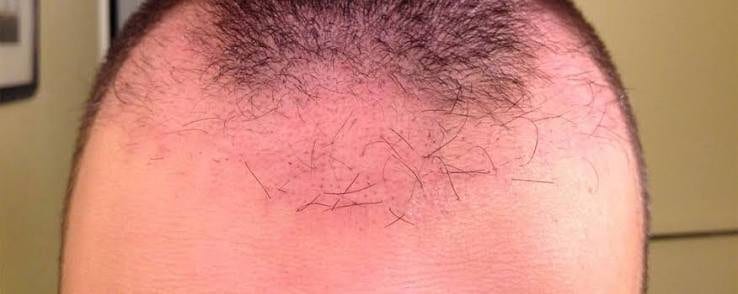
Timeline for shock loss recovery
Native hair lost to shock usually comes back, but on the hair cycle's schedule rather than yours.
Shock loss typically appears within the first two months after surgery and recovers over the following three to six months, following the ordinary rhythm of the hair cycle rather than any treatment. The wait is uncomfortable but the trajectory is usually predictable.
Why does shock loss recovery take months rather than weeks?
A follicle pushed into its resting phase cannot simply resume growing. It must first complete the resting phase, shed, and then re-enter the growth phase, after which a new shaft still has to grow long enough to become visible. That sequence is measured in months and cannot be shortened by any product.
What is the usual timeline for shock loss recovery?
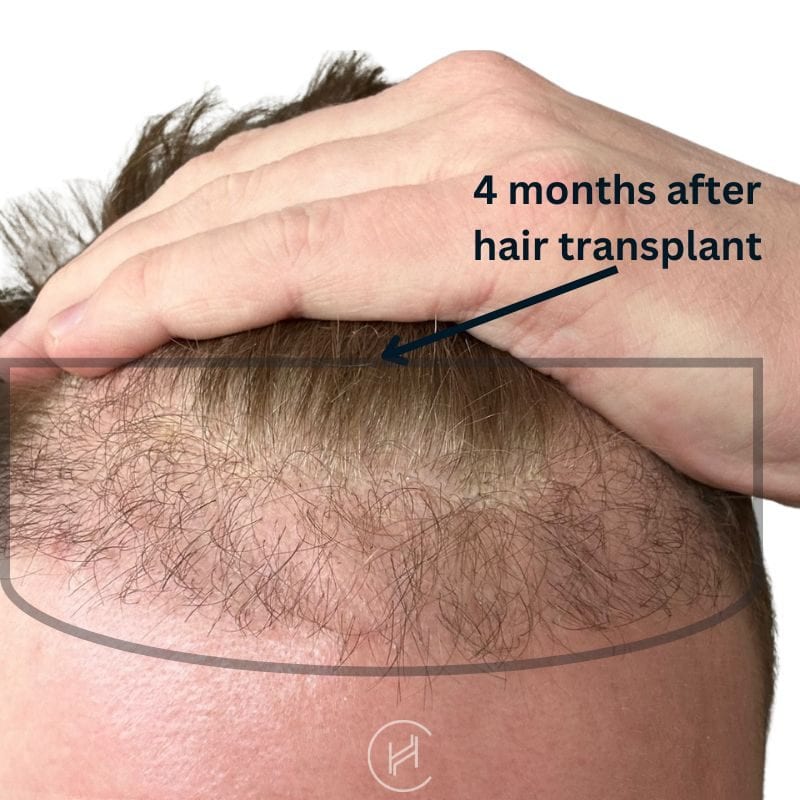
Shedding of native hair typically becomes noticeable in weeks two to eight. It stabilises around months two to four, when density is at its lowest and the area can look worse than before surgery. Regrowth begins around months three to six as fine, short hairs, and thickness and length recover between months six and twelve.
- Weeks 2 to 8: shedding of native hair becomes noticeable
- Months 2 to 4: the shed stabilises; density is at its lowest and the area can look worse than before surgery
- Months 3 to 6: regrowth begins, initially as fine, short hairs
- Months 6 to 12: thickness and length recover, converging with the transplanted hair's own growth curve
Why does month three or four feel like the worst point in recovery?
Visually, it usually is the worst point: transplanted shafts have shed but not yet regrown, and native hair tipped into rest has also gone, so two sheds coincide with neither having begun recovering. This is when people most often conclude the procedure failed, even though new growth typically starts here.
When is scalp shedding not simply shock loss?
Shedding is probably not simple shock loss if it continues past six months with no regrowth, extends well outside the surgical area, comes with scalp symptoms such as pain, scaling or pustules, or if the donor area looks like it is thinning rather than recovering. These patterns warrant assessment rather than patience.
- Shedding that continues past six months with no regrowth
- Shedding well outside the surgical area
- Shedding with scalp symptoms such as pain, scaling or pustules
- A donor area that is visibly thinning rather than recovering
These warrant assessment rather than patience, because they may reflect a separate cause needing diagnosis.
Sources
- Bernstein RM, Rassman WR. Graft Anchoring in Hair Transplantation. Dermatologic Surgery, 2006;32(2):198-204. pubmed.ncbi.nlm.nih.gov/16442039
This article summarises published research and standard clinical practice. It is general educational information, not medical advice, and it does not replace the instructions your own surgical team gives you. Where their guidance differs from anything here, follow theirs.
Get a no-obligation assessment against fixed criteria, directly on WhatsApp.