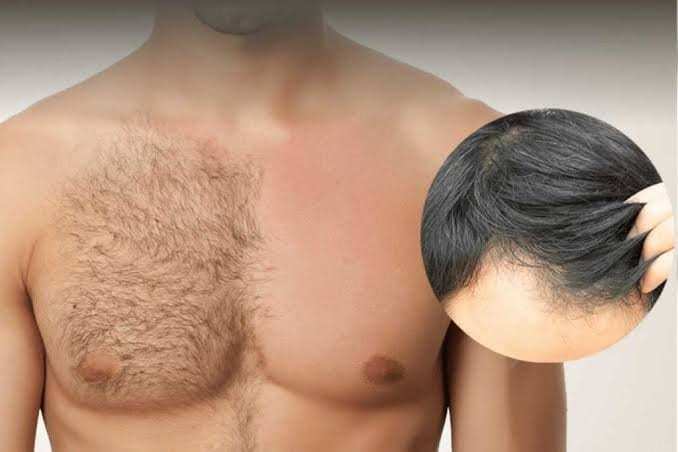
Body hair characteristics: growth cycle and calibre differences
Body hair has a shorter growth phase and a higher resting proportion than scalp hair, which limits the length transplanted body hair reaches.
Body hair has a shorter growth phase and a higher resting proportion than scalp hair, which limits the length transplanted body hair reaches. Those properties largely travel with the follicle, so they set the ceiling on what body hair grafts can do.
Why does body hair behave differently from scalp hair?
Body hair follicles spend far less time in the anagen (growth) phase than scalp follicles, which is why chest hair stops at a limited length while scalp hair grows long. This trait is intrinsic to the follicle, so it travels with the graft — transplanted body hair reaches a shorter maximum length than scalp hair.
Scalp hair and body hair are not the same tissue with different locations. They have systematically different growth cycles, and the differences are the reason body hair sits at the bottom of the donor hierarchy rather than a matter of surgical preference.
The dominant factor is the length of the growth phase. Scalp follicles spend years in anagen, which is why scalp hair grows long. Body hair follicles spend far less time in anagen, which is why chest hair reaches a certain length and stops.
This property is largely intrinsic to the follicle rather than to its location, so it substantially travels with the graft. Transplanted body hair typically reaches a shorter maximum length than scalp hair in the same recipient area.
What practical differences does body hair have compared with scalp hair?
Compared with scalp hair, body hair has a shorter growth phase limiting length, a higher resting proportion that adds variability, less synchronised cycling that can look uneven over time, curlier texture that complicates blending and extraction, mostly single-hair units that yield fewer hairs per graft, and generally less predictable survival after transfer.
- Shorter anagen. Limits achievable length, which affects both styling and how well body hair blends with scalp hair around it.
- Higher telogen proportion. A greater share of body hair follicles are resting at any moment. That affects what is extractable on the day and contributes to variability in the visible result.
- Cycle asynchrony. Body hair follicles cycle less in step with each other than scalp follicles, so transplanted body hair can look uneven as different grafts move through phases at different times.
- Curl and texture. Body hair is frequently curlier and of different texture, which affects both blending and extraction difficulty.
- Predominantly single-hair units. Graft counts translate to much lower hair counts than scalp grafts.
- Variable survival. Yield after transfer is generally reported as less predictable than for scalp hair.
What does the research evidence say about body hair transplantation?
Body hair transplantation has a much smaller research literature than scalp or beard work; the most substantial recent report is Umar and colleagues' 2024 multicentre study on beard and body hair FUE. Evidence supports body hair FUE as feasible supplementary supply when scalp and beard reserves are inadequate, but not as equivalent to scalp hair.
Body hair transplantation has a considerably smaller literature than scalp or beard work. Umar and colleagues published a multicentre study in Dermatologic Surgery in 2024 on beard and body hair transplantation by follicular unit excision using a skin-responsive device, which is the most substantial recent report on the technique.
What the literature supports is that body hair extraction by FUE is feasible and functions as a supplementary donor source in patients whose scalp and beard reserves are inadequate. What it does not support is equivalence with scalp hair, and no careful account claims otherwise.
Beard hair is better documented — Zhu and colleagues on large-scale beard extraction in advanced androgenetic alopecia, Gupta and colleagues on the beard in grade 6 and 7 alopecia, and Zhao and colleagues' published classification criteria for beard donor suitability. Beard hair sits between scalp and body hair in both evidence and predictability.
What should patients realistically expect from body-hair grafts?
Body hair realistically adds bulk behind the visible frontal zone for patients who would otherwise lack coverage — it does not build hairlines, blend seamlessly, or reach scalp length. Expect shorter hair, visible texture differences at close range, lower hair counts than the graft number suggests since most units are singles, and more variable yield.
The realistic framing is that body hair adds bulk behind the visible frontal zone in patients who would otherwise lack coverage. It does not build hairlines, it does not blend seamlessly, and it does not reach scalp length.
- Expect shorter hair from body-hair grafts than from scalp grafts in the same area.
- Expect texture differences that are visible at close range.
- Expect lower hair counts than the graft number suggests, since most units are singles.
- Expect more variability in yield, and ask the surgeon what they plan to do if yield is low.
Why is body hair being proposed for my hair transplant?
The more useful question is why body hair is proposed. It suits cases where the scalp safe zone and beard are genuinely exhausted, such as advanced patterns or repairs. If your scalp reserve is intact and body hair is offered just for a bigger graft number, the issue is the plan's size, not its source.
Sources
- Umar S, Khanna R, Maldonado JC, Chouhan K, Gonzales A. Beard and Body Hair Transplantation by Follicular Unit Excision Using a Skin-Responsive Device: A Multicenter Study. Dermatologic Surgery, 2024;50(3):306-308. pubmed.ncbi.nlm.nih.gov/38127669
- Zhu DC, He Y, Fan ZX, Wang J, Qu Q, Hu ZQ, Miao Y. Large-Scale Beard Extraction Enhances the Cosmetic Results of Scalp Hair Restoration in Advanced Androgenetic Alopecia in East Asian Men: A Retrospective Study. Dermatology and Therapy, 2020;10(1):151-161. pubmed.ncbi.nlm.nih.gov/31784942
- Zhao Y, Zhang J, Jiang B, Fan Z, Miao Y. Development of an Evaluation System to Classify Beard Donor Area for Hair Transplantation. Dermatologic Surgery, 2025;51(9):882-886. pubmed.ncbi.nlm.nih.gov/40323042
- Gupta B, Banerjee P, Priyadarshini Y, Rathi P. BEARD - A Potential Donor Site in Grade 6 and Grade 7 Alopecia: A Case Series. Journal of Maxillofacial and Oral Surgery, 2021;20(4):545-550. pubmed.ncbi.nlm.nih.gov/34776682
- Jimenez F, Ruifernández JM. Distribution of human hair in follicular units. A mathematical model for estimating the donor size in follicular unit transplantation. Dermatologic Surgery, 1999;25(4):294-298. pubmed.ncbi.nlm.nih.gov/10417585
This article summarises published research and standard clinical practice. It is general educational information, not medical advice, and it does not replace the instructions your own surgical team gives you. Where their guidance differs from anything here, follow theirs.
Get a no-obligation assessment against fixed criteria, directly on WhatsApp.