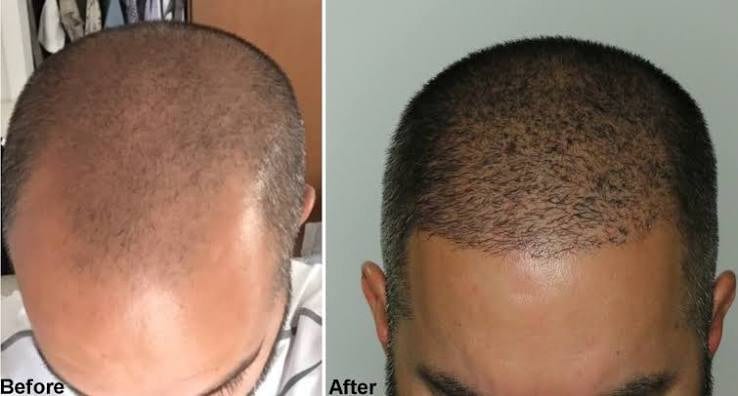
Mixing body and scalp donor hair in one session
Combining sources is standard practice in advanced cases: scalp hair for the visible frontal zone, beard or body hair for bulk behind it.
Combining sources is standard practice in advanced cases: scalp hair for the visible frontal zone, beard or body hair for bulk behind it. Placement by characteristic is what makes the mix work; placing sources interchangeably is what makes it fail.
Why is mixing donor hair sources normal in advanced hair loss cases?
In advanced patterns, the area needing coverage can exceed what the scalp safe zone can supply safely, so surgeons extend the reserve with beard or body hair rather than overharvesting scalp. Published studies report beard hair enhancing cosmetic results in grade 6-7 alopecia. In the right patient, mixing sources is the plan, not a compromise.
In advanced patterns the area needing coverage can exceed what the scalp safe zone can supply at a safe extraction proportion. Rather than overharvesting the scalp, a surgeon can extend the reserve with beard hair and, if necessary, body hair.
Zhu and colleagues' retrospective study of large-scale beard extraction in East Asian men with advanced androgenetic alopecia concluded that beard hair serves as an important additional donor supply and that its use enhanced cosmetic results. Gupta and colleagues reported specifically on the beard as a donor site in grade 6 and 7 alopecia — the group for whom scalp reserve is most likely to be inadequate.
So mixing is not a compromise forced by a bad plan. In the right patient it is the plan.
How should different donor hair sources be placed on the scalp?
Each donor source should go where its properties are an advantage: the finest scalp hair at the frontal hairline (never beard or body hair), scalp hair through the frontal third and mid-scalp, and beard or body hair reserved for the crown, which is viewed from distance where coarser hair still reads as good density.
The mix works when each source goes where its properties are an advantage and its differences are least visible.
- Frontal hairline: the finest available scalp hair, single-hair units only. Never beard, never body hair. This is where the result is judged at close range and where texture mismatches are unforgiving.
- Frontal third behind the hairline: scalp hair, building density with two-hair units.
- Mid-scalp: scalp hair where available, with beard hair blended in beneath or among it to add bulk.
- Crown: the natural home for beard and body hair. It is viewed from above and behind, at distance, and coarse hair produces good apparent density there.
The failure mode is a clinic that treats grafts as interchangeable units and places whatever comes next. That produces coarse beard hair at the hairline, which is one of the harder problems to correct.
What is layering in mixed donor hair transplants?
Layering places coarser beard grafts deeper or behind finer scalp grafts placed in front of and above them, so scalp hair provides visible surface texture while beard hair supplies density beneath. Because the eye reads surface and density at conversational distance, a well-layered mix is invisible, while a careless one shows coarse wiry hairs.
What are the practical downsides of a mixed donor hair session?
A mixed session takes longer, raising fatigue-related transection risk; leaves two donor areas to heal with separate aftercare; produces less predictable results because scalp, beard and body hair have different survival profiles; and can mature unevenly since growth cycles differ. Published criteria flag beard grafts as unsuitable below roughly 8 follicular units per cm².
- Session length. Extracting from two or three areas takes longer than one. Long sessions raise fatigue-related transection risk, which argues for staging.
- Two donor areas healing. You will have extraction sites on the scalp and on the face or chest, with separate aftercare for each.
- Different yields. Scalp, beard and body hair have different survival profiles, so the result is less predictable than a scalp-only session.
- Different timelines. Growth cycles differ between sources, so the result can mature unevenly.
- Assessment criteria. Beard donor suitability now has published criteria — Zhao and colleagues specify grafts as unsuitable below roughly 8 follicular units per cm², 60 μm diameter, or 10° emergence angle. Ask whether yours was assessed against something.
What questions should I ask a clinic about mixing donor hair sources?
Ask how many grafts come from each source and where each is placed, confirm none will go in the frontal third, how the beard area was assessed, and what happens if non-scalp grafts underperform. A clinic answering with a graft breakdown by source and region has a design; one giving a single total does not.
- How many grafts from each source, and where is each source going?
- Will any beard or body hair be placed in the frontal third? (The answer should be no.)
- How was my beard donor area assessed for suitability?
- What yield do you expect from each source, and what happens if the non-scalp grafts underperform?
- What will my beard or chest look like afterwards?
A clinic that answers with a graft breakdown by source and region has a design. One that answers with a single total has a number.
Sources
- Zhu DC, He Y, Fan ZX, Wang J, Qu Q, Hu ZQ, Miao Y. Large-Scale Beard Extraction Enhances the Cosmetic Results of Scalp Hair Restoration in Advanced Androgenetic Alopecia in East Asian Men: A Retrospective Study. Dermatology and Therapy, 2020;10(1):151-161. pubmed.ncbi.nlm.nih.gov/31784942
- Gupta B, Banerjee P, Priyadarshini Y, Rathi P. BEARD - A Potential Donor Site in Grade 6 and Grade 7 Alopecia: A Case Series. Journal of Maxillofacial and Oral Surgery, 2021;20(4):545-550. pubmed.ncbi.nlm.nih.gov/34776682
- Zhao Y, Zhang J, Jiang B, Fan Z, Miao Y. Development of an Evaluation System to Classify Beard Donor Area for Hair Transplantation. Dermatologic Surgery, 2025;51(9):882-886. pubmed.ncbi.nlm.nih.gov/40323042
- Umar S, Khanna R, Maldonado JC, Chouhan K, Gonzales A. Beard and Body Hair Transplantation by Follicular Unit Excision Using a Skin-Responsive Device: A Multicenter Study. Dermatologic Surgery, 2024;50(3):306-308. pubmed.ncbi.nlm.nih.gov/38127669
- Jimenez F, Ruifernández JM. Distribution of human hair in follicular units. A mathematical model for estimating the donor size in follicular unit transplantation. Dermatologic Surgery, 1999;25(4):294-298. pubmed.ncbi.nlm.nih.gov/10417585
This article summarises published research and standard clinical practice. It is general educational information, not medical advice, and it does not replace the instructions your own surgical team gives you. Where their guidance differs from anything here, follow theirs.
Get a no-obligation assessment against fixed criteria, directly on WhatsApp.