Beard hair as a donor source
Beard hair can substantially extend donor supply in advanced hair loss, and published series support its use.
Beard hair can substantially extend donor supply in advanced hair loss, and published series support its use. It is coarser than scalp hair with different growth characteristics, so it is generally used in the mid-scalp and crown rather than the hairline.
Why is beard hair used as a hair transplant donor source?
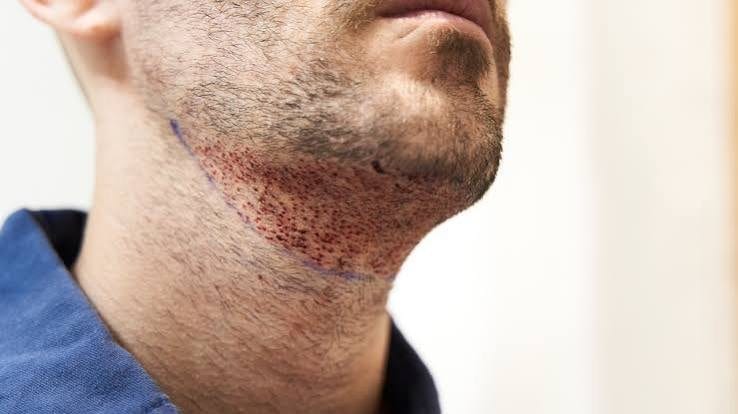
Beard hair extends a patient's donor reserve when advanced hair loss (Norwood 6–7) needs more coverage than the scalp's safe donor zone can supply. The submental and upper neck area is usually harvested: it has good density, thick hair, and extraction scars there heal well, hidden by the beard or jawline.
Scalp donor supply is finite, and in advanced patterns — Norwood 6 and 7 — the area to be covered can exceed what the safe scalp donor zone can provide. Beard hair is the most useful additional source, and it is used specifically to extend the reserve when the scalp cannot cover the plan.
The submental and upper neck region is the usual harvest area. It typically has good density, the hair is thick, and extraction scars in that region heal well and are concealed by the beard or by the position under the jaw.
What does published research show about beard hair as a donor source?
Published studies support beard-hair harvesting: a 2020 East Asian cohort found beard density around 48 follicular units per cm² and improved cosmetic results in advanced alopecia; a 2025 classification system marks beard grafts unsuitable below roughly 8 follicular units/cm², 60 μm diameter, or a 10° emergence angle.
Zhu and colleagues published a retrospective study in Dermatology and Therapy in 2020 on large-scale beard extraction in East Asian men with advanced androgenetic alopecia, concluding that beard hair serves as an important additional donor supply and that its use enhanced cosmetic results. They reported beard-area density in the region of 48 follicular units per cm².
Gupta and colleagues reported a case series in the Journal of Maxillofacial and Oral Surgery in 2021 specifically on the beard as a potential donor site in grade 6 and grade 7 alopecia — the patients for whom the scalp reserve is most likely to be inadequate.
Umar and colleagues published a multicentre study in Dermatologic Surgery in 2024 on beard and body hair transplantation by follicular unit excision using a skin-responsive device.
Zhao and colleagues went further and published an evaluation system in Dermatologic Surgery in 2025 to classify the beard donor area for hair transplantation, specifying that grafts are unsuitable below approximately 8 follicular units per cm², 60 μm in diameter, or emerging at angles below 10°.
That last paper is worth knowing about, because it means beard donor suitability is now something a surgeon can assess against published criteria rather than by impression.
How does beard hair differ from scalp hair?
Beard hair differs from scalp hair in five ways: it is thicker (more conspicuous outside dense areas), coarser and often more wiry, has a different anagen duration so transplanted hairs may fall short of scalp length, grows mostly as single-hair units rather than multi-hair grafts, and frequently differs in colour and greying pattern.
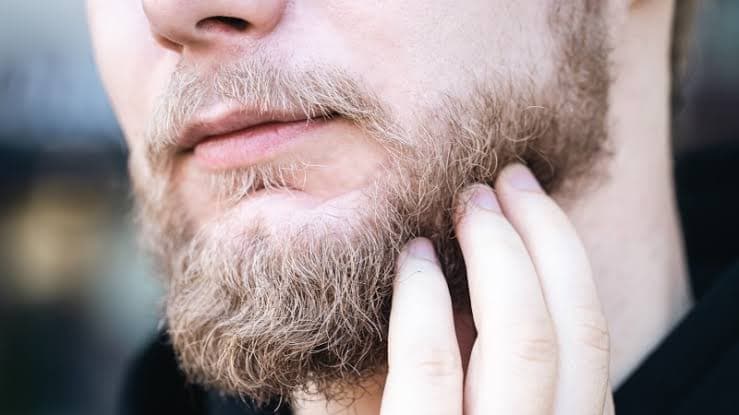
- Calibre. Beard hair is typically noticeably thicker than scalp hair. That gives good coverage per graft but makes it conspicuous if placed where fine hair belongs.
- Texture. It is often coarser and more wiry, and may curl differently.
- Growth cycle. Beard follicles have a different anagen duration from scalp follicles, so transplanted beard hair may not reach the same length.
- Follicular unit size. Beard hair is predominantly single-hair units, so graft counts do not translate directly into hair counts the way scalp grafts do.
- Colour. Beard and scalp hair frequently differ in colour and greying pattern in the same person.
Where on the scalp is beard hair transplanted, and where is it avoided?
Beard grafts are placed in the mid-scalp and crown, often blended beneath scalp grafts to add density and bulk. They are avoided at the hairline, where fine single-hair units are required and a coarse beard hair looks wrong. Clinics typically mix scalp hair at the frontal third with beard hair behind it.
The standard approach places beard grafts where their characteristics are an advantage and their differences are least visible: the mid-scalp and crown, often underneath or mixed with scalp grafts to add density and bulk.
Beard hair is generally avoided at the hairline. The hairline requires the finest available hair placed in single units, and a coarse beard hair at the frontal edge looks wrong in a way that is difficult to correct.
Mixing is common and sensible: scalp hair for the visible frontal third, beard hair to bulk out the areas behind it.
What should patients consider before agreeing to beard donor harvesting?
Before agreeing, weigh four factors: beard donor scars are usually hidden but can show on clean-shaven, high-contrast skin; heavy extraction can visibly thin the beard; harvesting is appropriate only when scalp supply is genuinely insufficient, not to expand an oversized plan; and the realistic goal is coverage, not a texture match.
- Extraction scars. The beard donor area gets the same dot scars as the scalp. They are usually well hidden, but if you shave clean and have high contrast skin, ask to see photographs.
- Your beard's appearance afterwards. Conservative extraction is invisible; heavy extraction can thin a beard visibly.
- Whether you actually need it. Beard harvesting is appropriate when scalp supply is genuinely insufficient. It is not a reason to enlarge a plan that the scalp could have covered conservatively.
- Realistic expectations about texture. The result is coverage, not a match.
Sources
- Zhu DC, He Y, Fan ZX, Wang J, Qu Q, Hu ZQ, Miao Y. Large-Scale Beard Extraction Enhances the Cosmetic Results of Scalp Hair Restoration in Advanced Androgenetic Alopecia in East Asian Men: A Retrospective Study. Dermatology and Therapy, 2020;10(1):151-161. pubmed.ncbi.nlm.nih.gov/31784942
- Gupta B, Banerjee P, Priyadarshini Y, Rathi P. BEARD - A Potential Donor Site in Grade 6 and Grade 7 Alopecia: A Case Series. Journal of Maxillofacial and Oral Surgery, 2021;20(4):545-550. pubmed.ncbi.nlm.nih.gov/34776682
- Umar S, Khanna R, Maldonado JC, Chouhan K, Gonzales A. Beard and Body Hair Transplantation by Follicular Unit Excision Using a Skin-Responsive Device: A Multicenter Study. Dermatologic Surgery, 2024;50(3):306-308. pubmed.ncbi.nlm.nih.gov/38127669
- Zhao Y, Zhang J, Jiang B, Fan Z, Miao Y. Development of an Evaluation System to Classify Beard Donor Area for Hair Transplantation. Dermatologic Surgery, 2025;51(9):882-886. pubmed.ncbi.nlm.nih.gov/40323042
- Jimenez F, Ruifernández JM. Distribution of human hair in follicular units. A mathematical model for estimating the donor size in follicular unit transplantation. Dermatologic Surgery, 1999;25(4):294-298. pubmed.ncbi.nlm.nih.gov/10417585
This article summarises published research and standard clinical practice. It is general educational information, not medical advice, and it does not replace the instructions your own surgical team gives you. Where their guidance differs from anything here, follow theirs.
Get a no-obligation assessment against fixed criteria, directly on WhatsApp.