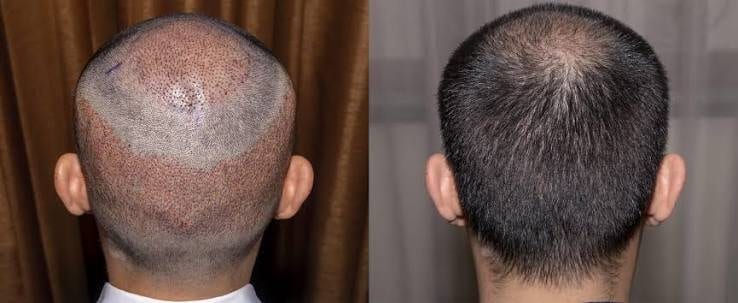
What happens to the donor area as it ages
The donor area thins with age like the rest of the scalp, which slowly reduces the camouflage over extraction scars.
The donor area thins with age like the rest of the scalp, which slowly reduces the camouflage over extraction scars. Nothing about the scars changes; the hair covering them does.
What three separate processes change the donor area as a patient ages?
Ordinary age-related thinning, which reduces density and hair calibre in everyone independent of androgenetic alopecia; androgenetic involvement of the donor periphery, or retrograde thinning advancing upward from the nape and ears in some men; and cumulative extraction, which never regrows. Only the third is caused by surgery, but all three reduce scar coverage.
The donor area changes over decades for reasons that are worth separating, because they have different implications.
- Ordinary age-related thinning. Hair density and shaft calibre decline with age in everyone, independently of androgenetic alopecia. This affects the donor zone as it affects everywhere else.
- Androgenetic involvement of the donor periphery. Retrograde thinning advancing upward from the nape and around the ears, present in some men and not others.
- Cumulative extraction. Whatever has been removed across one or more sessions, which does not regrow.
Only the third is caused by surgery. All three reduce the hair available to cover extraction scars.
Do hair transplant donor scars get more visible as a patient ages?
The scars reach final appearance by twelve months and don't change after that, but visibility does, since it depends on the hair covering them. As donor density declines with age, the same scars become easier to see at the same length, so a patient who could clip short at thirty-five may not manage it at fifty-five.
Extraction scars — FUE dots or an FUT line — reach their final appearance within about twelve months and then stay as they are. Their visibility does not.
Visibility is a function of the hair between and over them. As donor density declines with age, the same scars become progressively easier to see at the same hair length. A patient who could clip to a number two at thirty-five may not be able to at fifty-five, with no change in the scars themselves.
This is a slow process and for most patients a manageable one. It matters most for those who were harvested heavily to begin with, because they had less margin at the start.
Does greying hair make donor scars more or less visible?
Less visible. Grey and white hair has much lower contrast against the scalp than dark hair, and hypopigmented dot scars are pale, so as the donor area greys, the contrast between scar and hair falls and both thinning and dot scars generally become less conspicuous, partly offsetting the density lost with age.
Greying does complicate scalp micropigmentation, however, since colour-matching against greying hair is harder and needs periodic revisiting.
How does sun exposure affect the donor area over the years?
Repeated sun exposure increases the contrast between hypopigmented scar tissue and tanned skin, and can change the scar tissue's texture, so protecting the donor area with a hat or sunscreen has a cumulative benefit. This matters more after FUE specifically, since reduced donor-area sensation is common and can persist, so sunburn may go unfelt.
Scar tissue does not pigment like surrounding skin. Repeated sun exposure over years increases the contrast between hypopigmented scars and tanned skin, and can change the texture of scar tissue.
This is one of the few donor-area variables a patient controls after surgery. A hat outdoors, or sunscreen on a closely clipped scalp, has a cumulative effect over decades.
There is a specific reason for care here after FUE: reduced sensation in the donor area is common and can persist, so burning may not be felt until damage is done.
How should a patient plan for donor-area ageing before surgery?
Choose conservative extraction as long-term insurance, since a donor area harvested at a modest proportion has margin for age-related thinning that one harvested to its limit does not. State your hair-length intentions before surgery, photograph the donor area annually, protect it from the sun, and remember that micropigmentation remains available later at no donor cost.
- Conservative extraction is the long-term insurance. A donor area harvested at a modest proportion has margin for age-related thinning; one harvested to its limit does not.
- State your hair-length intentions before surgery. If you want to keep the short option for life, the plan must allow for donor thinning over decades, not just for the year after surgery.
- Photograph the donor area annually, at consistent length and lighting.
- Protect it from the sun.
- Know that micropigmentation remains available and costs no donor supply, which matters when the reserve is gone.
Sources
- Romera de Blas C, Vega Díez D, Ricart Vayá JM, Gómez Zubiaur A. Complications in follicular unit excision hair transplantation: current evidence and practical approaches. Frontiers in Medicine, 2026;13:1750989. pubmed.ncbi.nlm.nih.gov/41709896
- Maas D, et al. Rethinking the occipital scalp as a control in advanced androgenetic alopecia. Journal of the American Academy of Dermatology, 2026 (ahead of print). pubmed.ncbi.nlm.nih.gov/42398778
- Jimenez F, Ruifernández JM. Distribution of human hair in follicular units. A mathematical model for estimating the donor size in follicular unit transplantation. Dermatologic Surgery, 1999;25(4):294-298. pubmed.ncbi.nlm.nih.gov/10417585
- Rassman WR, Bernstein RM, McClellan R, Jones R, Worton E, Uyttendaele H. Follicular unit extraction: minimally invasive surgery for hair transplantation. Dermatologic Surgery, 2002;28(8):720-728. pubmed.ncbi.nlm.nih.gov/12174065
- Xu Y, et al. Case Report: Paired vertex-occipital assessment reveals donor-area involvement in diffuse unpatterned alopecia. Frontiers in Medicine, 2026;13:1797275. pubmed.ncbi.nlm.nih.gov/41982548
This article summarises published research and standard clinical practice. It is general educational information, not medical advice, and it does not replace the instructions your own surgical team gives you. Where their guidance differs from anything here, follow theirs.
Get a no-obligation assessment against fixed criteria, directly on WhatsApp.