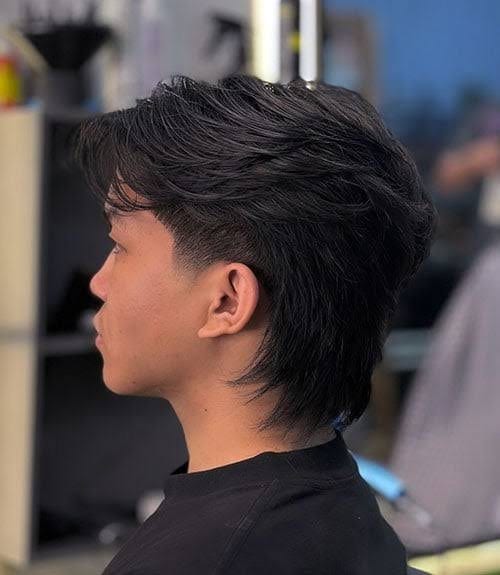
Donor area in Asian hair
Asian hair is typically coarse and straight with a relatively low number of hairs per follicular unit and lower density than Caucasian hair.
Asian hair is typically coarse and straight with a relatively low number of hairs per follicular unit and lower density than Caucasian hair. Coverage per graft is good, but the high hair-skin contrast makes donor scarring more visible.
What hair characteristics shape donor planning in Asian patients?
Asian scalp hair is coarse, giving strong coverage per hair, but straight, giving less camouflage than curl, with fewer hairs per follicular unit, lower follicular unit density, and high contrast between dark hair and lighter skin. The coarse-versus-straight traits cancel, but lower density, fewer hairs per unit and high contrast work against the donor area.
Asian scalp hair has a fairly consistent profile that shapes donor planning.
- Coarse shafts. Hair diameter is typically larger than in Caucasian hair, which gives strong coverage per hair.
- Straight. Straight hair covers less scalp area per hair than curly hair, and it lies flat, which reduces the camouflage effect.
- Fewer hairs per follicular unit. Single- and two-hair units predominate more than in Caucasian hair, so a graft count translates into fewer hairs.
- Lower follicular unit density. Density per cm² tends to be lower.
- High contrast. Dark, thick hair against typically lighter skin is a high-contrast combination.
The first two roughly cancel — thick shafts help, straightness hurts. The last three all work against the donor area.
Why is the donor area the limiting factor when planning for Asian hair?
Lower follicular density means a smaller lifetime reserve from the same safe-zone area, fewer hairs per unit means each graft delivers less, and high hair-skin contrast means thinning and dot scars show earlier and at longer hair lengths. All three push together, so graft numbers quoted for Caucasian patients don't transfer to Asian patients.
Lower density means a smaller lifetime reserve from the same safe-zone area. Fewer hairs per unit means each graft delivers less. And high hair-skin contrast means both thinning and white dot scars in the donor area show earlier and at longer hair lengths than they would in a lower-contrast patient.
Those three effects push in the same direction: the same graft number is a bigger proportional demand on the reserve, delivers less coverage, and leaves more visible evidence.
The practical conclusion is that extraction should be more conservative and more evenly distributed than in a higher-density patient, and that graft numbers quoted for Caucasian patients do not transfer.
How useful is beard hair as a donor supplement in Asian patients?
Zhu and colleagues reported in 2020 that large-scale beard extraction, at densities around 48 follicular units per cm², serves as an additional donor supply for East Asian men with advanced androgenetic alopecia. Zhao and colleagues' 2025 evaluation system set unsuitability thresholds around 8 follicular units per cm², 60 μm diameter, or a 10° emergence angle.
This is where the published Asian literature is most useful. Zhu and colleagues reported in Dermatology and Therapy in 2020 on large-scale beard extraction in East Asian men with advanced androgenetic alopecia, concluding that beard hair serves as an important additional donor supply and that its use enhanced cosmetic results. They reported beard-area density in the region of 48 follicular units per cm².
Zhao and colleagues subsequently published an evaluation system in Dermatologic Surgery in 2025 to classify the beard donor area, giving thresholds below which grafts are considered unsuitable — approximately 8 follicular units per cm², 60 μm diameter, or 10° emergence angle.
Beard hair in Asian patients is typically very coarse, which makes it well suited to bulking the mid-scalp and crown and poorly suited to the hairline.
What design choices follow from Asian hair's characteristics?
Single-hair grafts at the hairline are essential, since coarse, straight multi-hair units at the front edge look conspicuously artificial. Angle control matters more, because straight hair shows incorrect exit angles, where curl would forgive them. Conservative frontal density often looks better, while the crown consumes reserve quickly given lower density and fewer hairs per unit.
- Single-hair grafts at the hairline are essential. Coarse straight hair placed as multi-hair units at the front edge produces a conspicuously artificial result.
- Angle control matters more. Straight coarse hair shows incorrect exit angles clearly, whereas curl forgives them.
- Conservative frontal density often looks better than pushing density, because thick straight shafts read as denser than their count.
- The crown is expensive. With lower donor density and fewer hairs per unit, crown coverage consumes reserve quickly.
What should Asian patients ask about their donor plan?
Ask for your measured density and average hairs per follicular unit, what proportion of your donor area is planned for extraction given that density, and how extraction will be kept distributed. Ask to see twelve-month donor photographs at short hair length in patients with hair like yours, and what criteria judge beard-hair suitability if proposed.
- What is my measured density and my average hairs per follicular unit?
- What proportion of my donor area do you plan to extract, given that density?
- How will you keep extraction evenly distributed?
- Can I see donor photographs at twelve months at short hair length, in patients with hair like mine?
- If beard hair is proposed, what criteria are you using to judge suitability?
Sources
- Zhu DC, He Y, Fan ZX, Wang J, Qu Q, Hu ZQ, Miao Y. Large-Scale Beard Extraction Enhances the Cosmetic Results of Scalp Hair Restoration in Advanced Androgenetic Alopecia in East Asian Men: A Retrospective Study. Dermatology and Therapy, 2020;10(1):151-161. pubmed.ncbi.nlm.nih.gov/31784942
- Zhao Y, Zhang J, Jiang B, Fan Z, Miao Y. Development of an Evaluation System to Classify Beard Donor Area for Hair Transplantation. Dermatologic Surgery, 2025;51(9):882-886. pubmed.ncbi.nlm.nih.gov/40323042
- Jimenez F, Ruifernández JM. Distribution of human hair in follicular units. A mathematical model for estimating the donor size in follicular unit transplantation. Dermatologic Surgery, 1999;25(4):294-298. pubmed.ncbi.nlm.nih.gov/10417585
- Romera de Blas C, Vega Díez D, Ricart Vayá JM, Gómez Zubiaur A. Complications in follicular unit excision hair transplantation: current evidence and practical approaches. Frontiers in Medicine, 2026;13:1750989. pubmed.ncbi.nlm.nih.gov/41709896
- Rassman WR, Bernstein RM, McClellan R, Jones R, Worton E, Uyttendaele H. Follicular unit extraction: minimally invasive surgery for hair transplantation. Dermatologic Surgery, 2002;28(8):720-728. pubmed.ncbi.nlm.nih.gov/12174065
This article summarises published research and standard clinical practice. It is general educational information, not medical advice, and it does not replace the instructions your own surgical team gives you. Where their guidance differs from anything here, follow theirs.
Get a no-obligation assessment against fixed criteria, directly on WhatsApp.