Donor area numbness after extraction
Reduced sensation in the donor area is common after both FUE and strip surgery and usually resolves over weeks to months.
Reduced sensation in the donor area is common after both FUE and strip surgery and usually resolves over weeks to months. It is more pronounced and longer-lasting after strip harvesting, where a longer incision crosses more small sensory nerves.
Why does the donor area go numb after a hair transplant?
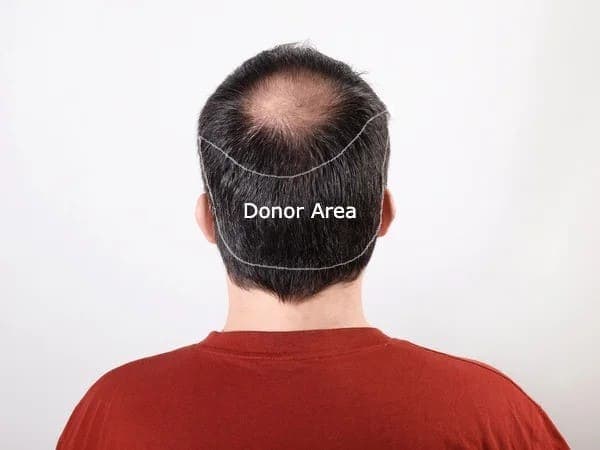
Donor numbness happens because surgery disrupts small cutaneous sensory nerves in the scalp's subcutaneous plane. Strip surgery cuts along a continuous incision, causing more extensive, longer-lasting numbness, while FUE's discrete punches cause patchier, milder loss of sensation. Local anaesthetic and tumescent fluid also cause temporary numbness on the day of surgery.
The scalp is supplied by small cutaneous sensory nerves running in the subcutaneous plane. Any surgery in the donor area disrupts some of them.
In strip surgery, a continuous horizontal incision crosses these nerves along its whole length, and the area above the incision is left with reduced sensation until the nerves regenerate. This is why strip numbness is typically more extensive and lasts longer.
In FUE, each punch is small and discrete, so nerve disruption is patchier and generally less severe. Numbness still occurs, often described as patchy areas of reduced or altered sensation across the harvested zone.
Local anaesthetic and tumescent fluid also produce numbness on the day, which is expected and separate from the surgical effect.
What does donor area numbness feel like after a hair transplant?
Donor area numbness can feel like muffled or distant touch, patchy numb areas (typical after FUE) or a band of reduced sensation above a strip scar (typical after FUT), tingling or pins and needles as nerves recover, itching that can be intense, and occasional brief shooting sensations as nerve fibres reconnect.
- Reduced sensation — touch feels muffled or distant.
- Numb patches with normal sensation between them, typical after FUE.
- A band of reduced sensation above a strip scar, typical after FUT.
- Tingling or pins and needles, which usually indicates nerves recovering.
- Itching, which is common during regeneration and can be intense.
- Occasional brief shooting sensations as nerve fibres reconnect.
What is the donor area numbness recovery timeline after a hair transplant?
Donor numbness follows a pattern: anaesthetic wears off on day one, sensation loss peaks during weeks one to four, gradual return occurs across months one to three (FUE mostly resolved), strip numbness mostly resolves by months three to twelve, and a small proportion retain permanently reduced sensation beyond twelve months, more often after strip surgery.
- Day 1. Anaesthetic effect wears off over hours; the surgical numbness underneath becomes apparent.
- Weeks 1-4. Numbness is at its most noticeable. Tightness after strip surgery is common in the same period.
- Months 1-3. Gradual return of sensation, often with tingling and itching as nerves regenerate. Most FUE numbness has substantially resolved.
- Months 3-12. Continued recovery. Most strip numbness resolves within this window.
- Beyond 12 months. A small proportion of patients retain a permanently reduced area of sensation, more often after strip surgery.
These are general patterns rather than guarantees, and individual recovery varies.
When is donor area numbness abnormal and needs medical attention?
Numbness alone is normal and needs no treatment, but contact the clinic if pain increases rather than fades, if redness, swelling, warmth or discharge appear (signs of infection), if numbness spreads instead of shrinking after the first weeks, or if severe persistent pain develops, since neuropathic pain is uncommon but reported and warrants review.
Numbness on its own, without other findings, is expected and does not require treatment.
What warrants contacting the clinic:
- Increasing pain rather than diminishing pain.
- Redness, swelling, warmth or discharge, which suggest infection.
- Numbness that is spreading rather than shrinking after the first weeks.
- Severe persistent pain, which is different from numbness and should be assessed.
Persistent neuropathic pain in the donor area is uncommon but reported, and it is a reason for review rather than for waiting it out.
How should I care for a numb donor area during recovery?
Protect a numb donor area by avoiding heat sources like hair dryers, hot water and sun exposure, since reduced sensation means you may not feel damage occurring. Avoid scratching despite common itching during nerve regeneration, expect recovery to be uneven across the area, and follow your clinic's washing schedule rather than judging by feel.
- Be careful with heat. Reduced sensation means reduced protection. Hair dryers, hot water and sun exposure can cause damage you do not feel at the time.
- Be careful with scratching. Itching during nerve regeneration is common and the healing donor area should not be scratched.
- Expect asymmetry. Recovery is rarely even across the whole area.
- Follow your clinic's washing schedule rather than judging by feel.
What questions should I ask my surgeon about donor area numbness before surgery?
Before surgery, ask how much numbness to expect with the proposed technique and for how long, what proportion of the surgeon's patients still report numbness at twelve months, how the answer changes if strip surgery is proposed, and who to contact if sensation is not returning as expected.
- How much numbness should I expect with the technique proposed, and for how long?
- What proportion of your patients report numbness at twelve months?
- If strip surgery is proposed, how does that change the answer?
- Who do I contact if sensation is not returning?
Sources
- Romera de Blas C, Vega Díez D, Ricart Vayá JM, Gómez Zubiaur A. Complications in follicular unit excision hair transplantation: current evidence and practical approaches. Frontiers in Medicine, 2026;13:1750989. pubmed.ncbi.nlm.nih.gov/41709896
- Rassman WR, Bernstein RM, McClellan R, Jones R, Worton E, Uyttendaele H. Follicular unit extraction: minimally invasive surgery for hair transplantation. Dermatologic Surgery, 2002;28(8):720-728. pubmed.ncbi.nlm.nih.gov/12174065
- Chauhan K, Tandon M, Kumar A, Taneja N, Hamid SAT. A comprehensive review of evolution of advanced follicular unit excision systems. Journal of Cutaneous and Aesthetic Surgery, 2025;18(2):69-77. pubmed.ncbi.nlm.nih.gov/40212421
- Parsley WM, Perez-Meza D. Review of factors affecting the growth and survival of follicular grafts. Journal of Cutaneous and Aesthetic Surgery, 2010;3(2). jcasonline.com
This article summarises published research and standard clinical practice. It is general educational information, not medical advice, and it does not replace the instructions your own surgical team gives you. Where their guidance differs from anything here, follow theirs.
Get a no-obligation assessment against fixed criteria, directly on WhatsApp.