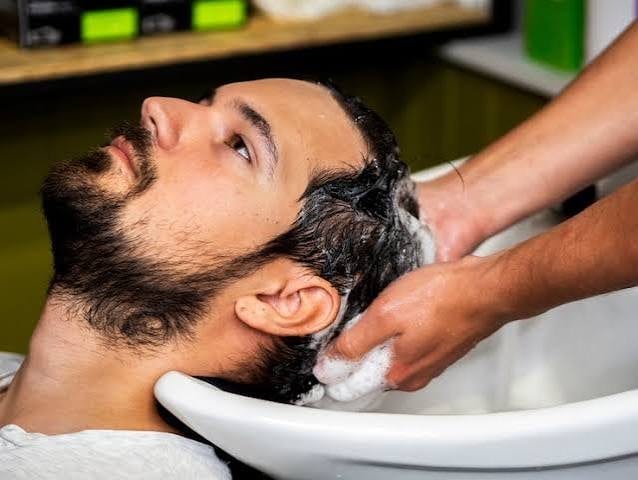
Washing and caring for the donor area
The donor area needs regular gentle washing from the point your clinic specifies.
The donor area needs regular gentle washing from the point your clinic specifies. Under-washing is the more common error and is associated with prolonged crusting and folliculitis; your clinic's protocol takes precedence over any general advice.
Why does donor area aftercare get less attention than the recipient area?
Donor aftercare gets neglected because post-operative instructions focus on the recipient area, where grafts can be dislodged in the first days — research on graft anchoring shows they are vulnerable early and secure by around day nine. The donor area lacks that urgency, but unlike a hairline, a badly healed donor area cannot be revised later.
Post-operative instructions concentrate almost entirely on the recipient area, for a good reason: grafts can be physically dislodged in the first days, so protecting them is urgent. Work on graft anchoring established that timetable clearly — grafts are vulnerable in the earliest days and secure by around day nine.
The donor area has no such urgency, so it receives less attention. But its appearance is permanent in a way the recipient result is not: a poorly designed hairline can be revised, and a badly healed donor area cannot.
What are the general principles for washing and caring for the donor area?
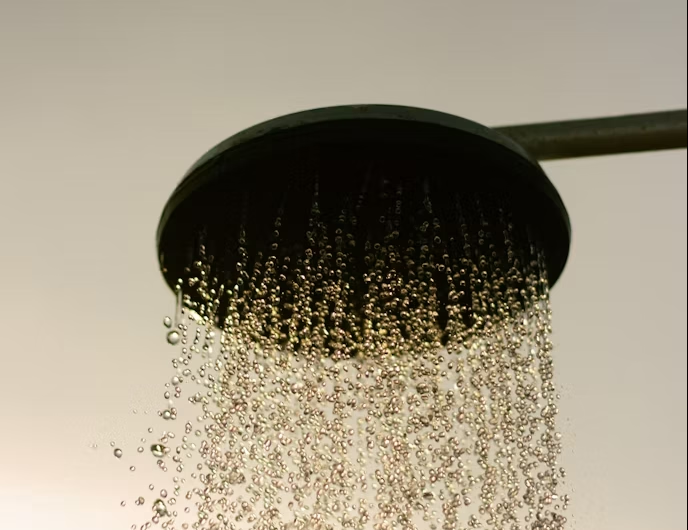
Your clinic's protocol takes precedence, but general principles include starting washing when told rather than being overly cautious (crusts left too long cause more folliculitis), washing gently but thoroughly, using the products you were given, lukewarm water at low pressure, patting rather than rubbing dry, and not scratching despite common itching.
Your clinic's specific protocol takes precedence over everything here, including the timings — clinics differ, and yours knows what was done to you.
- Start washing when told to. The commonest error is being too cautious. Crusts left in place longer than necessary are associated with more folliculitis and a slower settling.
- Be gentle but be thorough. The donor area needs the crusts to come off. Gentle repeated washing achieves that; timid dabbing does not.
- Use the products you were given rather than substituting.
- Lukewarm water, low pressure. Hot water and a strong shower stream are both unnecessary.
- Pat dry. Do not rub.
- No scratching. Itching in weeks two to six is common and is not a reason to scratch a healing donor area.
What should I avoid to protect the donor area after a hair transplant?
Avoid tight hats pressing on the donor area early on, sweating exercise until your clinic clears it (sweat and friction contribute to folliculitis), pools, saunas and hot tubs until cleared, direct sun (reduced sensation means you may not feel burning), clipping or shaving until told it is safe, and picking at anything.
Again, follow your clinic's timings. The general categories:
- Hats and headwear pressing on the donor area early on. Loose is better than tight, and your clinic will say when.
- Sweating exercise, which returns on a schedule your clinic sets. Sweat and friction contribute to folliculitis.
- Swimming pools, saunas, steam rooms and hot tubs until cleared.
- Direct sun on a healing donor area. Reduced sensation after extraction means you may not feel burning until damage is done.
- Clipping or shaving the donor area until you are told it is safe.
- Picking at anything. Crusts, spots, ingrown hairs — all of it.
How should I sleep to protect the donor area after a hair transplant?
For the first nights, sleep elevated to reduce both swelling and donor discomfort, sleep on your back where possible since lying on the donor area is uncomfortable, use a travel pillow if it helps you stay off the area, and use a clean pillowcase, changed frequently in the early weeks.
Lying on the donor area is uncomfortable and is not ideal for it. For the first nights:
- Sleep elevated, which reduces both swelling and donor discomfort.
- Sleep on your back where possible.
- A travel pillow helps some patients stay off the donor area.
- Use a clean pillowcase, changed frequently in the early weeks.
When should I contact the clinic about donor area problems during recovery?
Contact the clinic if pain increases rather than decreases after three days, if redness, warmth, swelling or discharge spreads, if you develop a fever, if crusts remain firmly attached well beyond the described window, if a firm lump develops, or if spots keep recurring in the same place.
- Increasing rather than decreasing pain after the first three days.
- Spreading redness, warmth, swelling or discharge.
- Fever.
- Crusts still firmly attached well beyond the window your clinic described.
- A firm lump developing in the donor area.
- Recurring spots in the same place over weeks.
Clinics deal with these constantly and would generally rather answer a message than see a problem develop.
How should I document the donor area during recovery from a hair transplant?
Photograph the donor area from behind at consistent hair length and lighting before surgery, then again at three, six and twelve months. This takes a minute each time and is the only objective record of the one part of the result you cannot see, turning future clinic conversations into evidence rather than recollection.
This sits within the wider washing routine described under aftercare.
Sources
- Bernstein RM, Rassman WR. Graft Anchoring in Hair Transplantation. Dermatologic Surgery, 2006;32(2):198-204. pubmed.ncbi.nlm.nih.gov/16442039
- Romera de Blas C, Vega Díez D, Ricart Vayá JM, Gómez Zubiaur A. Complications in follicular unit excision hair transplantation: current evidence and practical approaches. Frontiers in Medicine, 2026;13:1750989. pubmed.ncbi.nlm.nih.gov/41709896
- Giardiello F, De Medeiros Quirino L, Brigante R, Chumak M. Hyperbaric Oxygen Therapy for Enhanced Postoperative Recovery in Hair Transplantation. Cureus, 2025;17(12):e99635. doi.org/10.7759/cureus.99635
- Parsley WM, Perez-Meza D. Review of factors affecting the growth and survival of follicular grafts. Journal of Cutaneous and Aesthetic Surgery, 2010;3(2). jcasonline.com
- Fan Z, Gan Y, Qu Q, Wang J, Lunan Y, Liu B, Chen R, Hu Z, Miao Y. The effect of hyperbaric oxygen therapy combined with hair transplantation surgery for the treatment of alopecia. Journal of Cosmetic Dermatology, 2021;20(3):917-921. pubmed.ncbi.nlm.nih.gov/32770782
This article summarises published research and standard clinical practice. It is general educational information, not medical advice, and it does not replace the instructions your own surgical team gives you. Where their guidance differs from anything here, follow theirs.
Get a no-obligation assessment against fixed criteria, directly on WhatsApp.