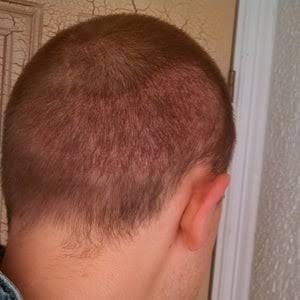
Donor area folliculitis and ingrown hairs
Small inflamed spots in the donor area are common in the weeks after extraction, usually from hairs struggling to emerge through healing skin.
Small inflamed spots in the donor area are common in the weeks after extraction, usually from hairs struggling to emerge through healing skin. Most settle without intervention; persistent or spreading inflammation should be seen by the clinic.
What does folliculitis in the donor area look like after a hair transplant?
Folliculitis in the donor area appears as small red or white-headed spots centred on hair follicles, sometimes tender, usually starting a couple of weeks after surgery and sometimes continuing for a few months. It is common enough to be considered ordinary post-operative course, alongside hypopigmentation, hypertrophic scarring, epithelial cysts and donor depletion as recognised complications.
Why does folliculitis happen in the donor area after FUE?
Donor folliculitis happens when regrowing hairs cannot break through firmer healing skin and curl back under the surface, provoking inflammation like an ordinary ingrown hair. Retained follicle fragments, crusting or heavy ointment blocking openings, bacteria entering disrupted follicles (especially after scratching), and sweat or friction from hats and exercise can all contribute.
- Hairs struggling to emerge. Healing skin over an extraction site can be firmer than normal skin. A regrowing hair that cannot break through curls back under the surface and provokes an inflammatory response — the same mechanism as an ordinary ingrown hair.
- Retained fragments. Where a follicle was transected, the remaining portion may continue to produce a hair that cannot emerge cleanly.
- Crusting and occlusion. Crusts left too long, or heavy ointment, can block follicular openings.
- Bacterial involvement. Ordinary skin flora entering disrupted follicles, particularly if the area is scratched.
- Sweat and friction. Hats, headwear and returning to exercise before the area has settled.
What should I do if I get folliculitis in the donor area?
The most important rule is not to squeeze or pick folliculitis spots, since this risks infection and can turn a self-limiting spot into a scar. Avoid digging out ingrown hairs, keep washing on the schedule you were given, try warm compresses if your clinic agrees, and report lesions so the clinic can assess them.
The instructions from your own clinic take precedence. As general principles:
- Do not squeeze or pick. This is the single most important point. Squeezing a lesion in a healing donor area risks introducing infection and can convert a self-limiting spot into a scar.
- Do not attempt to dig out an ingrown hair.
- Keep washing on the schedule you were given. Gentle, regular cleansing helps; skipping it because the area is tender does not.
- Warm compresses often help an individual lesion settle, if your clinic agrees.
- Report it. Clinics see this constantly and can tell you quickly whether what you have is ordinary or not.
When does donor area folliculitis need medical treatment?
Most folliculitis resolves on its own within days. Contact the clinic if lesions are spreading, if redness, warmth or swelling increases across an area, if there is significant pain or fever, if spots keep recurring in the same place, or if a firm lump develops. Treatment is typically topical or oral antibiotics, occasionally cyst drainage.
Most cases resolve on their own within days. Contact the clinic if:
- Lesions are spreading rather than settling.
- There is increasing redness, warmth or swelling across an area rather than at individual spots.
- There is significant pain.
- You have a fever.
- Lesions keep recurring in the same place over weeks, which can indicate a retained fragment or a cyst.
- A firm lump develops, which may be an epithelial cyst rather than folliculitis.
Treatment when needed is usually straightforward — topical or oral antibiotics, occasionally drainage of a cyst — and is a matter for the clinic or a doctor rather than self-management.
How can I prevent folliculitis in the donor area after a hair transplant?
Prevent donor folliculitis by following the washing protocol from the start, including the timing for crusts to clear, avoiding tight hats and headbands over the healing area, returning to sweating exercise only on your clinic's schedule, avoiding shaving or clipping the donor area until cleared, and keeping pillowcases clean in the early weeks.
- Follow the washing protocol from the start, including the timing of when crusts should be gone.
- Avoid tight hats and headbands over the healing donor area.
- Return to sweating exercise on the schedule your clinic sets, not earlier.
- Avoid shaving or clipping the donor area until you are told it is safe.
- Keep pillowcases clean in the early weeks.
Why does folliculitis matter more in the donor area than the recipient area?
In the recipient area, folliculitis is unpleasant but grafts are usually unaffected; in the donor area, inflammation and secondary infection around healing extraction sites can worsen scarring, since hypertrophic scarring is a documented donor complication. This is why picking matters — the donor area's final appearance is set during these weeks and cannot be revised later.
Ordinary donor healing is described in our aftercare guide.
Sources
- Romera de Blas C, Vega Díez D, Ricart Vayá JM, Gómez Zubiaur A. Complications in follicular unit excision hair transplantation: current evidence and practical approaches. Frontiers in Medicine, 2026;13:1750989. pubmed.ncbi.nlm.nih.gov/41709896
- Giardiello F, De Medeiros Quirino L, Brigante R, Chumak M. Hyperbaric Oxygen Therapy for Enhanced Postoperative Recovery in Hair Transplantation. Cureus, 2025;17(12):e99635. doi.org/10.7759/cureus.99635
- Fan Z, Gan Y, Qu Q, Wang J, Lunan Y, Liu B, Chen R, Hu Z, Miao Y. The effect of hyperbaric oxygen therapy combined with hair transplantation surgery for the treatment of alopecia. Journal of Cosmetic Dermatology, 2021;20(3):917-921. pubmed.ncbi.nlm.nih.gov/32770782
- Rassman WR, Bernstein RM, McClellan R, Jones R, Worton E, Uyttendaele H. Follicular unit extraction: minimally invasive surgery for hair transplantation. Dermatologic Surgery, 2002;28(8):720-728. pubmed.ncbi.nlm.nih.gov/12174065
This article summarises published research and standard clinical practice. It is general educational information, not medical advice, and it does not replace the instructions your own surgical team gives you. Where their guidance differs from anything here, follow theirs.
Get a no-obligation assessment against fixed criteria, directly on WhatsApp.