
Donor area pain and how long it lasts
Donor discomfort is usually worst in the first two or three days and settles over the first week or two.
Donor discomfort is usually worst in the first two or three days and settles over the first week or two. Strip surgery is generally more painful than FUE because of the closure, and tightness rather than sharp pain is the typical complaint.
What does donor area pain actually feel like after a hair transplant?
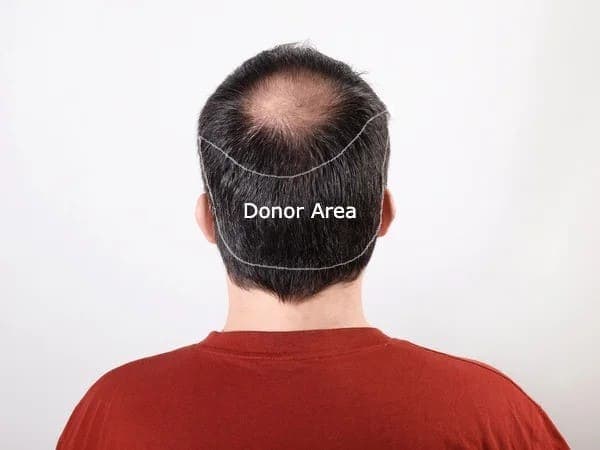
Donor area pain is usually more uncomfortable than the recipient area, which is numb then itchy. FUE typically causes diffuse soreness across the back and sides, worse on movement or lying down, and described as tight rather than sharp. Strip surgery causes more pronounced tightness from the closure pulling, with pain diminishing by day three.
The donor area is usually the more uncomfortable of the two surgical sites. The recipient area is numb, then itchy; the donor area is sore.
The common description after FUE is a diffuse soreness across the back and sides, worse on movement and when lying on it, with a tight or tender quality rather than sharp pain. After strip surgery, tightness is the dominant complaint — the sensation of the closure pulling — and it is generally more pronounced.
In the published case-report literature on post-operative recovery, pain scores are typically described as diminishing by around day three, which matches what most patients report.
What is the donor area pain timeline after a hair transplant?
Donor pain builds through the evening on the day of surgery as anaesthetic wears off, peaks during days one to three when sleeping is difficult, improves by days four to seven as crusts separate, leaves residual tightness (especially after strip surgery) with itching in weeks two to four, and resolves for most beyond a month.
- Day of surgery. Local anaesthetic wears off over several hours. Discomfort builds through the evening.
- Days 1-3. The peak. Soreness, tightness and tenderness are at their most noticeable. Sleeping is the practical problem, since lying on the donor area is uncomfortable.
- Days 4-7. Clear improvement in most patients. Crusts are separating and tenderness reduces.
- Weeks 2-4. Residual tightness, particularly after strip surgery. Itching often replaces soreness as nerves recover.
- Beyond a month. Most patients report no significant donor pain. Persistent pain beyond this point is not typical and should be reviewed.
Why is strip surgery more uncomfortable than FUE for the donor area?
Strip surgery is more uncomfortable because closing the wound requires tension that is felt continuously until healing progresses, often extending over a wide area and worsening with neck movement; patients with tighter scalps feel more discomfort. FUE punch sites are never closed or under tension, so discomfort is more diffuse and shorter-lived.
What helps with donor area pain after a hair transplant?
Pain management is the surgical team's responsibility, but measures include sleeping elevated to reduce swelling and discomfort, avoiding pressure on the donor area by sleeping on your back, taking prescribed analgesia on schedule rather than waiting for pain to build, keeping to the washing schedule, and avoiding neck strain from looking down at a phone.
Pain management after hair transplantation is your surgical team's responsibility and their instructions take precedence over anything here. In general terms:
- Sleeping elevated for the first nights, which also reduces swelling.
- Avoiding pressure on the donor area — sleeping on your back, and a travel pillow if that helps you stay off it.
- Taking prescribed analgesia on schedule in the first days rather than waiting for pain to build.
- Not skipping washing on the schedule you were given. Crusting left too long makes discomfort worse, not better.
- Avoiding neck strain — a large screen at eye level beats a phone looked down at for a week.
Aspirin and some anti-inflammatory medication may be restricted around surgery for bleeding reasons; follow the specific instructions you were given rather than assuming.
When should I contact the clinic about donor area pain?
Contact the clinic if donor pain increases rather than decreases after three days, if you notice redness, warmth, swelling or discharge, if you develop a fever, if severe pain is not controlled by prescribed analgesia, or if there is a specific point of intense pain rather than diffuse soreness — infection is uncommon but treatable.
- Pain increasing after the first three days rather than decreasing.
- Redness, warmth, swelling or discharge in the donor area.
- Fever.
- Severe pain not controlled by the analgesia you were prescribed.
- A specific point of intense pain rather than diffuse soreness.
Post-operative infection in the donor area is uncommon but treatable, and it is better identified early. Epithelial cysts and folliculitis are also recognised donor complications and can be tender.
What should I know about donor area pain before surgery?
Knowing in advance that donor discomfort is expected, peaks early and improves on a predictable schedule helps patients avoid mistaking ordinary day-two soreness for a complication. It is also worth planning around: the first three days are not the time to travel, do physical work, or be without your prescribed medication.
Sources
- Romera de Blas C, Vega Díez D, Ricart Vayá JM, Gómez Zubiaur A. Complications in follicular unit excision hair transplantation: current evidence and practical approaches. Frontiers in Medicine, 2026;13:1750989. pubmed.ncbi.nlm.nih.gov/41709896
- Giardiello F, De Medeiros Quirino L, Brigante R, Chumak M. Hyperbaric Oxygen Therapy for Enhanced Postoperative Recovery in Hair Transplantation. Cureus, 2025;17(12):e99635. doi.org/10.7759/cureus.99635
- Rassman WR, Bernstein RM, McClellan R, Jones R, Worton E, Uyttendaele H. Follicular unit extraction: minimally invasive surgery for hair transplantation. Dermatologic Surgery, 2002;28(8):720-728. pubmed.ncbi.nlm.nih.gov/12174065
- Parsley WM, Perez-Meza D. Review of factors affecting the growth and survival of follicular grafts. Journal of Cutaneous and Aesthetic Surgery, 2010;3(2). jcasonline.com
This article summarises published research and standard clinical practice. It is general educational information, not medical advice, and it does not replace the instructions your own surgical team gives you. Where their guidance differs from anything here, follow theirs.
Get a no-obligation assessment against fixed criteria, directly on WhatsApp.