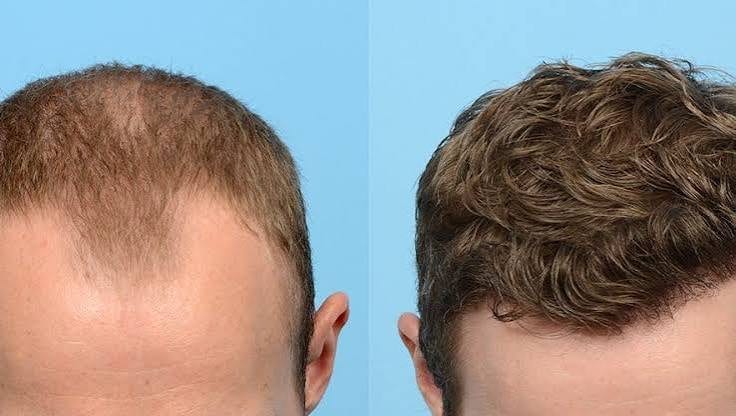
FUE and future hair loss: what it doesn't fix
A transplant moves resistant hair into a bald area.
A transplant moves resistant hair into a bald area. It does not stop the process causing the loss, so native hair around the grafts keeps thinning on its own schedule. Planning that fails to account for this produces results that unravel within years.
What does a hair transplant actually change?
A hair transplant relocates DHT-resistant follicles from the safe donor zone into a balding area, and those follicles keep their resistance, which is why transplanted hair persists. Nothing else changes: the susceptible native follicles around and between the grafts remain susceptible, and pattern hair loss continues in them.
What does unfixed native hair loss look like over time after an FUE transplant?
Left untreated, native hair loss around a transplant can leave a transplanted hairline persisting as an isolated band while the area behind it thins, a frontal zone with a widening bald gap behind it, a crown expanding around grafted hair, and a result that looked excellent at year one but incoherent by year seven.
- A transplanted hairline that persists while the area behind it thins, leaving an isolated band
- A treated frontal zone with a widening bald gap developing behind it
- A crown that expands outward around previously grafted hair
- A result that looked excellent at year one and incoherent at year seven
Why does future hair loss progression drive conservative transplant design?
A surgeon who places a low, dense hairline in a young patient without accounting for future progression creates a problem that will need more donor supply to fix, at a point when less of it remains. This is why surgeons wait until loss has stabilised, generally from the mid-twenties, and favour conservative hairlines.
What can be done to address ongoing native hair loss after an FUE transplant?
Five measures offset ongoing native loss around a transplant: medical treatment to slow it, standard alongside surgery; conservative design that still reads well as loss advances; reserved donor capacity for future sessions; staged planning rather than maximum coverage now; and honest projection of how the result will look at Norwood 6.
- Medical treatment to slow ongoing loss, which is why it is standard alongside surgery
- Conservative design that still reads well as loss advances
- Reserved donor capacity for future sessions
- Staged planning rather than maximum coverage now
- Honest projection of how the result looks at Norwood 6
Our review of low-dose oral Minoxidil and the non-surgical guide cover the medical side.
Sources
- Parsley WM, Perez-Meza D. Review of factors affecting the growth and survival of follicular grafts. Journal of Cutaneous and Aesthetic Surgery, 2010;3(2). jcasonline.com
This article summarises published research and standard clinical practice. It is general educational information, not medical advice, and it does not replace the instructions your own surgical team gives you. Where their guidance differs from anything here, follow theirs.
Get a no-obligation assessment against fixed criteria, directly on WhatsApp.