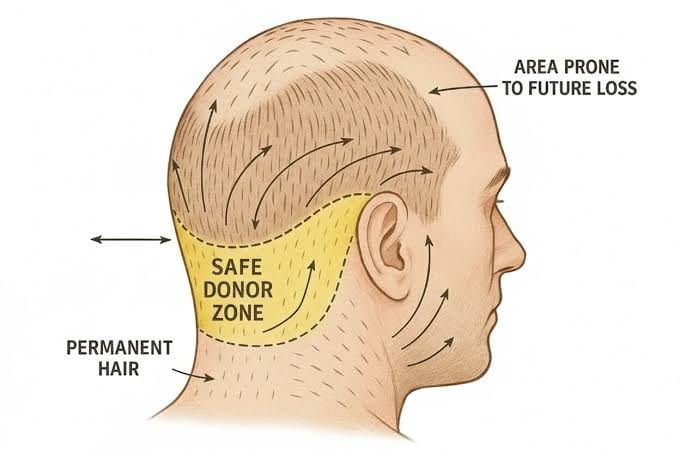
The safe donor zone, explained
The safe donor zone is the band of scalp at the back and sides where hair is largely resistant to DHT and so is expected to persist.
The safe donor zone is the band of scalp at the back and sides where hair is largely resistant to DHT and so is expected to persist. Taking grafts from outside it means transplanting hair that will thin later, and it is one of the more consequential errors a clinic can make.
Why does the safe donor zone exist?
The safe zone exists because pattern hair loss is driven by follicle sensitivity to dihydrotestosterone, and that sensitivity isn't uniform: follicles at the back and sides are largely resistant, which is why advanced loss leaves a horseshoe of hair. That resistance travels with a transplanted follicle, though it is more resistant, not immune.
Where is the safe donor zone located?
The safe donor zone is broadly a band across the occipital and lateral scalp, bounded above by where thinning progresses over time and below by the nape, where hair is less reliable. Its exact boundaries are individual, depending on your own pattern, family history and likely future progression, so assessment matters more than a diagram.
Why does taking hair from outside the safe zone fail?
Hair harvested from above the safe zone was going to be lost anyway; moved to the hairline, it thins on the same schedule and the result unravels over years. This is a particular risk in the young, whose eventual pattern isn't established yet, hence the guideline to wait until loss stabilises, from around the mid-twenties.
What should you ask about the safe donor zone at consultation?
Ask your clinic where exactly they will harvest from and how they determined your personal safe zone, what your measured donor density is there, how your family history affects that boundary, and how much can be taken now while still leaving capacity for a possible future session.
- Where exactly will you harvest from, and how did you determine my safe zone?
- What is my measured donor density there?
- How does my family history affect where you consider safe?
- How much can be taken now while leaving capacity for a future session?
Our guide to donor supply covers capacity in more detail.
Sources
- Parsley WM, Perez-Meza D. Review of factors affecting the growth and survival of follicular grafts. Journal of Cutaneous and Aesthetic Surgery, 2010;3(2). jcasonline.com
This article summarises published research and standard clinical practice. It is general educational information, not medical advice, and it does not replace the instructions your own surgical team gives you. Where their guidance differs from anything here, follow theirs.
Get a no-obligation assessment against fixed criteria, directly on WhatsApp.