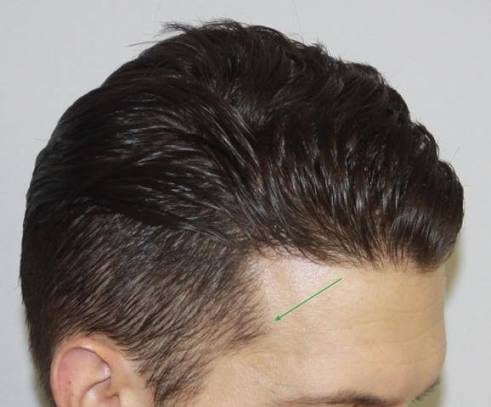
Rebuilding temple points
Temple points frame the face and their loss ages the appearance more than most people expect.
Temple points frame the face and their loss ages the appearance more than most people expect. They are also among the hardest areas to transplant well, because the hair is fine, the angle is extremely flat and the direction is unforgiving.
Why do the temple points matter in a hair transplant?
Temple points are the small triangular projections of hair at the sides of the forehead that frame the face and connect the hairline to the sideburn. When they recede, the face reads as longer and older even with an intact central hairline, so restoring them can change appearance more than the graft count suggests.
Why are temple points difficult to transplant?

Temple points are difficult because the hair lies at an extremely flat angle almost against the skin, is finer than scalp hair so coarse grafts look wrong, and requires single grafts only since multi-hair units show as tufts. Direction also changes across the small area, sweeping down and back, over thin skin with visible vessels.
- Extremely flat angle. Temple hair lies almost against the skin.
- Fine hair. Native temple hair is finer than scalp hair; coarse grafts look wrong.
- Single grafts only. Multi-hair units are immediately visible as tufts.
- Direction changes across a small area, sweeping down and back.
- Thin skin and visible vessels in the region.
How should temple point restoration be planned?
Planning uses single-hair grafts exclusively, ideally the finest donor hair available, positioned conservatively since over-built temples look artificial and age badly. Symmetry is checked carefully, because the face is not naturally symmetric, and the surgeon weighs whether the central hairline should take priority for limited donor supply.
- Single-hair grafts exclusively, ideally the finest available donor hair
- Conservative positioning; over-built temples look artificial and age badly
- Symmetry checked carefully, since the face is not naturally symmetric
- Consideration of whether the central hairline is a higher priority for limited donor supply
What results should patients expect from temple point restoration?
Temple work usually involves a few hundred grafts per side and is fussy rather than large. The result depends almost entirely on execution, since the same graft count can look excellent or obviously transplanted depending on angling, so ask to see previous temple work in a surgeon's portfolio, photographed close up.
Sources
- Parsley WM, Perez-Meza D. Review of factors affecting the growth and survival of follicular grafts. Journal of Cutaneous and Aesthetic Surgery, 2010;3(2). jcasonline.com
This article summarises published research and standard clinical practice. It is general educational information, not medical advice, and it does not replace the instructions your own surgical team gives you. Where their guidance differs from anything here, follow theirs.
Get a no-obligation assessment against fixed criteria, directly on WhatsApp.