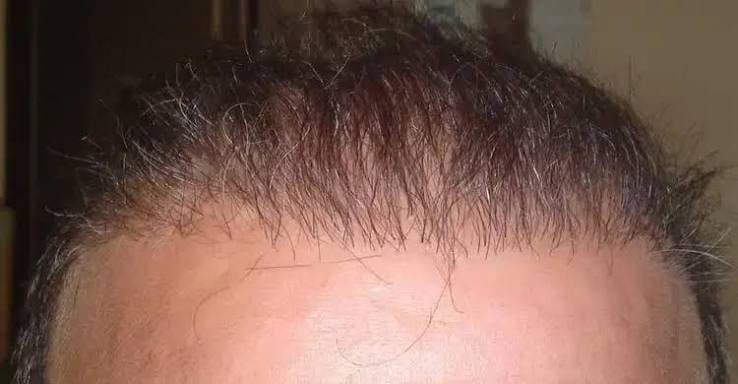
What a poor FUE result looks like and why
Poor results have recognisable signatures: wrong angles, straight hairlines, multi-hair grafts at the leading edge, depleted donor areas and density that does not match the plan.
Poor results have recognisable signatures: wrong angles, straight hairlines, multi-hair grafts at the leading edge, depleted donor areas and density that does not match the plan. Most trace back to decisions made before surgery rather than to bad luck.
What are the design failures that make an FUE result look poor?
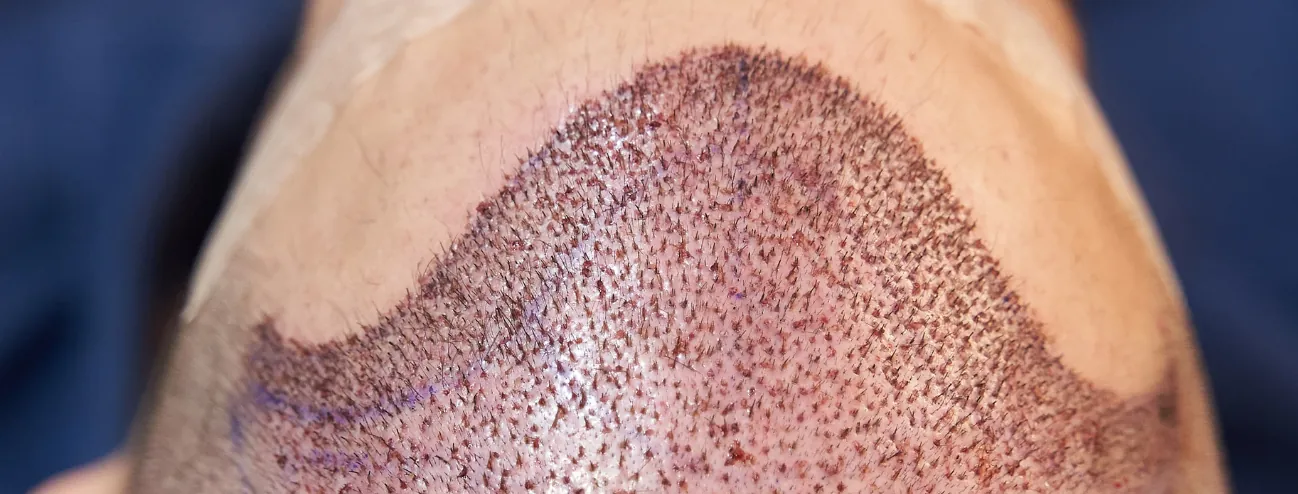
Design failures include a straight hairline, the most immediate giveaway since natural hairlines are irregular; a hairline set too low, which looks increasingly wrong as loss progresses; multi-hair grafts at the leading edge, producing a tufted, pluggy look; no transition zone, so density starts abruptly; and poor temple design or asymmetry.
- A straight hairline, the most immediate giveaway; natural hairlines are irregular
- A hairline set too low, which looks increasingly wrong as loss progresses
- Multi-hair grafts at the leading edge, producing a tufted, pluggy look
- No transition zone, so density starts abruptly
- Poor temple design or asymmetry
What technical failures cause a poor FUE result?
Technical failures include wrong angles, with hair standing up rather than lying down; a missing or reversed crown whorl; grafts placed too deep, causing pitting or cysts; grafts placed too shallow, leaving them raised; and uneven density that leaves visible patches.
- Wrong angles, hair standing up rather than lying down
- A missing or reversed crown whorl
- Grafts placed too deep, causing pitting or cysts
- Grafts too shallow, leaving them raised
- Uneven density, with visible patches
What causes yield failures in an FUE result?
Sparse growth despite a high quoted graft count usually points to transection during extraction, handling damage, long out-of-body time, dehydration or poor recipient sites, none of which are visible on the day; they only become apparent around twelve months. Over-harvesting shows as generalised, permanent thinning across the donor area at the back and sides.
What can be corrected in a poor FUE result?
Density can usually be added if donor supply remains. Wrong angles require removing and replacing grafts, which is difficult and costly. A hairline set too low can sometimes be raised by removing grafts. Donor depletion, however, cannot be reversed, leaving camouflage as the only option.
- Density can usually be added if donor supply remains
- Angles require removing and replacing grafts, which is difficult and costly
- A too-low hairline can sometimes be raised by removing grafts
- Donor depletion cannot be reversed; camouflage is the only option
Our repair guide covers what is realistically fixable.
Sources
- Parsley WM, Perez-Meza D. Review of factors affecting the growth and survival of follicular grafts. Journal of Cutaneous and Aesthetic Surgery, 2010;3(2). jcasonline.com
This article summarises published research and standard clinical practice. It is general educational information, not medical advice, and it does not replace the instructions your own surgical team gives you. Where their guidance differs from anything here, follow theirs.
Get a no-obligation assessment against fixed criteria, directly on WhatsApp.