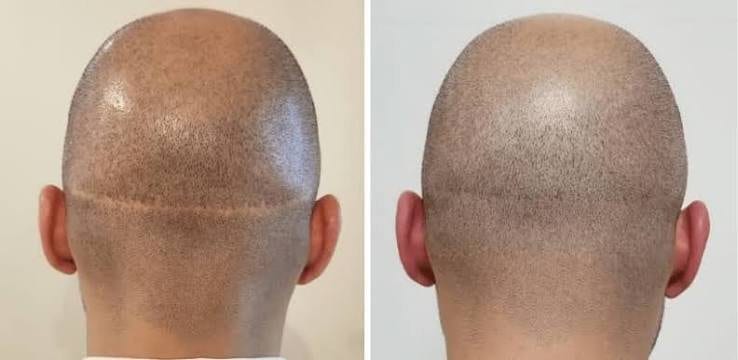
Scar visibility years after FUE or FUT
Scars reach their final appearance within the first year and change little afterwards.
Scars reach their final appearance within the first year and change little afterwards. What changes is the hair around them — so a scar that was invisible at year one can become visible at year ten purely through donor thinning.
Do hair transplant scars get worse over time?
No, hair transplant scars themselves do not get worse: they reach final size, shape and colour within roughly twelve months and then stay fixed. What changes over the following decades is the hair covering them — donor density declines with age and further sessions remove more, both reducing the camouflage that hid the scar.
This is the point that surprises patients. A donor scar — whether an FUT line or thousands of FUE dots — reaches its final size, shape and colour within roughly twelve months and then stays as it is.
What changes over the following decades is the hair covering it. Donor density declines slowly with age. Further sessions remove more. Both reduce the camouflage that made the scarring invisible at year one.
So the correct answer to 'will my scars get worse over time' is: the scars will not, but they may become more visible. That is a different mechanism with the same experience.
How do FUT strip scars change over time?
An FUT strip scar's long-term look is set largely by how it healed in the first year: a fine line stays fine and stays hidden under hair of moderate length indefinitely, while a stretched scar stays stretched, and years of sun exposure or age-related donor thinning can make it more visible later.
A strip scar's long-term appearance is largely set by how it healed in the first year — whether it stayed a fine line or stretched into a wider band under tension.
- A fine, well-healed line remains fine. It stays invisible under hair of moderate length essentially indefinitely.
- A stretched scar stays stretched. Stretching happens in the first months and does not reverse.
- Sun exposure over years can make a hypopigmented scar more conspicuous, since scar tissue does not tan with the surrounding skin. This is worth knowing for anyone who wears their hair short outdoors.
- Donor thinning with age reduces the cover over the line.
A second strip taken later, which is common in staged plans, also uses up scalp laxity and can affect how the earlier scar sits.
How do FUE dot scars change over time?
Individual FUE dot scars are stable, but their visibility isn't, because it depends on surrounding hair density: age-related donor thinning, further sessions that add dots while removing hiding hair, retrograde thinning at donor borders, and sun exposure all increase visibility over time, sometimes changing what hair length can hide them.
Individual dots are stable. Their collective visibility is not, because it depends on the density of the hair between them.
- Age-related donor thinning gradually reduces the hair covering the dots.
- Further sessions add more dots to the same area while removing more of the hair that hides them — the two effects compound.
- Retrograde thinning at the lower and lateral donor borders, where it occurs, exposes dots in the most visible parts of the donor zone.
- Sun exposure increases contrast between hypopigmented dots and surrounding skin over years.
The practical consequence is that a patient who could clip to a number two at year one may not be able to at year fifteen, without anything having gone wrong.
Why does sun protection matter for hair transplant scars?
Sun protection matters because scar tissue doesn't pigment like normal skin, so repeated sun exposure over years increases contrast between a hypopigmented scar and tanned surrounding skin; patients with short hair should protect the donor area with a hat or sunscreen, since reduced sensation after FUE can mean burning goes unfelt.
Scar tissue does not pigment like normal skin. Repeated sun exposure over years increases the contrast between a hypopigmented scar and the tanned skin around it, and it can also cause the scar tissue itself to change texture.
For patients who wear their hair short, this argues for sun protection over the donor area — a hat outdoors, or sunscreen on a shaved scalp. It is a small habit with a cumulative effect over decades.
There is an additional reason for it after FUE: reduced sensation in the donor area is common after extraction and can persist, which means you may not feel burning until damage is done.
What can you do if hair transplant scar visibility becomes a problem?
Options if scar visibility becomes a problem include scalp micropigmentation (reduces contrast, works at short lengths, but needs tattoo maintenance and harder colour matching as you grey), grafting into a strip scar to break up the line (lower graft survival, spends donor reserve), growing the hair longer, or scar revision for genuinely wide strip scars.
- Scalp micropigmentation reduces the contrast and works at short hair lengths. It costs no donor supply, which matters if yours is already spent. It is a tattoo and needs maintenance, and colour matching becomes harder as you grey.
- Grafting into a strip scar can break up the line, with the caveat that survival in scar tissue is generally lower and it spends donor reserve.
- Growing the hair longer, which is what most patients settle on.
- Scar revision, for genuinely wide strip scars in lax scalps, with an experienced surgeon.
Sources
- Romera de Blas C, Vega Díez D, Ricart Vayá JM, Gómez Zubiaur A. Complications in follicular unit excision hair transplantation: current evidence and practical approaches. Frontiers in Medicine, 2026;13:1750989. pubmed.ncbi.nlm.nih.gov/41709896
- Rassman WR, Bernstein RM, McClellan R, Jones R, Worton E, Uyttendaele H. Follicular unit extraction: minimally invasive surgery for hair transplantation. Dermatologic Surgery, 2002;28(8):720-728. pubmed.ncbi.nlm.nih.gov/12174065
- Jimenez F, Ruifernández JM. Distribution of human hair in follicular units. A mathematical model for estimating the donor size in follicular unit transplantation. Dermatologic Surgery, 1999;25(4):294-298. pubmed.ncbi.nlm.nih.gov/10417585
- Kim J, Ko YU, Yi KH. The condition of hair follicles produced by different punching methods during FUE surgery. Journal of Cosmetic Dermatology, 2024;23(12):4202-4207. pubmed.ncbi.nlm.nih.gov/39152658
- Maas D, et al. Rethinking the occipital scalp as a control in advanced androgenetic alopecia. Journal of the American Academy of Dermatology, 2026 (ahead of print). pubmed.ncbi.nlm.nih.gov/42398778
This article summarises published research and standard clinical practice. It is general educational information, not medical advice, and it does not replace the instructions your own surgical team gives you. Where their guidance differs from anything here, follow theirs.
Get a no-obligation assessment against fixed criteria, directly on WhatsApp.