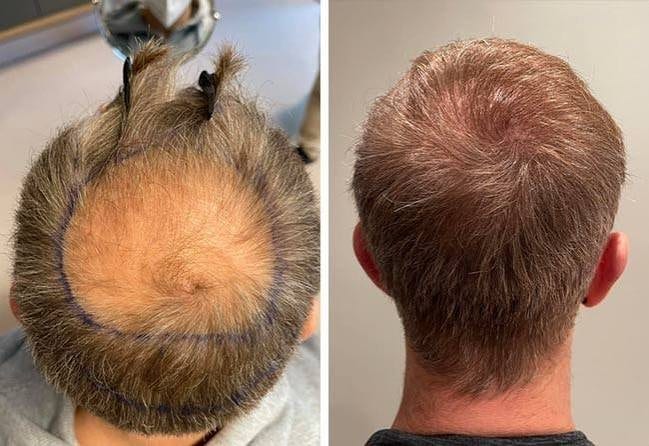
Graft implantation angle and natural results
Angle and direction do more for a natural result than density does.
Angle and direction do more for a natural result than density does. Hair leaves the scalp at a specific angle that varies by region, and grafts placed against that pattern look wrong however many of them there are.
Why does implantation angle matter so much?
Angle matters because hair lies down in a direction, letting light reflect along it while neighbouring hairs support each other for the appearance of coverage. Hairs at inconsistent angles scatter light and read as artificial even at good density, and since the recipient site sets the angle, the graft has no choice but to follow.
How does implantation angle vary by scalp region?
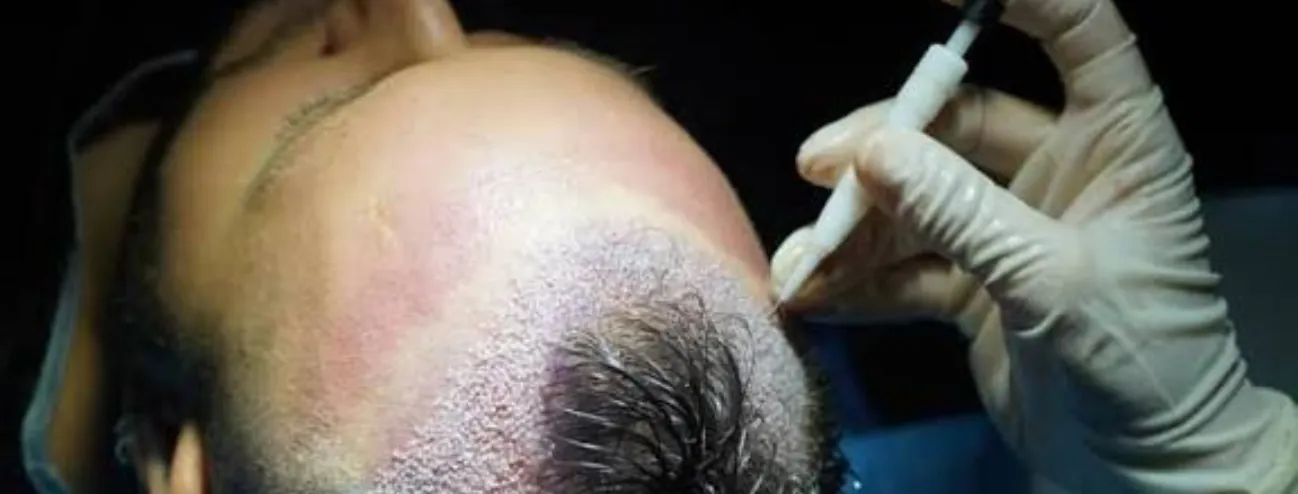
Implantation angle varies by region: the frontal hairline is acute, close to flat and pointing forward; the mid-scalp is moderately angled, generally forward and slightly lateral; the temples are extremely flat, pointing down and back, among the hardest areas to get right; and the crown needs a spiral whorl reconstructed rather than filled uniformly.
- Frontal hairline: very acute, close to flat against the skin, pointing forward
- Mid-scalp: moderately angled, generally forward and slightly lateral
- Temples: extremely flat, pointing down and back; among the hardest areas to get right
- Crown: a spiral whorl that must be reconstructed rather than filled uniformly
What does poor implantation angling look like?
Poor angling shows up as hair standing up rather than lying down, a doll-like or plugged appearance despite individual grafts, a hairline that looks drawn on rather than grown, a crown with no whorl or one spiralling the wrong way, and hair that will not style in any direction.
- Hair standing up rather than lying down
- A doll-like or plugged appearance despite individual grafts
- A hairline that looks drawn on rather than grown
- A crown with no whorl, or one spiralling the wrong way
- Hair that will not style in any direction
Why can't a wrong implantation angle be fixed later?
A wrong implantation angle can't be fixed later because angle is set permanently at the moment the recipient site is made, and no styling, product or treatment changes the direction a follicle emerges from the scalp. Correcting it means excising or removing the misplaced grafts and redoing the work entirely.
That is why repair surgery exists, and why this is worth getting right the first time.
Sources
- Parsley WM, Perez-Meza D. Review of factors affecting the growth and survival of follicular grafts. Journal of Cutaneous and Aesthetic Surgery, 2010;3(2). jcasonline.com
This article summarises published research and standard clinical practice. It is general educational information, not medical advice, and it does not replace the instructions your own surgical team gives you. Where their guidance differs from anything here, follow theirs.
Get a no-obligation assessment against fixed criteria, directly on WhatsApp.