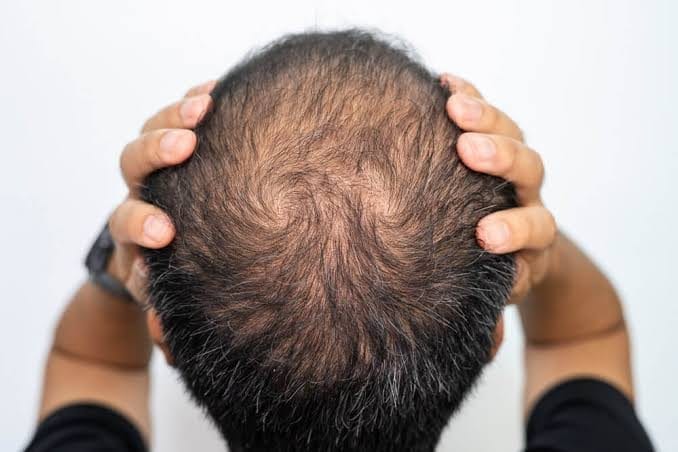
Why the crown is harder to restore
The crown is a large, curved area with a spiral growth pattern, and it consumes grafts faster than any other region while continuing to expand as loss progresses.
The crown is a large, curved area with a spiral growth pattern, and it consumes grafts faster than any other region while continuing to expand as loss progresses. Many surgeons deprioritise it deliberately, and that is usually sound advice rather than a limitation.
Why must the crown's spiral whorl be reconstructed rather than filled?
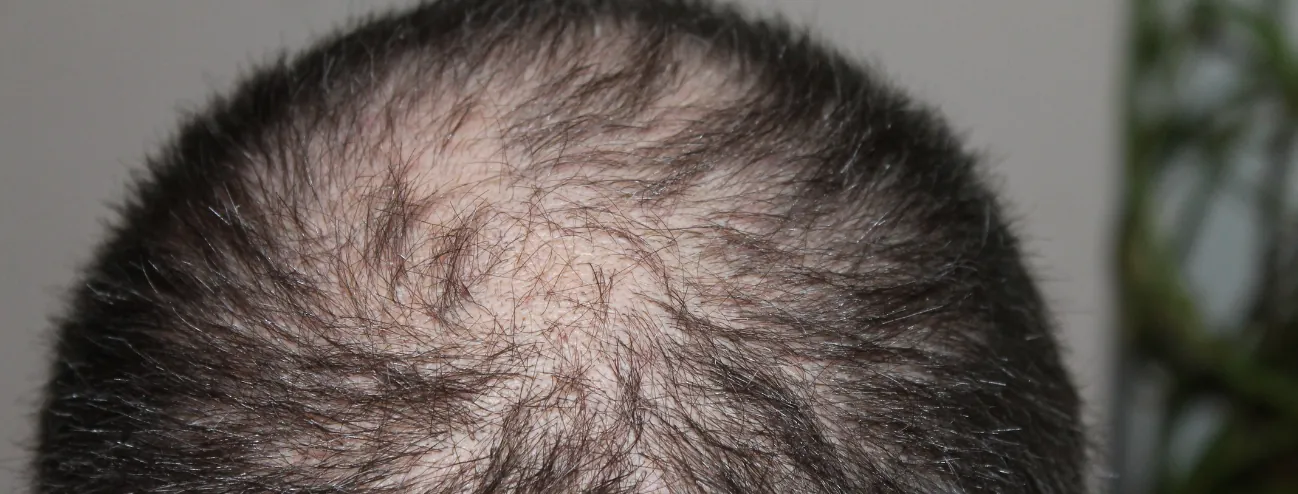
Crown hair grows in a spiral radiating from a central point, so the angle and direction change continuously across the area and a surgeon must rebuild that spiral rather than plant a uniform field. Done poorly, the crown looks flat and directionless, and no amount of density fixes it.
Why does the crown's geometry make it harder to cover?
The crown is a convex surface seen from above and behind, where light falls directly and scalp shows through more readily than the flatter frontal region, needing more density for the same visual effect. It does not frame the face, so grafts spent there buy less perceived improvement than the same grafts at the hairline.
Why is crown loss a moving target for surgical planning?
Crown loss typically expands outward over years, so a crown filled at thirty-five can end up surrounded by a widening bald ring at forty-five that looks worse than an untreated crown and needs further grafts to correct. This is the strongest argument for deferring crown work, particularly in younger patients.
What is a sensible strategy for crown hair loss?
A sensible strategy prioritises the hairline and mid-scalp, which frame the face, considers medical treatment to stabilise the crown before grafting it, and accepts partial coverage that creates an impression of density rather than full restoration. It also reserves donor capacity for future expansion and may add scalp micropigmentation as a lower-cost complement.
- Prioritise the hairline and mid-scalp, which frame the face
- Consider medical treatment to stabilise the crown before grafting it
- Accept partial coverage that creates an impression of density rather than full restoration
- Reserve donor capacity for future expansion
- Discuss scalp micropigmentation as a lower-cost complement
Our crown transplant guide covers this in more depth.
Sources
- Parsley WM, Perez-Meza D. Review of factors affecting the growth and survival of follicular grafts. Journal of Cutaneous and Aesthetic Surgery, 2010;3(2). jcasonline.com
This article summarises published research and standard clinical practice. It is general educational information, not medical advice, and it does not replace the instructions your own surgical team gives you. Where their guidance differs from anything here, follow theirs.
Get a no-obligation assessment against fixed criteria, directly on WhatsApp.