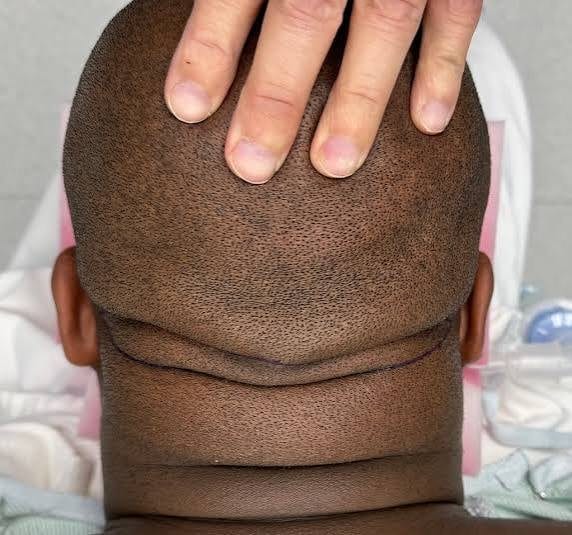
Scalp laxity and its effect on FUT donor yield
Scalp laxity determines how wide a strip can be taken and closed without tension.
Scalp laxity determines how wide a strip can be taken and closed without tension. Low laxity limits FUT yield and raises the risk of a stretched scar; it is largely irrelevant to FUE.
What is scalp laxity, and why does it matter for strip surgery?
Scalp laxity is how much the scalp moves over the skull: a lax scalp slides readily, a tight one barely moves, and it varies substantially between individuals. In follicular unit transplantation it is a hard constraint on yield, since the strip removed must be closed without tension, and strip width depends on available slack.
Why is closing a strip scar under tension the main risk in strip surgery?
A strip scar closed under tension tends to stretch as the wound edges are pulled apart while healing, producing a band several millimetres wide instead of a fine line. This is the main, irreversible failure mode of strip surgery. A surgeon facing a tight scalp should take a narrower strip and accept a smaller yield.
A strip scar that is closed under tension tends to stretch. The wound edges are pulled apart continuously as it heals, and instead of a fine line the result is a wider band — sometimes several millimetres, occasionally more.
A stretched scar is the main cosmetic failure mode of strip surgery, and it is largely irreversible. It can be improved somewhat with scar revision or camouflaged with micropigmentation or grafting into it, but it cannot be returned to a fine line.
This means a surgeon assessing a tight scalp has a choice: take a narrower strip and accept a smaller graft yield, or take the width they want and accept the scar risk. The first is correct. Patients pushing for a large single-session number are pushing toward the second.
How is scalp laxity assessed before strip surgery?
Laxity is judged at consultation: the surgeon moves the donor scalp up and down and side to side by hand, estimating the excursion, sometimes with a formal scale but usually by experienced judgement. It also changes with previous surgery, since each strip removed and closed reduces remaining slack, yielding progressively narrower strips on later procedures.
Laxity is judged manually at consultation. The surgeon places a hand on the donor area and moves the scalp up and down and side to side, estimating the excursion. Some use formal scales; most rely on experienced judgement.
It is also relevant that laxity changes with previous surgery. Each strip removed and closed reduces the remaining slack, which is why second and third strip procedures yield progressively narrower strips and why there is a limit to how many can be done.
Some surgeons recommend scalp exercises before strip surgery to increase laxity. Whether these produce a meaningful change is not well established, and they should be discussed with the surgeon rather than started on the basis of forum advice.
Why doesn't scalp laxity limit FUE the way it limits strip surgery?
FUE does not require closure — each punch site heals by secondary intention, with no wound edge under tension, so laxity is not a meaningful constraint on yield. For a patient with a tight scalp, this is an advantage. FUE yield is instead limited by density and how much extraction the donor area can absorb.
Follicular unit excision does not require closure. Each punch site heals by secondary intention, and there is no wound edge under tension. Laxity is therefore not a meaningful constraint on FUE yield.
This is one of the genuine advantages of FUE that is not marketing: for a patient with a tight scalp, FUE removes a constraint that would materially limit strip yield.
It is worth noting that the constraint does not disappear — it is replaced by a different one. FUE yield is limited by density and by how much extraction the donor area can absorb without visible thinning, which is a different ceiling but a ceiling nonetheless.
What else does scalp laxity affect besides strip width?
Tighter scalps generally cause more post-operative discomfort after strip closure, and tension may contribute to the numbness that commonly, and usually temporarily, follows strip surgery. Laxity also affects future options: a scalp already tightened by one strip has less slack to give for a second, which shapes how a staged multi-session plan is designed.
- Donor-area tightness after surgery. Patients with tighter scalps generally report more discomfort after strip closure.
- Numbness. Donor-area numbness after strip surgery is common and usually temporary, and tension may contribute.
- Future options. A scalp already tightened by a previous strip has less to give for a second, which affects how a staged plan is designed.
What questions should I ask if strip surgery (FUT) is proposed?
Before agreeing to strip surgery (FUT), ask about your scalp's laxity and the strip width it supports, the expected yield at your density, the surgeon's closure technique with twelve-month scar photographs, whether room remains for a second strip later, and whether FUE might give a better yield given your laxity.
- How lax is my scalp, and what strip width does that support?
- What yield does that width give at my density?
- What is your scar closure technique, and can I see twelve-month scar photographs?
- Does this leave room for a second strip later, or is this the only one?
- Would FUE give me a better yield given my laxity?
Sources
- Rassman WR, Bernstein RM, McClellan R, Jones R, Worton E, Uyttendaele H. Follicular unit extraction: minimally invasive surgery for hair transplantation. Dermatologic Surgery, 2002;28(8):720-728. pubmed.ncbi.nlm.nih.gov/12174065
- Romera de Blas C, Vega Díez D, Ricart Vayá JM, Gómez Zubiaur A. Complications in follicular unit excision hair transplantation: current evidence and practical approaches. Frontiers in Medicine, 2026;13:1750989. pubmed.ncbi.nlm.nih.gov/41709896
- Jimenez F, Ruifernández JM. Distribution of human hair in follicular units. A mathematical model for estimating the donor size in follicular unit transplantation. Dermatologic Surgery, 1999;25(4):294-298. pubmed.ncbi.nlm.nih.gov/10417585
- Chauhan K, Tandon M, Kumar A, Taneja N, Hamid SAT. A comprehensive review of evolution of advanced follicular unit excision systems. Journal of Cutaneous and Aesthetic Surgery, 2025;18(2):69-77. pubmed.ncbi.nlm.nih.gov/40212421
This article summarises published research and standard clinical practice. It is general educational information, not medical advice, and it does not replace the instructions your own surgical team gives you. Where their guidance differs from anything here, follow theirs.
Get a no-obligation assessment against fixed criteria, directly on WhatsApp.