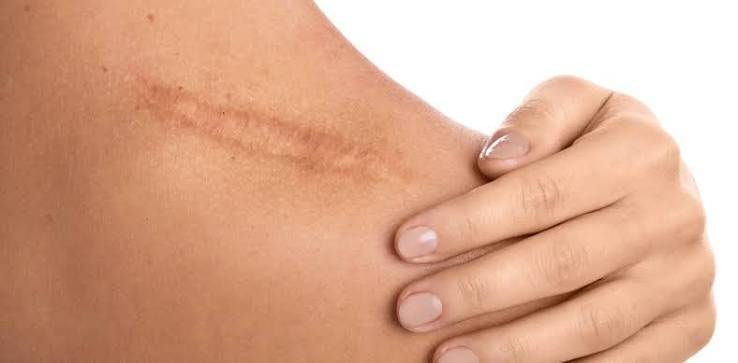
Long-term sun damage to the donor scar
Scar tissue does not pigment like normal skin, so repeated sun exposure over years increases the contrast between hypopigmented scars and tanned skin.
Scar tissue does not pigment like normal skin, so repeated sun exposure over years increases the contrast between hypopigmented scars and tanned skin. It is one of the few donor-area variables a patient controls after surgery.
Why do donor scars become more visible in sunlight over time?

Both FUE dot scars and FUT strip scars typically heal paler than surrounding skin because the tissue contains fewer functioning melanocytes, a documented donor-area complication. Since normal skin tans but scar tissue largely does not, sun exposure widens the contrast, so a donor area uniform in winter can look visibly stippled after a summer outdoors.
Both FUE dot scars and FUT strip scars typically heal slightly paler than the surrounding skin, because the healed tissue contains fewer functioning melanocytes. Hypopigmentation at extraction sites is documented among the recognised donor-area complications of follicular unit excision.
The practical consequence emerges in sunlight. Normal skin tans; scar tissue largely does not. So sun exposure darkens the surrounding scalp while leaving the scars pale, and the contrast between them increases.
A donor area that looked uniform indoors after a winter can look visibly stippled after a summer of outdoor work, without any change in the scars themselves.
What is the long-term cumulative effect of sun exposure on donor scars?
Sun-related scar contrast builds slowly over decades: repeated exposure increases visibility, especially in patients who wear their hair short and spend time outdoors, and chronic ultraviolet exposure can also change scar texture. Photoageing affects overall scalp skin quality, and skin cancer risk is higher on a chronically sun-exposed scalp with no hair covering it.
This is a slow process and its significance is cumulative rather than dramatic.
- Contrast increases with repeated exposure, and the effect is most pronounced in patients who both wear their hair very short and spend substantial time outdoors.
- Scar tissue can change texture with chronic ultraviolet exposure, becoming more conspicuous in its own right.
- Photoageing of the surrounding scalp affects skin quality over decades, which interacts with age-related donor thinning.
- Skin cancer risk on a chronically sun-exposed scalp is a general dermatological concern, and it is higher on a scalp that no longer has hair covering it.
Why is sun protection especially important for the donor area after a transplant?
Reduced sensation in the donor area after extraction is common, and in a minority of patients — more often after strip surgery — some numbness persists long-term. This matters because you may not feel a scalp burning until it has already happened, muting the usual warning signal exactly where tissue is vulnerable.
How can you protect the donor scar area from long-term sun damage?
Cover the donor area with a hat, the simplest and most effective measure, and apply sunscreen to a closely clipped scalp. Take particular care in the first year, when healing tissue is most vulnerable, and in high-UV settings such as altitude, water, snow or the tropics.
- Cover it. A hat is the simplest and most effective measure, and it is what most patients settle on.
- Sunscreen on a closely clipped or shaved scalp, reapplied — the donor area included, not just the top.
- Particular care in the first year, when healing tissue is more vulnerable and sensation is most reduced.
- Care in high-UV settings — altitude, water, snow, and the tropics.
- Have your scalp checked as part of ordinary skin surveillance if you spend a lot of time outdoors, particularly if you are fair-skinned.
Your clinic's specific post-operative timing on sun exposure takes precedence over general advice in the first weeks.
What can be done if donor scar contrast has already become visible?
Scalp micropigmentation is the most effective option, reducing contrast directly without using any donor supply; growing the hair longer and applying consistent sun protection from now on also help, though protection only stops further widening rather than reversing existing contrast. Greying helps over the long run, since lower hair-skin contrast makes pale scars less visible.
The options are the ones that apply to any visible donor scarring.
- Scalp micropigmentation, which reduces the contrast directly and costs no donor supply. It is the most effective intervention for this specific problem.
- Growing the hair longer.
- Consistent sun protection from now on, which stops the contrast widening further even though it does not reverse what has happened.
It is worth noting that greying works in your favour here over the long run: lower hair-skin contrast reduces the visibility of pale scars, which partly offsets the effect of accumulated sun exposure.
Sources
- Romera de Blas C, Vega Díez D, Ricart Vayá JM, Gómez Zubiaur A. Complications in follicular unit excision hair transplantation: current evidence and practical approaches. Frontiers in Medicine, 2026;13:1750989. pubmed.ncbi.nlm.nih.gov/41709896
- Rassman WR, Bernstein RM, McClellan R, Jones R, Worton E, Uyttendaele H. Follicular unit extraction: minimally invasive surgery for hair transplantation. Dermatologic Surgery, 2002;28(8):720-728. pubmed.ncbi.nlm.nih.gov/12174065
- Jimenez F, Ruifernández JM. Distribution of human hair in follicular units. A mathematical model for estimating the donor size in follicular unit transplantation. Dermatologic Surgery, 1999;25(4):294-298. pubmed.ncbi.nlm.nih.gov/10417585
- Kim J, Ko YU, Yi KH. The condition of hair follicles produced by different punching methods during FUE surgery. Journal of Cosmetic Dermatology, 2024;23(12):4202-4207. pubmed.ncbi.nlm.nih.gov/39152658
- Maas D, et al. Rethinking the occipital scalp as a control in advanced androgenetic alopecia. Journal of the American Academy of Dermatology, 2026 (ahead of print). pubmed.ncbi.nlm.nih.gov/42398778
This article summarises published research and standard clinical practice. It is general educational information, not medical advice, and it does not replace the instructions your own surgical team gives you. Where their guidance differs from anything here, follow theirs.
Get a no-obligation assessment against fixed criteria, directly on WhatsApp.