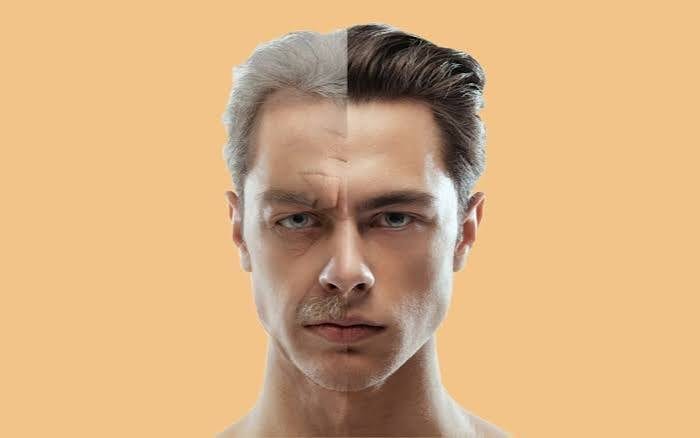
How aging skin affects graft appearance
Scalp skin thins and loses elasticity with age, which subtly changes how grafts sit and how scarring reads.
Scalp skin thins and loses elasticity with age, which subtly changes how grafts sit and how scarring reads. The effects are gradual and modest, and lower hair-scalp contrast from greying generally offsets them.
How does scalp skin change with age?
Aging scalp skin undergoes the same changes as skin elsewhere: the dermis thins with reduced collagen, elasticity and laxity decline, vascularity in the dermal plexus falls, chronic sun exposure causes photoageing, and pigmentary changes such as solar lentigines and mottling alter the skin's background tone.
Skin ageing affects the scalp as it affects everywhere else, though it is less discussed because hair usually covers it.
- Thinning of the dermis and reduced collagen.
- Loss of elasticity, which reduces scalp laxity and affects how the skin sits over the skull.
- Reduced vascularity in the dermal plexus.
- Photoageing in chronically sun-exposed areas, particularly relevant to men who have worn their hair short for decades.
- Pigmentary changes — solar lentigines and mottling, which alter the background against which hair is seen.
How does aging skin affect a transplanted hair result?
Aging skin has real but modest effects on transplanted results: it can slightly shift the angle hair exits the scalp, make existing scars — especially strip scars — marginally more visible, make old pitting or cobblestoning more noticeable, and change background skin contrast. None of these effects makes grafts fail.
The effects are real but modest, and none of them makes grafts fail.
- Exit angle. As skin thins and loses tone, the angle at which hair exits the surface can shift slightly. Over decades this is imperceptible in most patients.
- Scar appearance. Thinner, less elastic skin can make existing scars slightly more apparent, particularly a strip scar.
- Skin texture around grafts. Pitting or cobblestoning from older techniques can become marginally more visible as surrounding skin changes.
- Background contrast. Age-related pigmentary mottling changes what the scalp looks like between hairs.
There is no published long-term study of any of this in transplanted patients, which is worth stating: it follows from general dermatology plus clinical experience.
What matters more than skin aging for how a transplant looks after twenty years?
Three factors matter more than skin aging for how a transplant looks at twenty years: native hair loss around the grafts, the single largest driver of change; age-related thinning of donor and transplanted hair; and greying, which lowers hair-scalp contrast and generally improves apparent density.
It would be misleading to present skin ageing as a major determinant of how a transplant looks at twenty years. Three other things dominate it comfortably.
- Native hair loss around the grafts. The single largest driver of a changing result.
- Age-related hair thinning in both donor and transplanted hair — reduced calibre and density independent of androgenetic alopecia.
- Greying, which lowers hair-scalp contrast and generally improves apparent density.
That third one is worth emphasising, because it works against the others. A grey-haired man with moderate density and slightly aged scalp skin frequently looks better covered than a dark-haired man with the same follicle count.
What are the surgical implications of a hair transplant in older patients?
In older patients, thinner and less elastic scalp skin behaves differently under an extraction punch and reduces strip yield, healing is slower in both donor and recipient areas, strip closure quality and scar width are affected by lower elasticity, and moderate rather than maximum density is the more suitable target.
- Extraction handling. Thinner, less elastic skin behaves differently under a punch, and reduced laxity constrains strip yield.
- Slower healing, in both donor and recipient areas.
- Closure quality in strip surgery is affected by reduced elasticity, which bears on scar width.
- Moderate density targets. A natural, moderate result suits an older face; maximum density does not.
What is the one thing patients can do about aging scalp skin?
Sun protection is the one modifiable factor: photoageing is cumulative, worsens skin quality and scar appearance, and raises skin cancer risk on a hair-thinned scalp. It matters especially after FUE, since reduced donor-area sensation can delay noticing sunburn. A hat or sunscreen on a closely clipped scalp is a decades-long payoff.
Sources
- Romera de Blas C, Vega Díez D, Ricart Vayá JM, Gómez Zubiaur A. Complications in follicular unit excision hair transplantation: current evidence and practical approaches. Frontiers in Medicine, 2026;13:1750989. pubmed.ncbi.nlm.nih.gov/41709896
- Maas D, et al. Rethinking the occipital scalp as a control in advanced androgenetic alopecia. Journal of the American Academy of Dermatology, 2026 (ahead of print). pubmed.ncbi.nlm.nih.gov/42398778
- Rassman WR, Bernstein RM, McClellan R, Jones R, Worton E, Uyttendaele H. Follicular unit extraction: minimally invasive surgery for hair transplantation. Dermatologic Surgery, 2002;28(8):720-728. pubmed.ncbi.nlm.nih.gov/12174065
- Jimenez F, Ruifernández JM. Distribution of human hair in follicular units. A mathematical model for estimating the donor size in follicular unit transplantation. Dermatologic Surgery, 1999;25(4):294-298. pubmed.ncbi.nlm.nih.gov/10417585
- Parsley WM, Perez-Meza D. Review of factors affecting the growth and survival of follicular grafts. Journal of Cutaneous and Aesthetic Surgery, 2010;3(2). jcasonline.com
This article summarises published research and standard clinical practice. It is general educational information, not medical advice, and it does not replace the instructions your own surgical team gives you. Where their guidance differs from anything here, follow theirs.
Get a no-obligation assessment against fixed criteria, directly on WhatsApp.