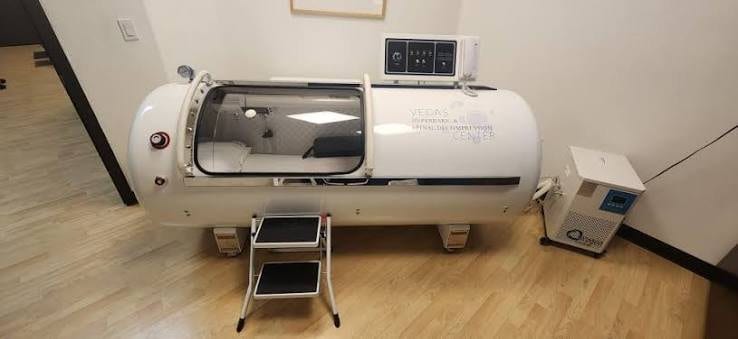
HBOT and reduced post-op swelling
Reduced swelling is one of the most commonly advertised benefits of post-transplant HBOT, but it is not what the published trial measured.
Reduced swelling is one of the most commonly advertised benefits of post-transplant HBOT, but it is not what the published trial measured. The trial found less itching and folliculitis and less early shedding; oedema was not its reported endpoint.
Did published HBOT research actually measure reduced post-op swelling?
No — the published HBOT hair-transplant research never reported oedema as an outcome. Fan's randomised trial measured early shedding, itching, folliculitis and nine-month survival; Giardiello's five-patient case report measured scab clearance, 97-99% graft integration, 2.8-day average recovery and pain scores. Swelling claims are extrapolated, not measured.
Reduced post-operative swelling is one of the most frequently advertised benefits of hyperbaric oxygen after a hair transplant. It is easy to see why: forehead and periorbital oedema is the most visible early complication, it peaks around days two to four, and a treatment that promised to prevent it would be genuinely attractive.
The difficulty is that the published clinical research on HBOT in hair transplantation did not report oedema as an outcome. Fan and colleagues' randomised trial reported early shedding rate, itching, folliculitis and survival at nine months. Giardiello and colleagues' five-patient case report described scab clearance within three to five days, graft integration of 97-99%, recovery time averaging 2.8 days and pain scores diminishing by day three.
So when a clinic tells you HBOT reduces swelling, they are not citing a measured result from the hair-transplant literature. They may be extrapolating from a mechanism, from general hyperbaric practice, or from their own uncontrolled observation.
Is there a plausible mechanism for HBOT reducing post-transplant swelling?
Yes — oedema is inflammatory, and Dong and Jin proposed HBOT's benefit may be anti-inflammatory, citing reduced IL-6, IL-12p40, MIP-1β and PDGF-BB expression; Thom's review describes HBOT modulating inflammatory signalling. The Fan trial's fall in itching and folliculitis (inflammatory endpoints) offers indirect support, but this remains a hypothesis, not a finding.
The mechanistic case is genuinely coherent, which is why this article is not simply a debunking.
Post-operative oedema is an inflammatory phenomenon. Dong and Jin, responding to the Fan trial, proposed that part of the benefit observed there may be anti-inflammatory, citing work on hyperbaric oxygen reducing the local expression of inflammatory factors including IL-6, IL-12p40, MIP-1β and PDGF-BB. Thom's review likewise describes hyperbaric oxygen acting through reactive species that modulate inflammatory signalling rather than simply improving oxygen delivery.
There is also indirect support in what the trial did measure. Itching and folliculitis are inflammatory endpoints, and both fell substantially in the HBOT group. A treatment that reduces post-operative inflammatory complications might well reduce inflammatory swelling too.
That is a reasonable hypothesis. It is not a finding.
What actually causes swelling after a hair transplant?
Post-transplant swelling is driven mainly by tumescent fluid volume infiltrated into the scalp, which gravity carries forward and down; larger sessions and more recipient sites increase it further. Head position (sleeping elevated), peri-operative steroid use and individual variation also affect how much a patient swells — factors ordinary post-operative care already manages.
It is worth putting the potential contribution in proportion, because oedema after a hair transplant has well-understood drivers that are already managed by ordinary post-operative care.
- Tumescent fluid volume. Large amounts of anaesthetic and tumescent solution are infiltrated into the scalp. Gravity carries it forward and down over the following days.
- Session size. Bigger sessions mean more recipient sites, more infiltration and more swelling.
- Head position. Sleeping elevated for the first few nights is the single most effective practical measure.
- Steroid use. Some surgeons use a short peri-operative corticosteroid course specifically to limit oedema.
- Individual variation. Some patients swell markedly and some barely at all with the same procedure.
Against that background, an adjunct would have to produce a substantial effect to be noticeable, and no study has measured whether it does.
Does the Cureus case report prove HBOT reduces swelling or speeds recovery?
No — the five-patient Cureus case report had no control group. It found scabs clearing in three to five days, 2.8-day average recovery, pain diminishing by day three and no complications, but without a comparison group none of those numbers can be attributed to HBOT rather than uncomplicated recovery generally.
The Cureus case report is the closest thing to supporting evidence for a comfort benefit, and it should be read for what it is. Five male patients, all treated with HBOT, no control group. Scabs cleared in three to five days, average recovery time was 2.8 days, pain diminished by day three, and no complications occurred.
Without a control group, none of those numbers can be attributed to the HBOT. Scabs clear, pain diminishes and patients recover after uncomplicated hair transplants without any adjunct at all. A case series describes what happened to five people; it cannot establish what caused it.
Is reduced swelling a good reason to pay for HBOT after a hair transplant?
No — swelling reduction is the commonly advertised HBOT benefit with the least direct trial support. What the trial did show — much less early shedding and roughly a third the itching/folliculitis rate — is real, but even those measured effects produced no statistically significant nine-month survival difference (96.9% versus 93.8%).
If reduced swelling is the reason you are considering paying for HBOT, you should know that it is the one commonly advertised benefit with the least direct support in the published literature. The trial did not measure it.
What the trial did find — much less early shedding, and roughly a third the rate of itching and folliculitis — is a real and patient-relevant result, and it is a better reason to consider the treatment than a swelling claim nobody has tested.
And the frame from that trial still applies. Even the effects that were measured did not translate into a statistically significant difference in nine-month survival: 96.9% with HBOT against 93.8% without. Whatever HBOT does for the first fortnight, the published evidence does not show it changing the twelve-month result.
Sources
- Fan Z, Gan Y, Qu Q, Wang J, Lunan Y, Liu B, Chen R, Hu Z, Miao Y. The effect of hyperbaric oxygen therapy combined with hair transplantation surgery for the treatment of alopecia. Journal of Cosmetic Dermatology, 2021;20(3):917-921. pubmed.ncbi.nlm.nih.gov/32770782
- Giardiello F, De Medeiros Quirino L, Brigante R, Chumak M. Hyperbaric Oxygen Therapy for Enhanced Postoperative Recovery in Hair Transplantation. Cureus, 2025;17(12):e99635. doi.org/10.7759/cureus.99635
- Dong X, Jin X. The effect of hyperbaric oxygen therapy combined with hair transplantation surgery for the treatment of alopecia [letter to the editor]. Journal of Cosmetic Dermatology, 2021. doi.org/10.1111/jocd.14131
- Thom SR. Hyperbaric oxygen: its mechanisms and efficacy. Plastic and Reconstructive Surgery, 2011;127 Suppl 1:131S-141S. pubmed.ncbi.nlm.nih.gov/21200283
This article summarises published research and standard clinical practice. It is general educational information, not medical advice, and it does not replace the instructions your own surgical team gives you. Where their guidance differs from anything here, follow theirs.
Get a no-obligation assessment against fixed criteria, directly on WhatsApp.