Iron deficiency and hair loss medication
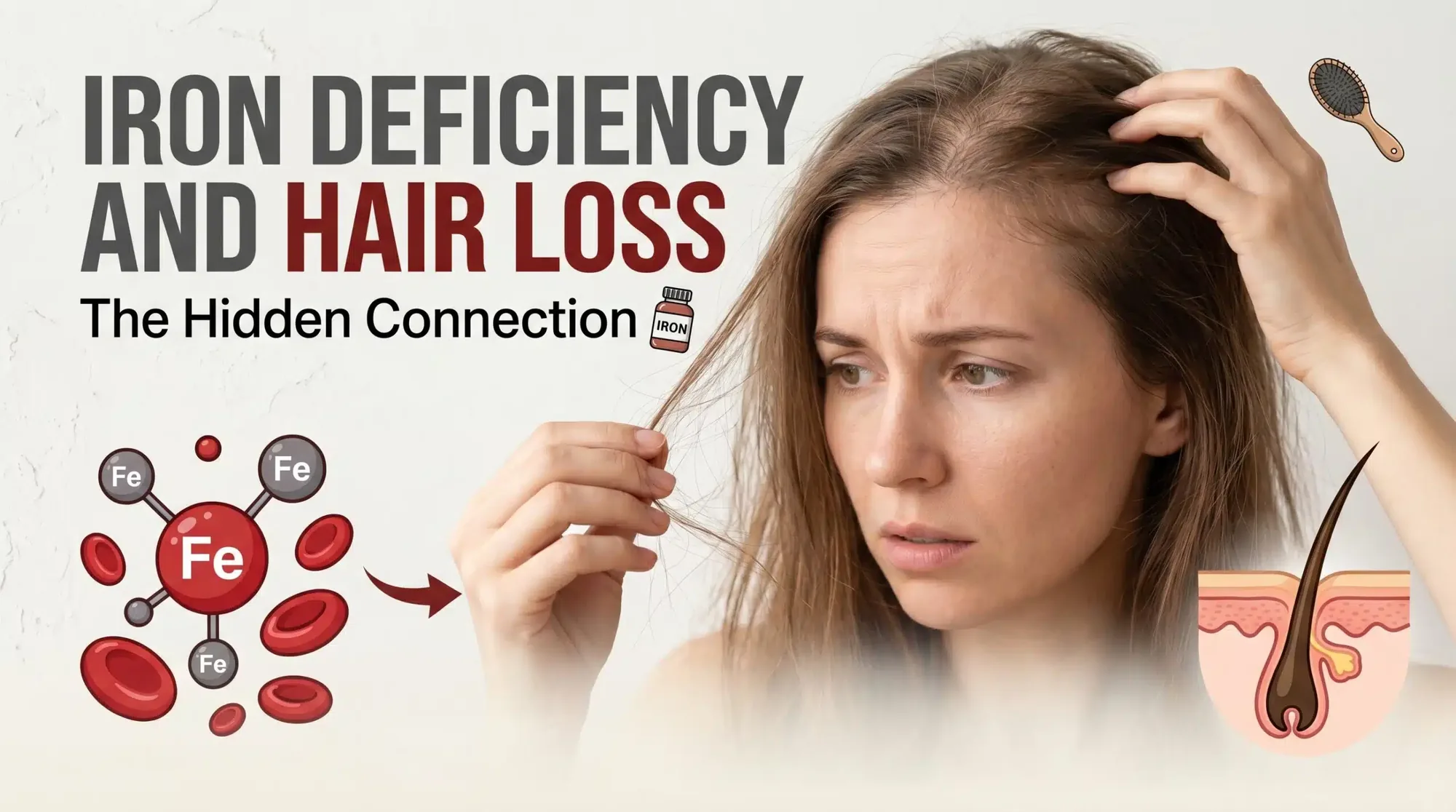
Iron deficiency is a genuine and treatable cause of hair shedding, particularly in women.
Iron deficiency is a genuine and treatable cause of hair shedding, particularly in women. It should be tested for rather than assumed, because supplementing iron you do not need is not benign.
Why does iron deficiency affect hair growth?
Hair follicles are among the body's most metabolically active tissues and depend on iron for their cellular machinery, so when iron stores fall the body prioritises essential functions and hair production suffers. The typical presentation is diffuse shedding rather than patterned loss, often described as telogen effluvium.
How should iron deficiency be tested for hair loss?
Testing for iron deficiency needs ferritin, not just a full blood count, since haemoglobin can look normal while iron stores are depleted. Ferritin reflects stored iron but rises with inflammation, which can mask deficiency. Clinicians treating hair loss often want ferritin well above the anaemia threshold, though that threshold is not universally agreed.
Why shouldn't you supplement iron without a confirmed deficiency?
Supplementing iron without confirmed deficiency is risky: overload is harmful since the body cannot efficiently excrete excess iron, gastrointestinal side effects are common, it can mask the real cause and delay diagnosis, it interacts with absorption of other medications, and unexplained deficiency needs investigating rather than simply treating the level.
- Iron overload is harmful, and the body has no efficient route to excrete excess
- Gastrointestinal side effects are common
- It can mask the real cause, delaying diagnosis
- Absorption interactions with other medications
- Unexplained deficiency needs investigating, since the cause may matter more than the level
Does correcting iron deficiency treat androgenetic alopecia?
Correcting iron deficiency addresses that specific cause but does not treat androgenetic alopecia, which has a different mechanism; someone can have both conditions, and treating one will not resolve the other. Establish the diagnosis before attributing hair loss to pattern baldness, particularly in women.
Our guide to hair loss in women covers the work-up.
Sources
- Treister-Goltzman Y, Yarza S, Peleg R. Iron Deficiency and Nonscarring Alopecia in Women: Systematic Review and Meta-Analysis. Skin Appendage Disorders, 2022;8(2):83-92. pubmed.ncbi.nlm.nih.gov/35415182
- Trost LB, Bergfeld WF, Calogeras E. The diagnosis and treatment of iron deficiency and its potential relationship to hair loss. Journal of the American Academy of Dermatology, 2006;54(5):824-844. pubmed.ncbi.nlm.nih.gov/16635664
- Zhang D, LaSenna C, Shields BE. Serum Ferritin Levels: A Clinical Guide in Patients With Hair Loss. Cutis, 2023;112(2):62-67. pubmed.ncbi.nlm.nih.gov/37820340
- Ganz T. Systemic iron homeostasis. Physiological Reviews, 2013;93(4):1721-1741. pubmed.ncbi.nlm.nih.gov/24137020
- Tolkien Z, Stecher L, Mander AP, Pereira DI, Powell JJ. Ferrous sulfate supplementation causes significant gastrointestinal side-effects in adults: a systematic review and meta-analysis. PLoS One, 2015;10(2):e0117383. pubmed.ncbi.nlm.nih.gov/25700159
- Liwanpo L, Hershman JM. Conditions and drugs interfering with thyroxine absorption. Best Practice & Research Clinical Endocrinology & Metabolism, 2009;23(6):781-792. pubmed.ncbi.nlm.nih.gov/19942153
- Almohanna HM, Ahmed AA, Tsatalis JP, Tosti A. The Role of Vitamins and Minerals in Hair Loss: A Review. Dermatology and Therapy, 2019;9(1):51-70. pubmed.ncbi.nlm.nih.gov/30547302
This article summarises published research. It is general educational information, not medical advice, and it is not a recommendation to start, stop or change any medication. Prescription drugs carry contraindications and interactions; discuss them with a doctor who knows your medical history.
Get a no-obligation assessment against fixed criteria, directly on WhatsApp.