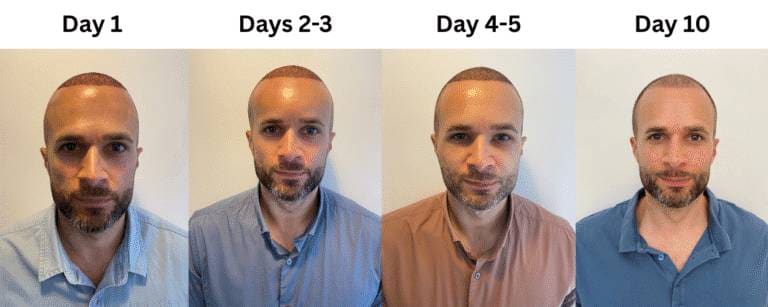
Day-by-day healing timeline, days 1-14
What happens on the scalp in the two weeks that decide how much of your transplant survives.
The first fortnight after a transplant is the only period when a graft can still be physically lost. Research on graft anchoring found that pulling a hair dislodged the graft for the first two days, that adherent crusts could still take a graft through day five, that by day six pulling a hair no longer dislodged it, and that by day nine grafts were no longer at risk. Everything patients are told about washing, sleeping and exercise is built on that timetable.
Why do the first two weeks after a hair transplant matter so much?
A newly placed graft has no blood supply and is held only by clotting and surrounding tissue, so it can still be pulled out. Bernstein and Rassman studied 42 patients, pulling on grafts at intervals to find when they could no longer be dislodged, and that research underpins the post-operative care timetable clinics use.
A transplanted follicle is not attached to anything when it is placed. It sits in a small incision, held by clotting and by the tightness of the surrounding tissue, and it has no blood supply of its own until the scalp grows one for it. Until that happens, the graft can be pulled out.
Most post-operative instructions exist for that reason. There is a measurable window in which physical force can remove grafts, and a point after which it cannot.
That window has been measured. Bernstein and Rassman studied 42 patients, deliberately pulling on grafts at intervals after surgery to establish when they could no longer be dislodged. The answers below come from that work, and the practical timetable most clinics use is built on it.
What happens to hair grafts on days 0 to 2 after a transplant?
In the anchoring study, pulling on a transplanted hair during the first two days always dislodged the graft, making this the period of strictest care: no touching the area, no tight hats, no towel-drying. The recipient area looks raw and pink, crusts begin forming within about 24 hours, and forehead swelling has not started yet.
In the anchoring study, pulling on a transplanted hair during the first two days always resulted in a lost graft.
This is the period of absolute care. No touching the recipient area, no hats that pull on or press into the grafts, no sleeping face-down, no towel-drying. Any force applied to a hair in this window transfers directly to a follicle that has nothing holding it in place.
What you will see
The recipient area looks raw and pink, with tiny points of dried blood forming around each graft. Crusts begin to form within about 24 hours. The donor area, whether punched or sutured, is typically more uncomfortable than the recipient area at this stage.
Swelling
Forehead swelling has usually not started yet. It tends to appear later, which surprises people who expect the worst on day one.
Why are crusts the main risk to hair grafts on days 3 to 5?
By days three to five, grafts have begun attaching, but pulling an adherent scab can still cost a graft, since the crust is bonded to the follicle beneath it. Gentle washing usually starts in this window to soften crusts safely, while swelling from anaesthetic fluid typically peaks around days two to four.
By this point the grafts have begun to attach, but the study found a specific hazard that outlasts the obvious one: pulling on an adherent scab still cost a graft through day five.
Most patients miss this. Yanking a hair is obviously dangerous; picking at a crust is less obviously so, and it stays dangerous for longer, because the crust is bonded to the graft beneath it and lifting one lifts the other.
Gentle washing usually begins somewhere in this window on most clinic protocols, precisely because softening crusts is safer than letting them harden and then catch on a pillow or a collar.
Swelling peaks
Forehead and sometimes eyelid swelling typically appears around days two to four and settles over the following few days. It is the result of fluid from the anaesthetic and the procedure tracking downward under gravity, which is why it moves from the hairline toward the brow rather than staying where the work was done.
Are hair grafts safe from days 6 to 8 after transplant surgery?
By day six, pulling on a hair no longer dislodges the graft as the follicle binds into surrounding tissue, but crusts remain present and bonded, so washing should stay gentle rather than vigorous. The recipient area typically looks less inflamed, and donor-area sensation may be reduced, usually resolving over weeks to months.
The anchoring study found that by day six, pulling on a hair no longer dislodged the graft. The follicle has begun to bind into the surrounding tissue.
That is a meaningful threshold, but it is not the end of the window. Crusts are still present and still bonded, and they are still the mechanism by which grafts come out. Washing continues to be gentle and deliberate rather than vigorous.
Most people find the recipient area is now less angry-looking, with redness fading unevenly. Sensation in the donor area may be reduced or odd; that is normal and usually resolves over weeks to months.
When are hair transplant grafts no longer at risk of falling out?
At nine days after surgery, research found grafts were no longer at risk of being dislodged, marking the end of physical vulnerability for the transplant. This covers mechanical loss only; it does not mean healing is complete, since redness, sweating limits, sun exposure and infection risk are separate concerns with their own timetables.
What does healing look like on days 10 to 14 after a hair transplant?
By days ten to fourteen, crusts formed early on typically shed, taking the visible transplanted hair shaft with them; this is expected shedding, not graft loss, since the follicle stays in place. By two weeks, the recipient area is usually pink with little crusting, the donor area is surface-healed, and swelling has resolved.
Crusts that formed in the first days generally shed between days seven and fourteen, taking the visible stubble of the transplanted hair shaft with them. By the end of the second week most scalps are largely clear of crusting.
Losing those hairs is expected and is not graft loss. The visible shaft sheds; the follicle stays. What follows is a dormant phase before new growth begins, which is covered in our guide to aftercare and recovery.
What normal looks like at two weeks
- Recipient area pink or slightly red, no crusting or only traces
- Most or all transplanted shafts shed
- Donor area healed at the surface, possibly still numb or tight
- Swelling resolved
What symptoms after a hair transplant should prompt a call to the clinic?
Contact your clinic rather than waiting if you notice increasing redness, heat or pain instead of steady improvement, pus or crusting that returns after clearing, fever, spreading or late-onset swelling, or a graft visibly coming out, especially in the first week. Infection after a transplant is uncommon but time-sensitive.
The timetable above describes uncomplicated healing. Some things are not part of it and should be reported rather than waited out:
- Increasing redness, heat or pain after the first few days, rather than steadily decreasing
- Pus, or crusting that returns after clearing
- Fever
- Spreading swelling, or swelling that appears late rather than early
- A graft that has visibly come out, especially in the first week
Infection after a hair transplant is uncommon but it is time-sensitive. Contact your clinic, and if you are at home in another country and cannot reach them quickly, see a doctor locally rather than waiting for a reply.
Sources
- Bernstein RM, Rassman WR. Graft Anchoring in Hair Transplantation. Dermatologic Surgery, 2006;32(2):198-204. pubmed.ncbi.nlm.nih.gov/16442039
- Parsley WM, Perez-Meza D. Review of factors affecting the growth and survival of follicular grafts. Journal of Cutaneous and Aesthetic Surgery, 2010;3(2). jcasonline.com
This article reviews published research and standard clinical practice. It is general educational information, not medical advice, and it does not replace the specific instructions your own surgical team gives you. Where their guidance differs from anything here, follow theirs.
Get a no-obligation assessment against fixed criteria, directly on WhatsApp.