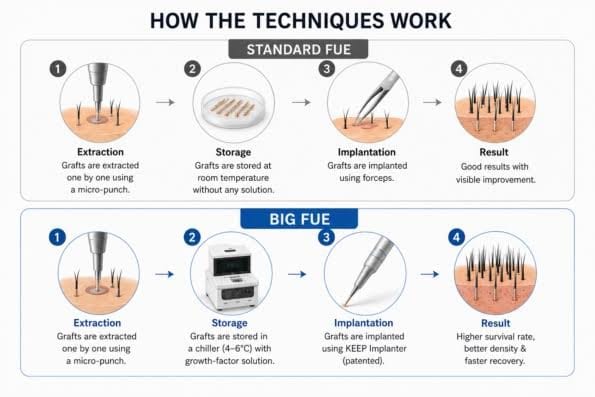
What FUE actually is, step by step
Follicular unit excision removes hair one natural grouping at a time using a small circular punch, then places each graft into a prepared site in the thinning area.
Follicular unit excision removes hair one natural grouping at a time using a small circular punch, then places each graft into a prepared site in the thinning area. The whole operation is a tissue transfer, and every stage of it affects how many follicles survive.
What is FUE (follicular unit excision)?
FUE (follicular unit excision) removes hair's natural one-to-four-hair bundles, called follicular units, one at a time with a punch typically well under a millimetre across, then transfers them to the thinning area. Strip surgery removes a band of scalp instead, dissecting units out under microscopes; both plant the same grafts, differing only in harvesting.
What are the stages of an FUE hair transplant?
FUE proceeds through six stages: planning and design, local anaesthesia to donor and recipient areas, extraction of follicular units one at a time, sorting and counting grafts by hair count into holding solution, creating small recipient-site incisions at the planned angle and density, and finally placing each graft into its matched site.
- Planning and design. Hairline and coverage priorities are drawn and agreed before anything is shaved.
- Anaesthesia. Local anaesthetic to donor and recipient areas.
- Extraction. Follicular units are punched and lifted out of the donor area one at a time.
- Sorting and counting. Grafts are inspected, grouped by hair count and kept in holding solution.
- Recipient site creation. Small incisions are made at the angle and density the design calls for.
- Placement. Grafts are placed into those sites, matched by size to the position.
What actually determines the result of an FUE hair transplant?
Two invisible factors determine an FUE result: transection, meaning how often the punch cuts through a follicle instead of coring cleanly around it, and how grafts are handled between extraction and placement, including time outside the body. Damage to the follicle's bulge region is more harmful than damage to the bulb, so gentle handling matters.
Two things a patient cannot see. The first is transection, meaning how often the punch cuts through a follicle instead of coring cleanly around it. The second is what happens between extraction and placement: how long grafts spend outside the body, whether they stay moist and how they are handled.
The review literature notes that damage to the bulge region of the follicle is more harmful than damage to the bulb, which is why gentle handling matters more than it looks. Our article on out-of-body time and graft survival covers the timing side.
Is FUE a cure for hair loss?
No. FUE is not a cure for hair loss; it moves existing hair rather than stopping the process that caused the loss. Native hair around the transplanted area can continue thinning afterward, which is why medical treatment is usually discussed alongside surgery.
Sources
- Bernstein RM, Rassman WR. Graft Anchoring in Hair Transplantation. Dermatologic Surgery, 2006;32(2):198-204. pubmed.ncbi.nlm.nih.gov/16442039
- Parsley WM, Perez-Meza D. Review of factors affecting the growth and survival of follicular grafts. Journal of Cutaneous and Aesthetic Surgery, 2010;3(2). jcasonline.com
This article summarises published research and standard clinical practice. It is general educational information, not medical advice, and it does not replace the instructions your own surgical team gives you. Where their guidance differs from anything here, follow theirs.
Get a no-obligation assessment against fixed criteria, directly on WhatsApp.