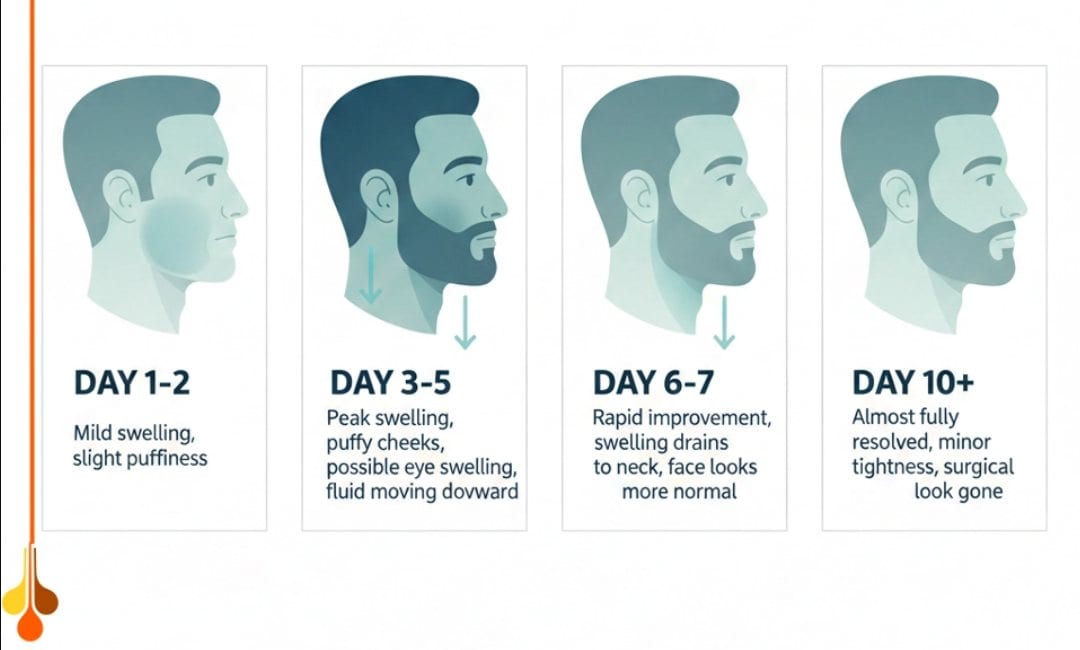
Swelling timeline and why it moves to the forehead
Swelling after a transplant rarely stays where the surgery happened. Gravity explains almost all of it.
Swelling after a hair transplant is caused by fluid from anaesthetic and tissue response, and it tracks downward under gravity from the scalp to the forehead and sometimes the eyelids. It typically appears around days two to four, peaks over a day or two and then resolves. It looks dramatic and is almost always harmless, but late or one-sided swelling is a different matter.
Why does swelling after a hair transplant appear on the forehead instead of the scalp?
A transplant injects a large volume of anaesthetic and saline into the scalp, and the body's inflammatory response to thousands of small wounds adds more fluid; since the scalp is bound tightly to the skull, that fluid migrates downward under gravity into the looser tissue of the forehead and eyes.
A hair transplant involves injecting a substantial volume of fluid into the scalp: local anaesthetic, and usually a saline solution used to firm the tissue for graft placement. The body also mounts its own inflammatory response to thousands of small wounds, which brings more fluid into the area.
That fluid has to go somewhere. The scalp is tightly bound to the skull, so it cannot hold much. The forehead and the loose tissue around the eyes can. Fluid migrates downward through the soft tissue planes under gravity, which is why the swelling appears in places where no surgery was performed.
This is also why swelling is worse in people who spend the first days lying flat.
What is the day-by-day timeline for swelling after a hair transplant?
Swelling typically follows a set pattern: little or none on days zero to one, appearing and peaking across the forehead and eyelids on days two to four, then settling progressively through days four to seven. At its worst it can partially close an eye for a day, which is startling but not a complication.
- Day 0 to 1: usually little or no visible swelling. People often report feeling fine and assume they have escaped it.
- Day 2 to 4: swelling appears and peaks, typically across the forehead, sometimes reaching the eyelids.
- Day 4 to 7: it settles progressively as the fluid is reabsorbed and drained.
At its worst it can close one or both eyes partially for a day. That is startling but is not in itself a sign of a complication.
What actually reduces swelling after a hair transplant?
The most effective measures work with gravity: sleeping with the head elevated for the first several nights is the single most effective step, followed by staying upright during the day and applying cold only to the forehead, never the grafts. Some clinics prescribe a short steroid course; take it as directed.
The measures that help are the ones that work with gravity rather than against it.
- Sleep elevated. Head raised on pillows or in a reclining position for the first several nights. This is the single most effective step.
- Stay upright during the day. Sitting and walking are better than lying down.
- Cold on the forehead only. A cool pack on the forehead and above the brows, never on the recipient area or the grafts.
- Follow any prescribed medication. Some clinics prescribe a short steroid course specifically to limit swelling; take it as directed rather than improvising.
Massaging the swelling does not help and risks touching the grafts. Our aftercare guide covers sleeping position in more detail.
When is swelling after a hair transplant a sign of a problem?
Routine swelling is symmetrical, painless or mildly uncomfortable, and improving by the end of the first week. Report swelling that is one-sided, hot, red and tender rather than soft and pale, that starts late or worsens after improving, or that comes with fever; difficulty breathing or swallowing is an emergency, not a hair transplant question.
Post-operative swelling of the kind described above is symmetrical, painless or mildly uncomfortable, and improving by the end of the first week. Swelling that does not fit that description is worth reporting:
- Marked swelling on one side only
- Swelling that is hot, red and tender rather than soft and pale
- Swelling that starts late, after the first week, or that worsens after it had begun improving
- Swelling with fever
- Any difficulty breathing or swallowing, which is an emergency and not a hair transplant question
Sources
- Bernstein RM, Rassman WR. Graft Anchoring in Hair Transplantation. Dermatologic Surgery, 2006;32(2):198-204. pubmed.ncbi.nlm.nih.gov/16442039
This article reviews published research and standard clinical practice. It is general educational information, not medical advice, and it does not replace the specific instructions your own surgical team gives you. Where their guidance differs from anything here, follow theirs.
Get a no-obligation assessment against fixed criteria, directly on WhatsApp.