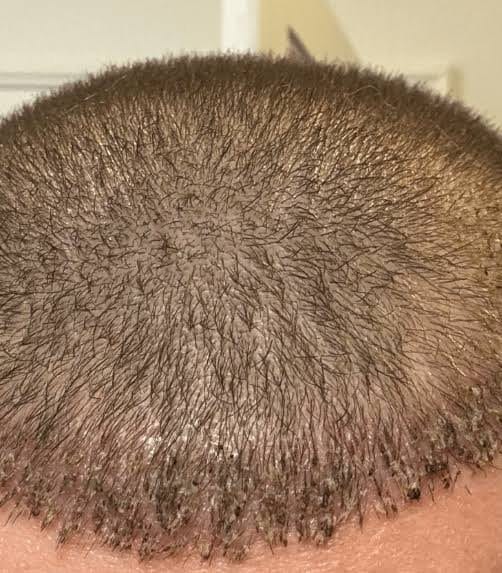
When scabs should fall off naturally
Crusts are the last thing standing between a graft and the outside world. Knowing when they are meant to go stops people removing them too soon.
Crusts form within the first day or so after surgery and normally shed between days seven and fourteen. They matter because they are bonded to the graft underneath: research on graft anchoring found that pulling an adherent scab cost a graft through day five, a longer risk window than pulling on a hair. Letting them soften and release on their own is the whole objective of early washing.
What are the crusts after a hair transplant made of?
Crusts form when blood and tissue fluid dry around each transplanted hair shaft, covering the recipient area with hundreds or thousands of them, one per graft. They are a normal wound covering that protects the graft beneath; the only issue is that each crust stays attached to its graft, making it a handle.
When do hair transplant crusts normally fall off?
Crusts begin forming within about 24 hours of surgery, are fully established within two to three days, and typically shed between days seven and fourteen, unevenly across the scalp. A releasing crust usually takes the visible hair shaft with it, which can look alarming, but the follicle stays beneath the surface and regrows hair later.
Crusts generally begin forming within about 24 hours of surgery and are fully established within two to three days. They then soften and release gradually, typically shedding between days seven and fourteen.
By the end of the second week most people have a recipient area that is largely clear. Shedding is uneven: some areas clear on day eight, others hold on past day twelve. That patchiness is normal and is not a sign that anything has gone wrong.
Why they take the hair with them
When a crust releases, the visible hair shaft embedded in it usually comes away too. This alarms people who assume they are watching their transplant fall out. They are not. The shaft is shed; the follicle remains in place below the surface and will produce a new hair after a dormant period.
Why does removing a scab too early risk losing a hair graft?
Bernstein and Rassman's study of 42 patients found two risk windows: pulling a hair dislodged a graft only through day two, but pulling an adherent scab could dislodge one through day five. Because crusts stay bonded to the graft, they extend the danger period, making them the more persistent hazard.
Bernstein and Rassman's study of graft anchoring in 42 patients produced two separate risk timelines, and the difference between them is the point of this article.
- Pulling on a hair dislodged the graft for the first two days, and by day six no longer did.
- Pulling on an adherent scab resulted in a lost graft through day five.
The study noted that the presence of crusting extends the interval during which grafts are at risk of being dislodged. In other words, the crust is the more persistent hazard, and it is the one people are most tempted to interfere with, because it looks like something that should be tidied away.
How can you help hair transplant crusts release naturally?
The purpose of early washing is to soften crusts steadily so they release on schedule: apply water and foam gently by hand without a direct shower jet, never rub, scrub or towel-dry the area, and use saline or a prescribed spray between washes to keep crusts soft.
The early washing routine most clinics prescribe is there mainly to soften crusts steadily, so they release on schedule instead of hardening and then catching on a pillowcase.
- Follow your clinic's start date for washing rather than a general rule from the internet; protocols differ.
- Apply water and foam gently by hand, without a shower jet directed at the recipient area.
- Do not rub, scrub or use a towel on the recipient area; pat or air dry.
- Saline or a prescribed spray between washes keeps crusts soft.
- Expect crusts to release over several days, not all at once.
Our aftercare guide covers the full routine week by week.
What crusting symptoms after a hair transplant are not normal?
Report crusting to your clinic if it returns after the area has cleared, is thick, yellow or weeping rather than dry and dark, comes with increasing redness, heat, tenderness or fever, or if nothing has shed by around three weeks. These patterns can indicate infection or folliculitis, both treatable but not by picking.
Crusting that behaves differently from the pattern above is worth reporting to your clinic:
- Crusts that return after the area has cleared
- Thick, yellow or weeping crusting rather than dry dark crusts
- Crusting with increasing redness, heat, tenderness or fever
- Nothing shedding at all by around three weeks
These can indicate infection or folliculitis, both of which are treatable and neither of which should be managed by picking.
Sources
- Bernstein RM, Rassman WR. Graft Anchoring in Hair Transplantation. Dermatologic Surgery, 2006;32(2):198-204. pubmed.ncbi.nlm.nih.gov/16442039
- Parsley WM, Perez-Meza D. Review of factors affecting the growth and survival of follicular grafts. Journal of Cutaneous and Aesthetic Surgery, 2010;3(2). jcasonline.com
This article reviews published research and standard clinical practice. It is general educational information, not medical advice, and it does not replace the specific instructions your own surgical team gives you. Where their guidance differs from anything here, follow theirs.
Get a no-obligation assessment against fixed criteria, directly on WhatsApp.