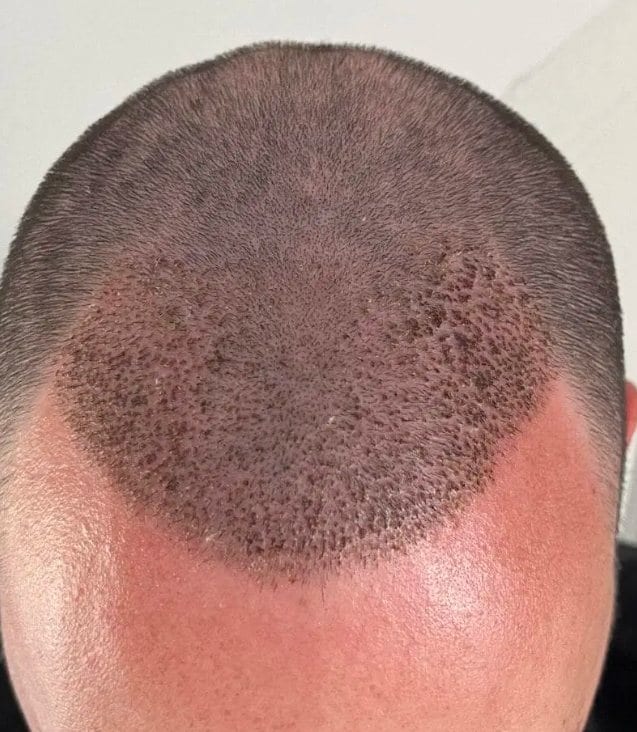
Signs a scab is being removed too early
How to tell the difference between a crust that released on its own and one that took a graft with it.
A crust that releases naturally comes away dry, painlessly and without bleeding. One removed too early resists, hurts, bleeds from a pinpoint, and may bring a small white bulb with it. Research on graft anchoring found that pulling an adherent scab cost a graft through day five, so the distinction matters most in the first week.
How can you tell if losing a scab cost you a hair graft?
By how it came away. Most people do not deliberately pick crusts; they snag one on a pillow or while washing and then wonder whether it cost them a graft. A crust that had finished its job releases without resistance, pain or bleeding, while one still holding a graft resists, stings, leaves a bead of fresh blood and often carries a small white bulb at the base of the hair.
What does a naturally released hair transplant crust look like?
A naturally released crust comes away without resistance, pain or bleeding, leaving intact pink skin underneath; a hair shaft may come away with it, but nothing is attached to its base. A shed hair shaft alone is not graft loss, since it is discarded as part of normal post-operative shedding while the follicle stays behind.
- The crust comes away with no resistance, often during washing or drying
- There is no pain
- There is no bleeding
- The skin underneath is pink and intact
- A hair shaft may come with it, with nothing attached to the base
A shed hair shaft on its own is not graft loss. The shaft is discarded by the follicle as part of the normal post-operative shedding phase, and the follicle stays behind.
What does a hair transplant crust look like if it was removed too early?
A prematurely removed crust resists being lifted, causes a sharp localised sting, leaves a small bead of fresh blood, and may show a tiny white or translucent bulb of follicular tissue at its base, or a small empty depression where the graft was. Bleeding with a bulb is the clearest sign a graft came out.
- Resistance. The crust does not lift; it has to be pulled.
- Pain. A sharp, localised sting at that specific point.
- Pinpoint bleeding. A small bead of fresh blood at the site afterwards.
- A visible bulb. A tiny white or translucent swelling at the base of the hair attached to the crust. That is follicular tissue.
- An empty site. A small depression or open point where a graft was.
Bleeding and a bulb together are the clearest indication that a graft has come out rather than a crust having finished.
When is the risk of losing a graft to a crust highest after a transplant?
In the graft-anchoring study, pulling an adherent scab could dislodge a graft through day five, pulling a hair stopped dislodging grafts by day six, and by day nine grafts were no longer at risk. An incident in the first five days deserves attention; after day nine, a crust coming away is not a graft problem.
What should you do if a graft comes out with a scab?
Losing a graft or two is not a catastrophe among thousands placed, so the response should be proportionate: stop touching the area, apply light pressure with sterile gauze if it bleeds, resume your normal washing routine at the next scheduled time, and contact your clinic if several grafts come out or bleeding does not stop.
One graft is not a catastrophe. A session involves thousands, and losing a handful across two weeks does not meaningfully change a result. The response should be proportionate.
- Stop touching the area. Do not investigate the site with fingers or tweezers.
- Apply light, clean pressure with sterile gauze if there is bleeding, without rubbing.
- Resume the normal saline and washing routine at the next scheduled time.
- Photograph the area if you want a record for your clinic.
- Contact your clinic if several grafts have come out, if bleeding does not stop with light pressure, or if you are unsure.
What matters more than the single incident is changing whatever caused it: a pillow arrangement, a hat, a drying habit.
Washing technique is what decides how crusts come away, and that is set out in the aftercare routine.
Sources
- Bernstein RM, Rassman WR. Graft Anchoring in Hair Transplantation. Dermatologic Surgery, 2006;32(2):198-204. pubmed.ncbi.nlm.nih.gov/16442039
This article reviews published research and standard clinical practice. It is general educational information, not medical advice, and it does not replace the specific instructions your own surgical team gives you. Where their guidance differs from anything here, follow theirs.
Get a no-obligation assessment against fixed criteria, directly on WhatsApp.