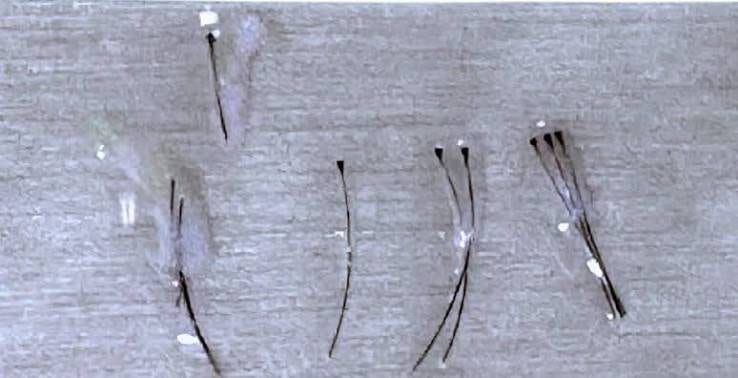
Graft survival percentages across long-term studies
Reported survival figures come from small studies at twelve months or less, and they are measured in inconsistent ways.
Reported survival figures come from small studies at twelve months or less, and they are measured in inconsistent ways. There is no long-term survival data, and the high percentages quoted in marketing are not from long-horizon research.
Where do the graft survival percentages quoted in clinic marketing come from?

From small, short-follow-up studies, not long-term research. A hyperbaric oxygen trial reported 96.9% graft survival at nine months in 34 patients; a five-patient case report described 97-99% integration; a punching-method comparison reported 90.5% versus 88.3%. These are legitimate figures, but none measures long-term survival or comes from a large enough population study.
Survival percentages appear constantly in clinic marketing, usually somewhere in the nineties. It is worth knowing what actually underlies them.
The published figures come from small studies with short follow-up. The randomised trial of hyperbaric oxygen as a post-transplant adjunct reported nine-month survival of 96.9% in the treated group and 93.8% in controls, in a total of 34 patients. A five-patient case report described graft integration of 97-99%. Technique comparisons report yield rates — one comparison of punching methods reported 90.5% with an oscillatory method against 88.3% with a rotary method.
These are legitimate research figures. None of them is a long-term survival rate, and none is from a study large enough to establish a population figure.
Why do different clinics' graft survival percentages mean different things?
Because studies measure four different things under the same name: yield rate, the proportion of extracted grafts that come out usable; graft survival, the proportion of implanted grafts producing hair, depending on when it's measured; hair count in a tattooed reference zone, the most rigorous but rarest method; and global assessment, an observer's impression.
Different studies measure different things and call them the same thing.
- Yield rate — the proportion of extracted grafts that come out intact and usable. A measure of extraction quality, not of growth.
- Graft survival — the proportion of implanted grafts producing hair at follow-up. Depends entirely on when you look.
- Hair count in a defined zone — the most rigorous measure, requiring a tattooed reference area counted at baseline and follow-up. Rarely done.
- Global assessment — an observer's impression, which is the weakest and the most common.
A clinic quoting 98% survival is usually not saying which of these it measured, when, in how many patients, or by whom.
Why does the timing of a graft survival measurement matter so much?
Survival at nine months, twelve months and ten years are three different numbers, and only the first two have ever been measured. Twelve months is the endpoint because a result has matured — shed weeks two to three, regrown months three to four — and ten-year survival has never been measured at scale.
Graft survival at nine months, twelve months and ten years are three different numbers, and only the first two have ever been measured.
The twelve-month figure is the conventional endpoint because that is when a result matures — transplanted hair sheds at weeks two to three, regrows from around months three to four, and is final at about twelve months. Measuring earlier understates survival.
Measuring later has never been done at scale. What happens to graft counts at five or ten years is genuinely unknown, and the answer is complicated by the fact that donor hair is largely rather than absolutely resistant to DHT.
What can't a quoted graft survival percentage tell you?
A quoted percentage can't tell you whether it was calculated on grafts extracted or implanted, since transection losses are hidden if measured on implants only; whether a surviving graft still produces as many hairs as in the donor area; whether the result actually looks good, since survival says nothing about hairline design; or long-term persistence.
- Grafts extracted versus grafts implanted. Grafts are lost to transection and handling. A survival percentage calculated on implanted grafts hides losses that already happened.
- Hairs versus grafts. A surviving graft may produce fewer hairs than it did in the donor area.
- Whether the result looks good. Survival percentage says nothing about angle, density distribution or hairline design, which determine whether a result reads as natural.
- Long-term persistence. Not measured anywhere.
What questions turn a vague survival percentage into a meaningful one?
Ask how it was measured (yield, survival, hair counts, or impression), at what time point, in how many patients, whether consecutive or selected, who counted them, and whether it was calculated on grafts extracted or implanted. Very few clinics can answer these, because very few actually measure, so a quoted percentage alone carries no weight.
- Measured how — yield, survival, hair counts in a defined zone, or impression?
- At what time point?
- In how many patients, and were they consecutive or selected?
- Counted by whom, and blinded to anything?
- Calculated on grafts extracted or grafts implanted?
Very few clinics can answer these, because very few measure. That is not necessarily a criticism of the clinic — it is the state of the field — but it does mean a quoted percentage should carry no weight in choosing one.
Sources
- Fan Z, Gan Y, Qu Q, Wang J, Lunan Y, Liu B, Chen R, Hu Z, Miao Y. The effect of hyperbaric oxygen therapy combined with hair transplantation surgery for the treatment of alopecia. Journal of Cosmetic Dermatology, 2021;20(3):917-921. pubmed.ncbi.nlm.nih.gov/32770782
- Giardiello F, De Medeiros Quirino L, Brigante R, Chumak M. Hyperbaric Oxygen Therapy for Enhanced Postoperative Recovery in Hair Transplantation. Cureus, 2025;17(12):e99635. doi.org/10.7759/cureus.99635
- Kim J, Ko YU, Yi KH. The condition of hair follicles produced by different punching methods during FUE surgery. Journal of Cosmetic Dermatology, 2024;23(12):4202-4207. pubmed.ncbi.nlm.nih.gov/39152658
- Parsley WM, Perez-Meza D. Review of factors affecting the growth and survival of follicular grafts. Journal of Cutaneous and Aesthetic Surgery, 2010;3(2). jcasonline.com
- Bernstein RM, Rassman WR. Graft Anchoring in Hair Transplantation. Dermatologic Surgery, 2006;32(2):198-204. pubmed.ncbi.nlm.nih.gov/16442039
- Romera de Blas C, Vega Díez D, Ricart Vayá JM, Gómez Zubiaur A. Complications in follicular unit excision hair transplantation: current evidence and practical approaches. Frontiers in Medicine, 2026;13:1750989. pubmed.ncbi.nlm.nih.gov/41709896
This article summarises published research and standard clinical practice. It is general educational information, not medical advice, and it does not replace the instructions your own surgical team gives you. Where their guidance differs from anything here, follow theirs.
Get a no-obligation assessment against fixed criteria, directly on WhatsApp.