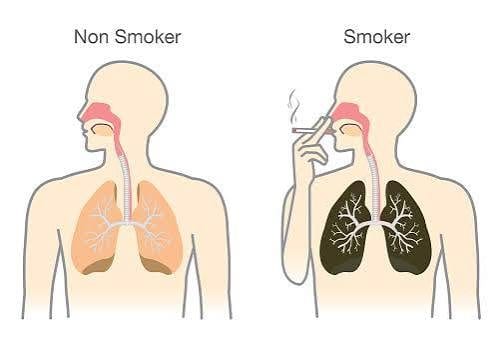
Healing in smokers vs non-smokers
Smokers heal less reliably after surgery generally, and the mechanisms involved bear directly on hair transplantation: nicotine constricts the small vessels a graft depends on, and carbon monoxide reduces oxygen delivery.
Smokers heal less reliably after surgery generally, and the mechanisms involved bear directly on hair transplantation: nicotine constricts the small vessels a graft depends on, and carbon monoxide reduces oxygen delivery. Many surgeons will discuss modifying or declining a case in heavy smokers.
How does smoking's mechanism specifically threaten a newly placed hair graft?
A newly placed graft has no blood supply of its own and survives on diffusion until the recipient bed grows vessels into it, entirely dependent on microvascular flow and oxygen delivery. Nicotine constricts small blood vessels while carbon monoxide binds haemoglobin in preference to oxygen, reducing oxygen reaching the tissue when it is most vulnerable.
What does smoking's impaired healing mean in practice for a hair transplant patient?
In practice, smoking is linked to slower closure of donor and recipient sites, more wound-healing problems generally, more prominent donor scarring in some patients, and a plausible mechanism for reduced graft yield, though this is not quantified by good trial data in transplant patients specifically. The general-surgery evidence is strong even without that figure.
- Slower closure of donor and recipient sites
- Higher risk of wound-healing problems generally
- More prominent donor scarring in some patients
- A plausible mechanism for reduced graft yield, though this is not quantified by good trial data in transplant patients specifically
It is worth being precise: the wound-healing evidence in general surgery is strong, while a specific measured effect on transplant graft survival is not something the literature establishes with a clean number.
What do clinics typically ask smokers to do before and after a hair transplant?
Most clinics ask for cessation for a period before surgery and continuing afterward, though exact windows differ between surgeons, so get yours directly from your clinic rather than a general figure. Nicotine replacement and vaping still deliver nicotine and therefore still cause vasoconstriction, so raise them explicitly rather than assuming they are exempt.
What should you do if you are not going to quit smoking before surgery?
Say so honestly: a surgeon who knows you will not stop can adjust planning, density and expectations accordingly, while a surgeon who is told only what the patient thinks they want to hear cannot, and it is the patient who bears the consequence of that gap.
The practical steps either way are the same, and they are listed under aftercare.
Sources
- Bernstein RM, Rassman WR. Graft Anchoring in Hair Transplantation. Dermatologic Surgery, 2006;32(2):198-204. pubmed.ncbi.nlm.nih.gov/16442039
This article summarises published research and standard clinical practice. It is general educational information, not medical advice, and it does not replace the instructions your own surgical team gives you. Where their guidance differs from anything here, follow theirs.
Get a no-obligation assessment against fixed criteria, directly on WhatsApp.