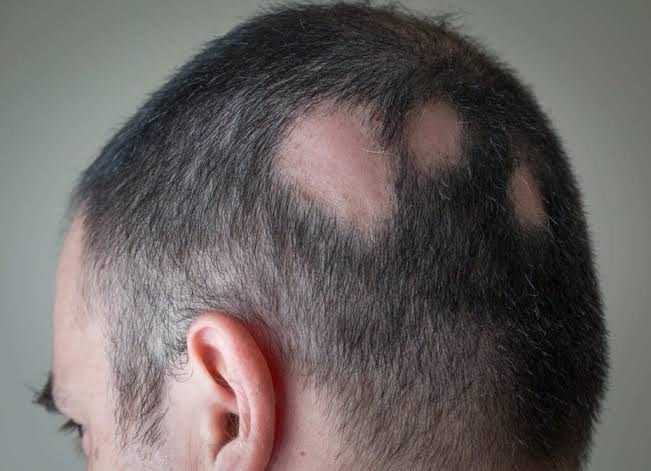
Corticosteroid injections for alopecia areata
Intralesional corticosteroid injections are a long-standing first-line treatment for limited patchy alopecia areata.
Intralesional corticosteroid injections are a long-standing first-line treatment for limited patchy alopecia areata. They suppress the local immune attack on the follicle, and they are unrelated to pattern hair loss, where they have no role.
What is alopecia areata and how does it differ from pattern hair loss?
Alopecia areata is an autoimmune condition in which the immune system attacks hair follicles, producing well-defined patches of loss that can progress to complete scalp or body hair loss. It is not androgenetic alopecia and does not respond to the same treatments, and the follicle is not destroyed, so regrowth remains possible.
How are corticosteroid injections used to treat alopecia areata?
Corticosteroid is injected directly into affected patches, typically at several points, and is usually repeated at intervals of several weeks. The approach is most appropriate for limited, patchy disease rather than extensive loss, and where regrowth happens, it generally begins over the following one to two months.
- Corticosteroid injected directly into affected patches, typically at several points
- Usually repeated at intervals of several weeks
- Most appropriate for limited, patchy disease rather than extensive loss
- Regrowth, when it happens, generally begins over one to two months
What are the limitations of corticosteroid injections for alopecia areata?
Corticosteroid injections are impractical for extensive disease where the surface area is too large, and repeated use can cause local skin atrophy at injection sites. They do not prevent relapse, since they treat current patches rather than the underlying condition, involve uncomfortable multiple injections, and spontaneous remission is common, complicating judgment.
- Not practical for extensive disease, where the surface area is too large
- Local skin atrophy at injection sites with repeated use, sometimes visible as small depressions
- Does not prevent relapse. It treats current patches rather than the underlying condition.
- Discomfort, since multiple injections into the scalp are unpleasant
- Spontaneous remission is common in alopecia areata, which complicates judging what the treatment did
Does hair transplantation work for alopecia areata?
Generally nowhere during active disease: transplanting into an actively autoimmune scalp places healthy follicles into an environment attacking follicles. Surgery is only considered once the condition has been demonstrably quiet for a sustained period, and even then cautiously. For extensive or refractory disease, systemic options including JAK inhibitors have changed what is possible.
Alopecia areata is a different condition from the pattern loss covered under causes of hair loss.
Sources
- King B, et al. Two Phase 3 Trials of Baricitinib for Alopecia Areata. New England Journal of Medicine, 2022. nejm.org/doi/full/10.1056/NEJMoa2110343
This article summarises published research. It is general educational information, not medical advice, and it is not a recommendation to start, stop or change any medication. Prescription drugs carry contraindications and interactions; discuss them with a doctor who knows your medical history.
Get a no-obligation assessment against fixed criteria, directly on WhatsApp.