JAK inhibitors: newest option for alopecia areata
JAK inhibitors are the first systemic drugs approved for severe alopecia areata, and they have changed the outlook for a condition that previously had little to offer.
JAK inhibitors are the first systemic drugs approved for severe alopecia areata, and they have changed the outlook for a condition that previously had little to offer. They also carry a class-wide boxed warning and require monitoring.
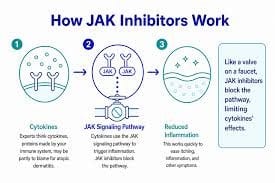
What are JAK inhibitors and how do they treat alopecia areata?
Janus kinase (JAK) inhibitors block signalling pathways that immune cells use to communicate, which in alopecia areata interrupts the immune attack on the hair follicle and allows regrowth. This is a genuinely different situation from pattern hair loss: these drugs do not treat androgenetic alopecia and are not prescribed for it.
When were JAK inhibitors approved for alopecia areata and how effective are they in trials?
Baricitinib was FDA-approved in June 2022 as the first systemic treatment for severe alopecia areata, followed by ritlecitinib in June 2023 and later deuruxolitinib. In the BRAVE-AA1/AA2 phase 3 trials, roughly 35 to 40 percent of baricitinib patients reached SALT 20 or below by week 36, versus 23 percent for ritlecitinib at week 24.
Baricitinib was approved by the FDA in June 2022 as the first systemic treatment for severe alopecia areata, followed by ritlecitinib in June 2023, with deuruxolitinib subsequently also approved in the United States.
In the BRAVE-AA1 and BRAVE-AA2 phase 3 trials, published in the New England Journal of Medicine, significantly more patients on baricitinib achieved a SALT score of 20 or below at week 36, meaning 20 percent or less scalp hair loss. Reported figures put roughly 35 to 40 percent of patients reaching that threshold at 36 weeks. For ritlecitinib, 23 percent achieved SALT 20 or below at week 24.
What safety risks do JAK inhibitors carry?
JAK inhibitors carry a class-wide boxed warning covering thrombosis, malignancy, major adverse cardiac events, death and elevated herpetic infection risk. That warning derives largely from studies in other conditions and older populations, so how far it applies to younger alopecia areata patients is debated, but these remain specialist-prescribed drugs requiring baseline assessment and ongoing monitoring.
What should patients expect practically from JAK inhibitor treatment?
JAK inhibitor treatment generally requires a long-term commitment, since discontinuation is associated with relapse, and response takes months rather than weeks. Specialist prescribing and monitoring are required throughout, cost and reimbursement vary substantially between countries, and these drugs have no role in treating androgenetic alopecia, only alopecia areata.
- Long-term treatment is generally needed; discontinuation is associated with relapse
- Response takes months rather than weeks
- Specialist prescribing and monitoring are required
- Cost and reimbursement vary substantially between countries
- They have no role in androgenetic alopecia
Sources
- King B, et al. Two Phase 3 Trials of Baricitinib for Alopecia Areata. New England Journal of Medicine, 2022. nejm.org/doi/full/10.1056/NEJMoa2110343
This article summarises published research. It is general educational information, not medical advice, and it is not a recommendation to start, stop or change any medication. Prescription drugs carry contraindications and interactions; discuss them with a doctor who knows your medical history.
Get a no-obligation assessment against fixed criteria, directly on WhatsApp.